Heat, Ice, or Smoke: Keep Your Training Going Indoors
By Larry Betz | Prepared Not Paranoid https://www.preparednotparanoid.com/
Updated November 9, 2026
It's 110 degrees outside. Or it's icy. Or wildfire smoke has the air quality in the red. Or your knee is talking to you and today isn't a running day. Whatever the reason, the walk, jog, or ruck you planned isn't happening.
That's when a cardio machine at home earns its keep. Consistency is what builds fitness, and a machine in the garage or spare room means you never have to skip a session because of what's happening outside.
Up until this point in the series, we've covered aerobic training with little or no equipment. This post is the final part of the series. It covers the machines I think are worth having in a home gym, how they compare, and how to pick the right one for you.
Before You Buy: 5 Questions
What's your goal? Steady endurance, short hard intervals, or a little of both?
What do your joints say? If your knees, hips, or back have a history, low impact matters.
How much space do you have? Measure it, and leave room to get on and off safely.
Do you need it to work without power? Several of these machines run on your effort alone.
Will you actually use it? The best machine is the one you'll get on three times a week.
The Rower
If you're looking to add one low-impact machine to your home gym, I highly recommend the Concept2 RowErg. It's a top-of-the-line rowing machine, known for its durability, smooth operation, and full-body workout.
Full body. Rowing works your legs, core, back, and arms in every stroke. About 60% of the power comes from your legs, not your arms.
Low impact. Minimal stress on your joints, so it suits nearly every fitness level, including people coming back from injury.
Adjustable. You control the intensity with how hard you pull, and the damper adjusts the feel.
Easy to store. It separates into two pieces and has built-in wheels.
No outlet needed. The monitor runs on batteries, and the flywheel is powered by you.
Pair it with your other training. Alternate rowing and jogging days through the week. Rowing strengthens your upper and lower body together, which helps prevent muscle imbalances and overuse injuries.
Form tip: Legs, then body, then arms on the way back. Arms, then body, then legs on the way forward. Most beginners pull with their arms too early.
The SkiErg
Another great product from Concept2 is the SkiErg. It simulates the double-pole motion of Nordic skiing.
Upper-body focus. Where the rower is balanced, the SkiErg puts more emphasis on your shoulders, triceps, back, and core.
Standing work. Your legs and core stay engaged through the standing position, and you can add a hip hinge and knee bend for more power.
Great variety. It mixes up your cardio and challenges your body in a new way.
Small footprint. Mount it on the wall or use the floor stand.
No outlet needed. Same battery-powered monitor as the rower.
Good option if: your knees or hips don't love the rower's seated position, or you want to build upper-body endurance.
Air Bike vs. Stationary Bike
The Air (Fan) Bike
The air bike, often called an assault bike or fan bike, uses a large fan for resistance. The harder you pedal and push, the harder it gets. Moving handlebars let you work your upper and lower body at the same time.
Best for: high-intensity interval training (HIIT) and short, hard efforts.
Space: a bit more than a stationary bike, plus room for the arm swing.
No outlet needed.
Heads up: it's loud and it moves a lot of air. Some people love the fan in the summer.
The Stationary Bike
A stationary bike uses adjustable resistance, set by a knob or electronically, and focuses on your legs.
Upright bikes mimic outdoor cycling and take up less floor space.
Recumbent bikes have a reclined seat with back support. They're a great choice if balance, your lower back, or getting on and off is a concern.
Best for: steady cardio, longer sessions, and people recovering from injury.
Easy to track progress, because the resistance levels are fixed and measurable.
Bottom line: the air bike is the tougher, full-body interval machine. The stationary bike is the gentler, steady, easier-to-control choice.
Manual vs. Electric Treadmill
Manual Treadmill
A manual treadmill is powered only by you. The belt moves when you move, so you control the speed.
More work. Getting the belt moving takes more effort from your legs and core, which makes it great for intervals.
Smaller and lighter, usually less expensive, and easier to move.
No outlet needed.
Note: flat manual treadmills can feel stiff and awkward. Curved manual treadmills run smoother but cost more.
Electric Treadmill
An electric treadmill uses a motor to move the belt at a set speed.
Steady and consistent. Great for long walks, steady runs, and holding a pace.
Lots of options: incline, pre-set programs, heart rate, and more.
Bigger and heavier, and it needs a dedicated outlet.
Best for: walkers, and anyone who wants long, steady sessions indoors.
Treadmill Safety, Especially With Kids or Grandkids Around
Treadmills are one of the most common causes of exercise equipment injuries at home. In 2021, the U.S. Consumer Product Safety Commission issued an urgent warning about a popular treadmill after a child's death and multiple incidents of children being pulled under the machine.
Always use the safety key and clip it to your clothing.
Remove the key and unplug the treadmill when you're done, and store the key out of reach.
Keep kids and pets away while it's running, and never let them play on it.
Leave clear space behind it, about 6 feet, in case you slip off the back.
The Machines Side by Side
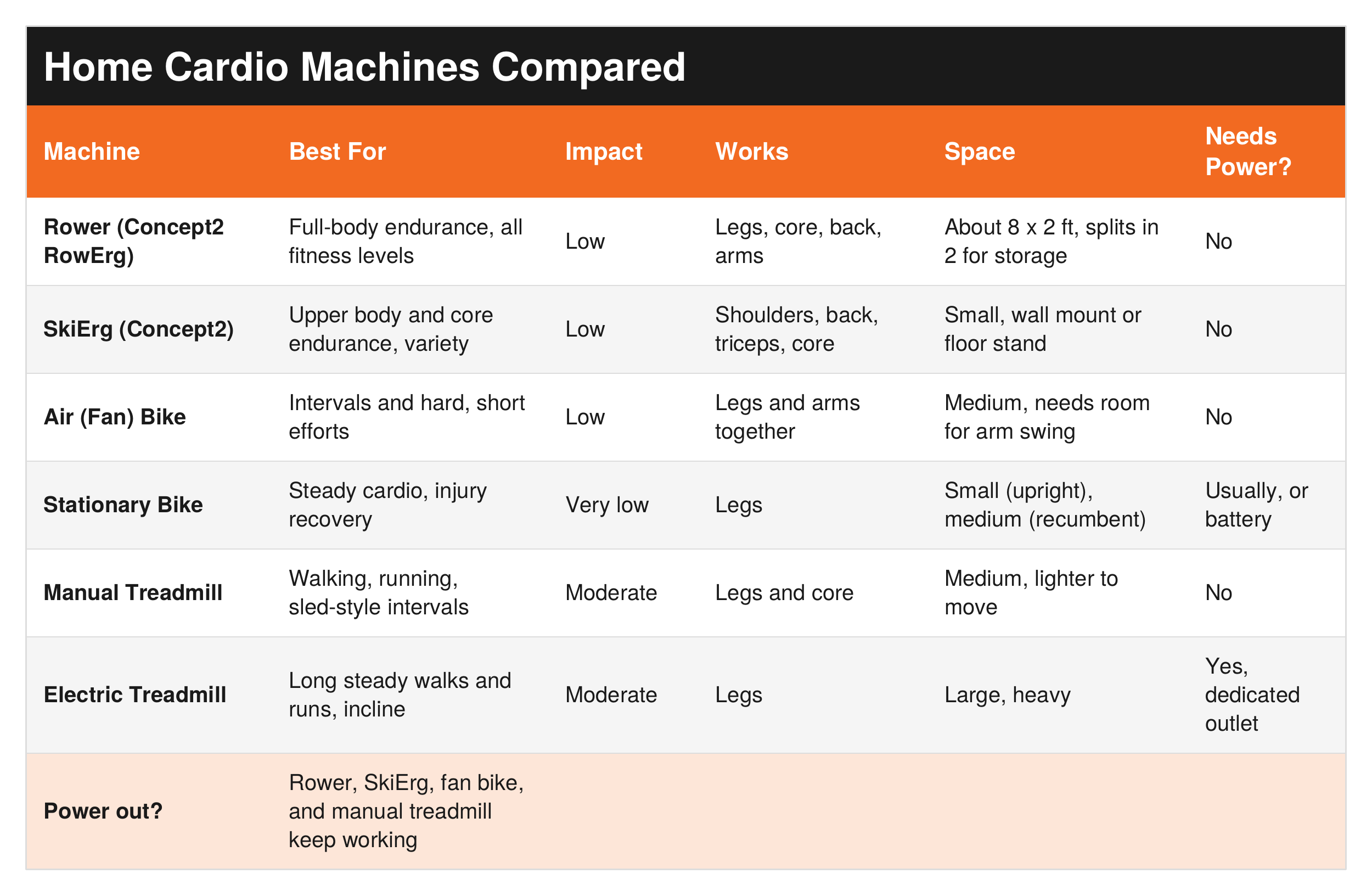
Here's how the main home machines compare on what matters most: what they're best for, how hard they are on your joints, what they work, how much space they take, and whether they need power.
The Preparedness Angle
Notice the last column. The rower, SkiErg, air bike, and manual treadmill all keep working when the power goes out. If you're building a home that's ready for anything, that's worth thinking about. During a long outage, a storm, or bad air days when you're stuck inside, you can still train.
Getting the whole house ready for an outage? My free Lights Out guide gets your family ready for a power outage before the lights go out. Get it free here.
Other Machines You'll See in the Gym
These are common in commercial gyms. They can work at home, but they usually cost more and take more space.
Elliptical. A smooth, gliding, low-impact motion that's easy on the knees and hips. Moving handlebars add upper-body work.
StairMaster. Continuous stair climbing that targets your glutes, quads, hamstrings, and calves. Tough, effective, and great for leg endurance.
Jacob's Ladder. A self-paced climbing machine set at an angle. A full-body, high-intensity workout that's easier on the lower back. Big footprint, high cost.
VersaClimber. A vertical climbing motion that works your upper and lower body together and raises your heart rate fast. Smaller footprint, but very intense and expensive.
Which Machine Fits You?
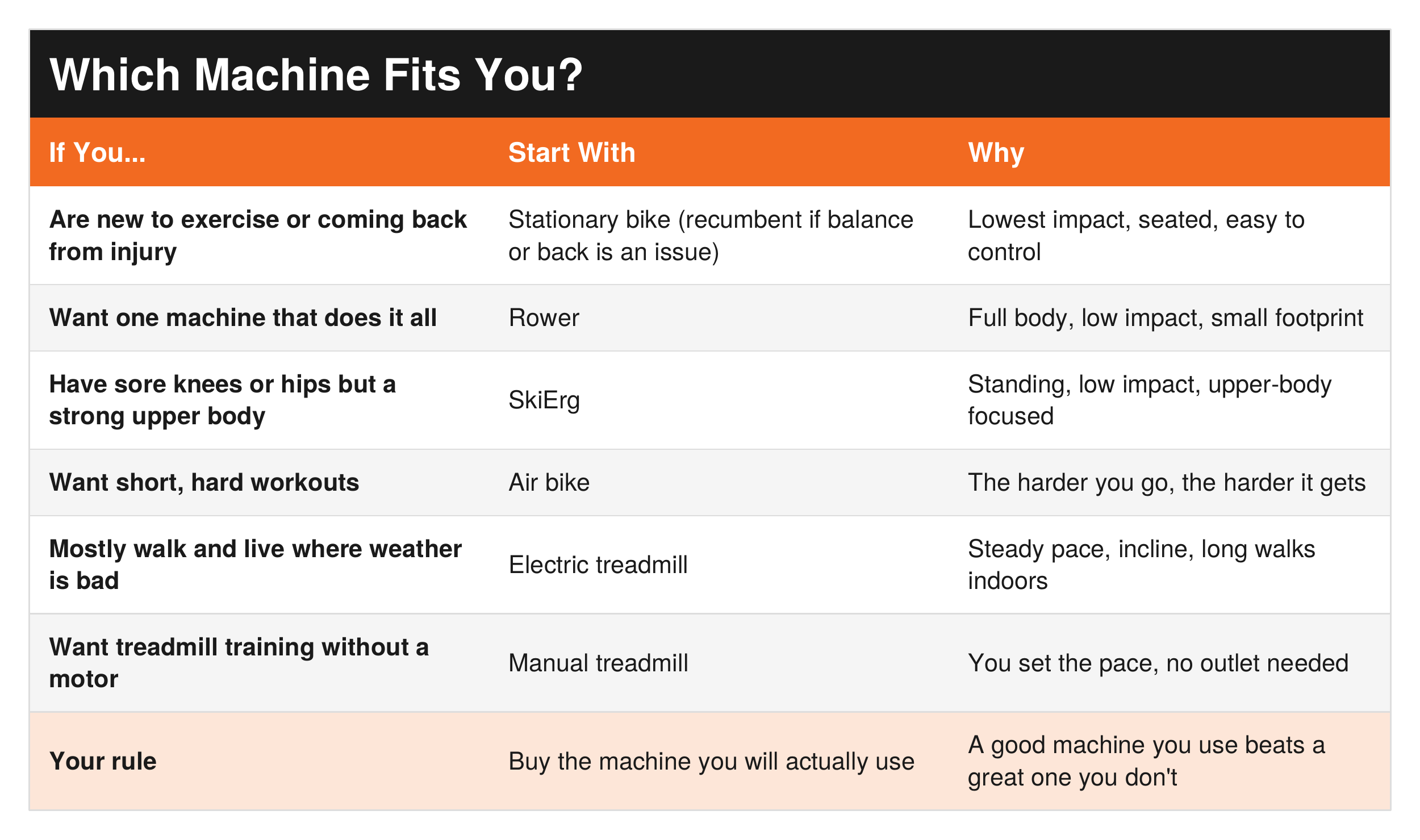
Use this guide to match a machine to your goals and your body.
Using a Machine With the 90-Day Program
Any machine on this list can stand in for a session in my free 90-Day Aerobic Fitness Program when weather or an old injury keeps you indoors. Keep it simple:
Same time, same effort. If the plan says a 30-minute walk at RPE 5, do 30 minutes on the machine at RPE 5.
RPE is your Rate of Perceived Exertion, from 0 to 10. Use the talk test: at RPE 5 you can talk but not sing.
For intervals, the air bike and rower are ideal. Try 20 to 30 seconds hard, then 1 to 2 minutes easy, repeated for 15 to 20 minutes.
Warm up first, just like any other session. My free Dynamic Warm-Up Guide takes you head to toe in about 10 minutes. Get it free here.
Safety First
Talk to your doctor first, especially if you have a heart condition, high blood pressure, joint problems, or past injuries.
Learn proper form before adding intensity, especially on the rower and SkiErg.
Start easy. Machines make it tempting to go hard on day one.
Respect old injuries. Pick the machine that doesn't bother them.
Stop for any chest pain, dizziness, or sharp joint pain.
Bad weather day? Any machine here can stand in for a session. The free 90-Day Aerobic Fitness Program gives you a walking and walk-jog plan that builds your endurance step by step.
The Prepared Protector doesn't let the weather, the smoke, or a power outage decide whether they train. One machine that runs on your own effort keeps your fitness on track through the days when getting outside isn't an option.
Ask Yourself
If I couldn't train outside for a week, what would I do?
Which machine fits my goals, my joints, and my space?
Would my training survive a power outage?
Remember
The best cardio machine is the one you'll use. Pick the one that fits your goals, your joints, and your space, and you'll never have to skip a session because of the weather again.
Get Started Today
Get the free 90-Day Aerobic Fitness Program. A 90-day walking and walk-jog plan that builds your endurance step by step. Use any machine here on the days you can't get outside. Get it free here.
Get the free Dynamic Warm-Up Guide. A simple warm-up routine to get your body ready to move and help prevent injury. Get it free here.
Get the free Lights Out guide. Get your family ready for a power outage before the lights go out. Get it free here.
Quick Answers
What is the best cardio machine for a home gym?
The best machine is the one you will actually use three times a week. For one low-impact machine that works your whole body, a rower like the Concept2 RowErg is hard to beat.
Which cardio machines work without electricity?
The rower, the SkiErg, the air (fan) bike, and a manual treadmill all run on your own effort, and the monitors use batteries. They keep working during a power outage, a storm, or bad air days when you are stuck inside.
What is the easiest cardio machine on the joints?
A stationary bike is the gentlest, and a recumbent bike adds back support for anyone with balance or lower back concerns. The rower and SkiErg are also low impact once you learn good form.
How do I keep kids safe around a treadmill?
Clip the safety key to your clothing, then remove the key, unplug the treadmill, and store the key out of reach when you are done. Keep kids and pets away while it is running, and leave about 6 feet of clear space behind it.
Tools I Recommend
For the Concept2 RowErg and SkiErg, air bikes, stationary bikes, and treadmills I recommend, see my Fitness Amazon store, and for foam rollers and recovery gear, my Recovery Amazon store.
The Full Series
Aerobic Fitness- Part 1: Walking and Rucking: The Foundation of Real-World Fitness
Aerobic Fitness- Part 3: Speed, Agility, and Quickness: Train to Stop, Turn, and Go
Aerobic Fitness- Part 4: Modified Strongman Training: Real-Life Strength
Aerobic Fitness- Part 5: Cardio Machine Buyer’s Guide: Train Through Any Weather
Related Reading
References
U.S. Department of Health and Human Services. (2018). Physical Activity Guidelines for Americans, 2nd edition. https://health.gov/our-work/nutrition-physical-activity/physical-activity-guidelines/current-guidelines
Gibala, M. J., Little, J. P., MacDonald, M. J., & Hawley, J. A. (2012). Physiological adaptations to low-volume, high-intensity interval training in health and disease. Journal of Physiology, 590(5), 1077-1084. https://doi.org/10.1113/jphysiol.2011.224725
Centers for Disease Control and Prevention. Measuring Physical Activity Intensity. https://www.cdc.gov/physical-activity-basics/measuring/index.html
Consumer Reports. Urgent Safety Warning Issued for Peloton Tread+ Treadmill. https://www.consumerreports.org/product-safety/peloton-plus-tread-treadmill-urgent-safety-warning-cpsc
Consumer Reports. How to Stay Safe on a Treadmill. https://www.consumerreports.org/health/treadmills/how-to-stay-safe-on-a-treadmill-a1909564642/
Concept2. RowErg and SkiErg product information. https://www.concept2.com
Disclaimer
These suggestions are intended to help you and your family build awareness, confidence, and safer decision-making habits. No safety plan, checklist, or training can guarantee 100% protection. The goal is not to create fear, but to help guide families toward more informed, prepared, and practical safety decisions in everyday life. As an Amazon Associate, I earn from qualifying purchases. Product mentions reflect my own experience.
This article is for general informational and educational purposes only. It is not medical advice and is not a substitute for guidance from your physician or a qualified fitness professional. Exercise equipment carries a risk of injury. Talk to your doctor before starting any new exercise program, especially if you have a medical condition, past injuries, or have been inactive. Follow the manufacturer's instructions and safety guidelines for any machine. Stop any activity that causes pain, dizziness, or chest discomfort.
If you have chest pain, severe shortness of breath, or feel faint while training, stop and call 911.
Awareness gives you time. Time gives you options.
The Prepared Protector is someone who's decided that loving someone means being ready for them, not just hoping things go fine.
Prepared Not Paranoid. Protecting the Most Vulnerable Among Us.