A Plan Only Works If Your Family Has Practiced It
By Larry Betz | Prepared Not Paranoid https://www.preparednotparanoid.com/
A plan nobody has practiced is just a piece of paper. Over this series, you've built a family communication plan, set up your phones, and learned about satellite devices, walkie-talkies, ham radio, scanners, and weather alerts. Now comes the part that makes it all work when it counts: family emergency drills and a simple battery plan. You don't need hours. A few minutes a month and a short drill twice a year will put your family ahead of almost everyone.
Why Practice Matters
Under stress, people don't rise to the occasion. They fall back on what they've practiced. If your family has never sent a test "I'm OK" text, never turned on the radios, and never walked to the meeting place, they'll be figuring it out in the middle of the emergency, when they can least afford to.
Practice also shows you what's broken while it's easy to fix: a dead radio battery, a phone number that changed, a satellite plan that lapsed, or a child who doesn't know the way to the meeting place. Every problem you find in a drill is one you won't find in a real emergency.
FEMA recommends reviewing and practicing your family communication plan at least once a year. The schedule below goes a little further, without taking much time.
Your Practice Schedule
Here's a simple schedule.
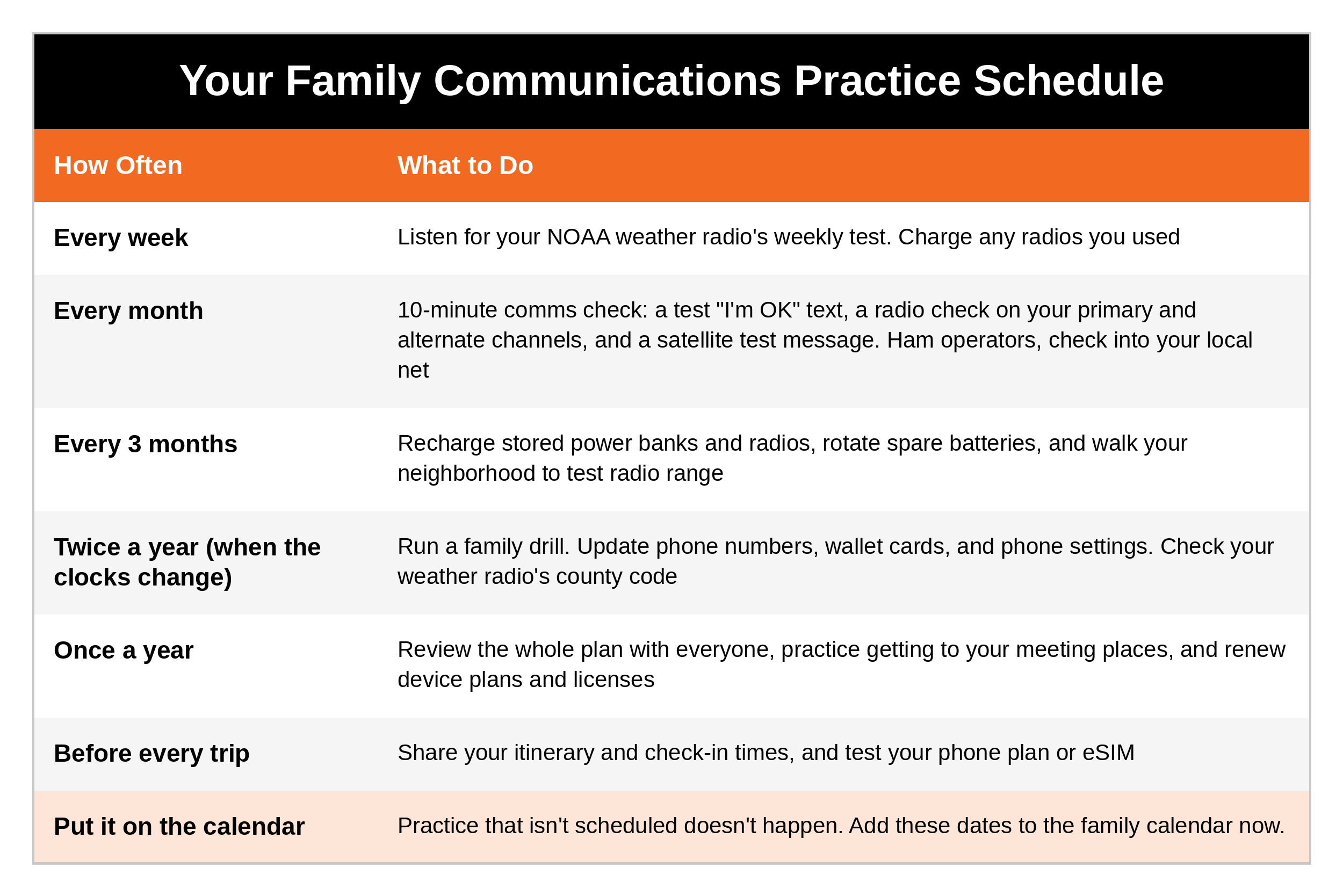
Use the clock change as your reminder. Twice a year, when the clocks change in March and November, many families already check their smoke alarms. Add your family drill and your plan update to the same weekend.
The 10-Minute Monthly Comms Check
Pick a day each month, like the first Sunday, and run through this together:
Send a test "I'm OK" text to the family group and your out-of-area contact, using the format from Part 1
Do a radio check on your primary channel, then switch to your alternate channel and check again
Send a satellite test message if you have a satellite messenger, or run your phone's satellite demo
Ham operators: check into your local weekly net
Check the batteries on everything you just used, and charge what's low
Fix what didn't work before you put it away
That's it. Ten minutes, and you know your layers work.
How to Test Each Device
Phone satellite features: use the satellite demo in your phone's settings (iPhone and Pixel both have one), outside with a clear view of the sky
Satellite messenger: send a test or check-in message to a family member, and confirm they got it. Check that your plan is still active.
Personal locator beacon: run the self-test exactly as the manufacturer's instructions describe. Never trigger a real distress signal to test it. GPS self-tests are limited over the battery's life, so don't overdo it.
NOAA weather radio: the National Weather Service sends a weekly test. Make sure your radio sounds the alert, and check that your county code is still right.
Walkie-talkies: walk your neighborhood with a family member and find out how far your radios actually reach from your house. Try the meeting place, too.
Ham radio: check into a net, and practice reaching a friend radio-to-radio without the repeater.
Scanner: make sure it still picks up your local fire and EMS dispatch, since systems change.
Home phone: if you rely on a home phone in a power outage, test its battery backup.
Run a Family Drill
Twice a year, run one of these drills. Keep it short, make it a game for younger kids, and talk about what happened afterward.
Drill 1: "The Phones Are Down"
Announce that cell service is out.
Everyone works through your PACE plan from Part 1:
Try a text first (in real life, texts sometimes get through when calls don't)
Reach your out-of-area contact
Switch to the radios on your primary channel at the agreed time
If you still can't reach someone, go to your neighborhood meeting place
Afterward, ask: did everyone know the next step without being told?
Drill 2: The Nighttime Alert
Set off a weather radio test or announce a pretend tornado or flash flood warning after dark. Everyone grabs shoes and a flashlight and goes to your shelter spot or out to higher ground, depending on your risk. Time it. Then talk about who woke whom, and what slowed you down.
Drill 3: The Missed Check-In
If you check on an aging parent or someone who lives alone, practice what happens when they don't answer: who calls first, who drives over, and when you'd ask for a welfare check. My free Missed Check-In Protocol walks you through every step. [LINK]
Drill 4: The Travel Check-In
Before your next trip, practice the check-in plan from Part 8 with your contact back home. Send a check-in at the agreed time and confirm they know what to do if one is missed.
Keep notes. Write down what worked, what didn't, and what you'll fix. That list is your to-do list until the next drill.
Free printable: my Family Comms Drill Card puts all of this on paper: the 10-minute monthly check with a log for the whole year, all four drills, a battery and device log, and your twice-a-year update checklist. Print it, stick it on the fridge, and check it off together. [LINK]
Battery Management
In an emergency, power is what keeps every layer of your plan alive. A radio with a dead battery is just a paperweight.
Here's how to keep each device ready.
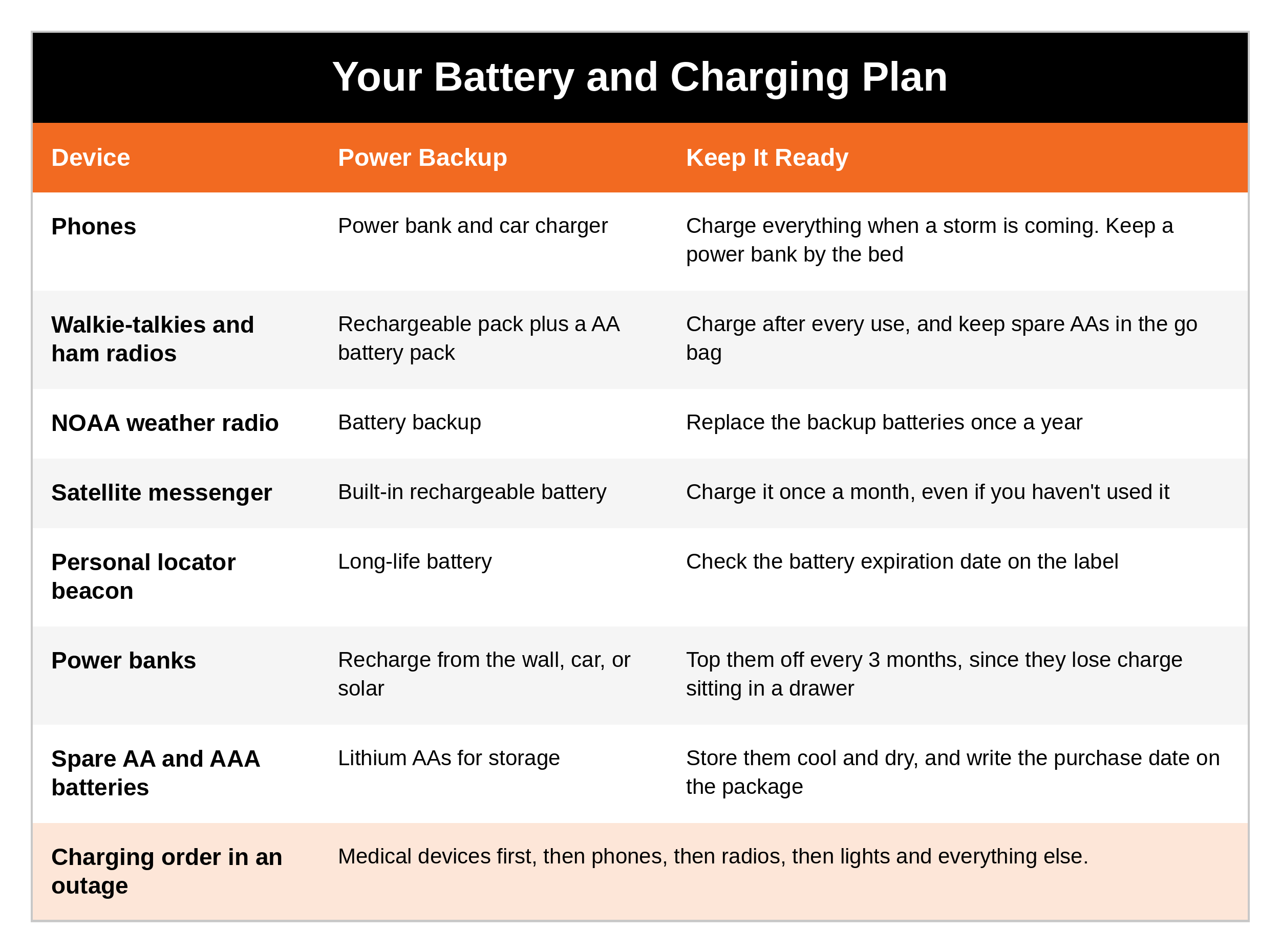
A few more battery tips:
Batteries lose charge sitting in a drawer. Power banks, radios, and satellite messengers all slowly drain in storage, so top them off every few months.
Heat is a battery's enemy. Don't store batteries or power banks in a hot car for long periods, especially in summer.
Lithium AA batteries store well, handle cold weather, and are less likely to leak than alkaline batteries in a device you rarely use.
Write the date on spare batteries when you buy them, and use the oldest first.
Take batteries out of devices you'll store for months, so a leak doesn't ruin them.
Have a way to recharge in a long outage: a car charger, a solar panel, or a portable power station. My Backup Power series covers all of these.
Keep Your Plan Current
A plan is only as good as its information. Twice a year, update:
Phone numbers, work and school information, and your out-of-area contact
Wallet cards for every family member
Your phone settings: Medical ID, emergency contacts, and alert settings (Part 2)
Your radio plan: channels, check-in times, and who carries which radio (Part 4)
Device plans and licenses: satellite plans, your GMRS license (10 years), your ham license (10 years), and your PLB registration
My free Family Emergency Communication Plan printable makes the update easy. Print a fresh copy, fill it in together, and swap out the old wallet cards. [LINK]
The Whole Series in One Place
When disaster strikes, staying connected can make all the difference. This series covered a wide range of tools, from smartphones and satellite messengers to ham radios, scanners, and walkie-talkies, all to help you build a layered, reliable communication plan.
The key takeaway? Don't rely on just one single device. A resilient plan includes short- and long-range options, backup power, and the ability to send and receive information, even when the grid is down.
Here's every part of the series:
Introduction: Why Your Family Needs Communication Layers https://www.preparednotparanoid.com/pnp-library/emergency-communications
Part 1: Your Family Communication Plan https://www.preparednotparanoid.com/pnp-library/emergency-communications-family-plan
Part 2: Your Smartphone in an Emergency https://www.preparednotparanoid.com/pnp-library/emergency-communications-lesson1
Part 3: Satellite Messengers, Satellite Phones, and Cell-Based Radios https://www.preparednotparanoid.com/pnp-library/emergency-communications-lesson2
Part 4: Walkie-Talkies: FRS, GMRS, and CB https://www.preparednotparanoid.com/pnp-library/emergency-communications-lesson3
Part 5: Ham Radio https://www.preparednotparanoid.com/pnp-library/emergency-communications-tgxr6
Part 6: Police and EMS Scanners https://www.preparednotparanoid.com/pnp-library/emergency-communications-scanners
Part 7: Weather Alerts https://www.preparednotparanoid.com/pnp-library/emergency-weather
Part 8: Staying Connected Overseas https://www.preparednotparanoid.com/pnp-library/emergency-communications-overseas
Part 9: Practice, Drills, and Battery Management (you're here)
Preparedness isn't about fear. It's about having options when others don't.
Ask Yourself
When was the last time my family actually practiced our communication plan?
If the power went out tonight, which of our radios and power banks would be charged?
Is our weekly, monthly, and twice-a-year practice on the family calendar?
Remember
Practice is what turns a plan into a habit. Ten minutes a month, a short drill twice a year, and a battery plan will keep every layer of your family's communication plan ready to work. The prepared protector doesn't just build the plan. They practice it until everyone knows what to do without being told.
Get Started Today
FREE GUIDE: Lights Out, The Prepared Not Paranoid Blackout Plan. What to do in the first 30 minutes, the first 24 hours, and beyond when the power goes out, including how to keep your phones, radios, and power banks charged. [CTA: Comment or DM "KEYWORD" / or download it here: LINK]
Go Deeper
The Family Safety Toolkit. This post helps your family practice the plan and keep it ready. The Toolkit gives you 20 checklists covering every area of family safety and preparedness, from your go bag and your vehicle to first aid and home safety, all for $19.99. [Get it here: https://www.preparednotparanoid.com/family-safety-toolkit]
The Family Emergency Preparedness Manual is coming soon.
Tools I recommend: The radios, weather radios, satellite messengers, and batteries I recommend are in my Backup Communications Amazon store, https://link.amazon/B09z0lfEb, and the power banks, solar panels, and power stations are in my Backup Power Amazon store, https://link.amazon/B0aqcCOsk
Related reading:
Emergency Communications, Part 1: Your Family Communication Plan https://www.preparednotparanoid.com/pnp-library/emergency-communications-family-plan
Backup Power, Introduction https://www.preparednotparanoid.com/pnp-library/alternative-power
Backup Power, Part 7: Your Family Outage Plan https://www.preparednotparanoid.com/pnp-library/alternative-power-lesson7
References
FEMA / Ready.gov. Family Emergency Communication Plan; Make a Plan.
National Weather Service. NOAA Weather Radio: weekly tests and SAME programming.
ACR Electronics. Personal locator beacon self-test guidance.
FCC. GMRS and Amateur Radio license terms.
Disclaimer
These suggestions are intended to help you and your family build awareness, confidence, and safer decision-making habits. No safety plan, checklist, drill, or device can guarantee 100% protection. Follow each device maker's instructions for testing and battery care, and never send a real distress signal to test a device. This article is for general informational purposes only. Follow the instructions of local officials during an emergency. Affiliate disclosure: I've linked to products from my Amazon store that I personally recommend. As an Amazon Associate, I earn from qualifying purchases, at no extra cost to you. Thank you for supporting my work.
In an emergency, call 911. If a call won't go through, try texting 911 where it's available, and include your location in the first message.
Awareness gives you time. Time gives you options.
The prepared protector is someone who's decided that loving someone means being ready for them, not just hoping things go fine.
Prepared Not Paranoid. Protecting the Most Vulnerable Among Us.