Safe Drinking Water- Part 3: Filters, Purifiers, and Water Trends
What Actually Removes What's in Your Water, and What's Just Hype
By Larry Betz | Prepared Not Paranoid https://www.preparednotparanoid.com/
Every water filter box promises clean water. Most of them don't tell you what they actually remove. Some are certified, some were tested once by a lab the company paid, and some only prove their parts are lead-free. Then there's a whole new aisle of hydrogen bottles, copper cups, and alkaline machines. This post sorts it out, so you buy the right filter once and know which trends are worth your money.
How to Read a Filter's Claims
Before we compare filters, here's something most people don't know: "tested to NSF standards" is not the same as "NSF certified."
Certified means an independent organization (NSF, IAPMO, or WQA) tested the product, checks the factory, and keeps testing it over time.
Tested to means the company paid a lab to run the test once. It can still be good data, but no one is checking it over time.
Materials-only certifications (NSF/ANSI 372, or 42 "materials") only mean the parts are lead-free and safe. They say nothing about what the filter removes.
Here's what each standard covers.

You can look up any product in the free NSF, IAPMO, or WQA online listings.
Gravity-Fed Water Filters
Gravity-fed water filters are an excellent choice for clean drinking water, whether or not you have power. They use the natural force of gravity to push water through the filter, which makes them reliable for home use, travel, and emergency preparedness. They come in various sizes for households of different sizes and needs. Let's look at some options.
Pitcher-Sized Filters
Clearly Filtered Water Pitcher: This pitcher is known for removing hundreds of contaminants, including heavy metals, fluoride, PFAS, pesticides, and pharmaceuticals. The company says it's tested to NSF/ANSI Standards 42, 53, 401, and 473. Each filter lasts about 100 gallons. It is one of the few pitchers that reduces fluoride. Check the brand's performance data sheet for exact results.
Epic Nano Water Filter Pitcher: The Epic Nano uses nanofiber technology and carbon to reduce a wide range of contaminants, including lead, PFAS, microplastics, and, according to lab testing, bacteria and viruses. It is NSF certified to Standards 42 and 372; its other results come from independent lab testing. The Nano does not reduce fluoride. Each filter lasts about 100 gallons.
Brita Elite Water Filter Pitcher (formerly Longlast+): The Elite is certified to reduce lead, PFOA/PFOS, microplastics, mercury, cadmium, and chlorine. It lasts up to 120 gallons, or about 6 months, making it a durable and cost-effective option. It does not remove fluoride, bacteria, or chloramine. Note: the standard white Brita filter does much less (it is not certified for lead or PFAS), so make sure you buy the Elite.
Here's how the three compare.
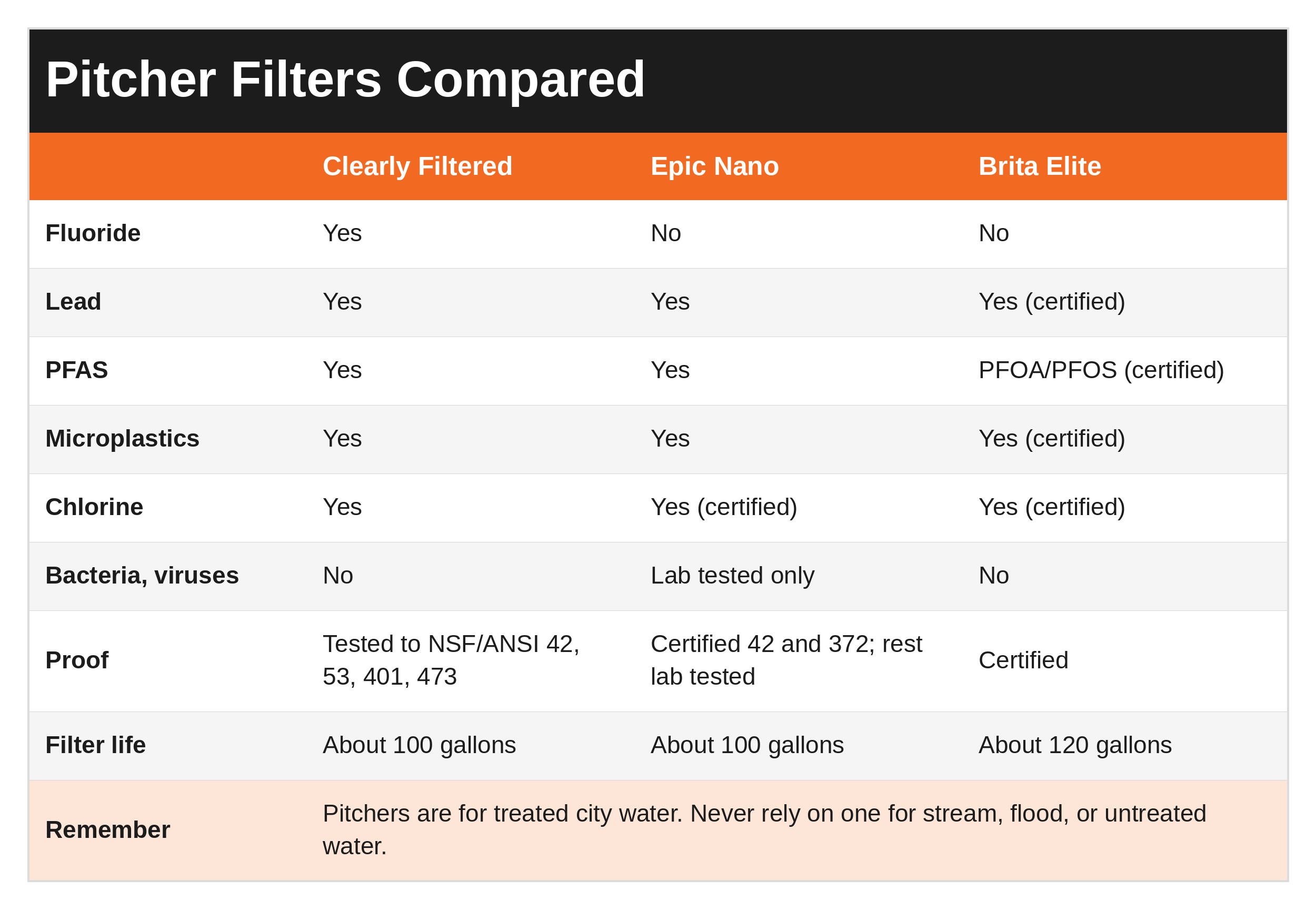
Pitcher filters are made for city water that's already been treated. Don't rely on any pitcher to make stream, flood, or untreated water safe.
Pitcher-style filters are convenient for small households and quick filtration, but they have limited capacity and need frequent refills. For a bigger solution, larger countertop gravity filters are a significant upgrade. They sit on a countertop or stand and filter much more water at a time, which makes them a solid long-term option for everyday health and emergency preparedness.
Countertop Gravity-Fed Water Filters
Big Berkey Gravity Water Filter: The Big Berkey has been the most popular name in gravity filters for years, and it's still sold through authorized dealers. It holds 2.25 gallons, good for families of up to four. Berkey's own lab reports claim it removes viruses, bacteria, heavy metals, chlorine, pharmaceuticals, and more, with fluoride removal requiring the separate PF-2 fluoride filters. Here's what you should know before buying: from 2022 to 2023, EPA issued stop-sale orders on the Black Berkey elements, ruling that because they contain silver, they had to be registered under the federal pesticide law. Berkey challenged EPA in court; the case was dismissed on legal standing, and the Supreme Court declined to hear it in December 2024. Black Berkey replacement elements are now hard to find, and the current Phoenix replacement elements are certified only to NSF/ANSI 42 (chlorine) and 372 (lead-free materials). The broader removal claims come from company-commissioned lab testing, not certification.
ProOne Big+ Gravity Water Filtration System: The ProOne G2.0 filters have been independently tested to NSF/ANSI Standards 42, 53, and 401 and the P231 microbiological protocol, but they are not performance certified. ProOne's data claims removal of over 200 contaminants, including heavy metals, pesticides, chlorine, and up to 97.5% of fluoride, all in one filter. The Big+ holds 3 gallons, and each filter is rated for about 1,000 to 1,200 gallons.
Waterdrop King Tank: The Waterdrop King Tank is made of stainless steel, holds 2.25 gallons, and filters about 4 gallons per hour. With its fluoride filters installed, Waterdrop claims it reduces fluoride by up to 98%, along with lead, chlorine, and other heavy metals. Its filters are rated for 3,000 gallons, making it one of the lowest-cost options per gallon. Its only certification is NSF/ANSI 372 (lead-free materials), and the manual says not to use it on unsafe water unless it's been disinfected first.
Here's how the three compare.

My take: I like gravity filters because they work without power, and they belong in every preparedness plan. But none of these three is certified to remove bacteria and viruses. For water from an unknown source, use the filter, then disinfect rule from Part 2.
Water Distillers and Reverse Osmosis Systems
Water distillers and reverse osmosis (RO) systems are both highly effective at purifying water, and each has its strengths and limitations. Distillers use heat and need electricity. Standard RO systems use your home's water pressure to push water through a special membrane. Tankless and countertop RO units also need electricity. Both are excellent for clean drinking water every day, but in a power outage or when the city water stops, you need a gravity filter as your backup.
How a Water Distiller Works
A water distiller purifies water the same way nature does. It heats water to a boil, turning it into steam and leaving behind contaminants like heavy metals, bacteria, viruses, nitrates, fluoride, and dissolved solids. The steam is then cooled and condensed back into liquid, producing very pure water. A few chemicals (some VOCs) can boil and travel with the steam, which is why good distillers include a carbon filter at the end. Distillation also removes beneficial minerals, so some people choose to remineralize the water before drinking. Most countertop distillers take about 4 to 6 hours to make a gallon.
Water Distillers
H2o Labs Countertop Water Distiller: This distiller makes about 1 gallon (4 liters) of distilled water per cycle. It has a stainless steel body and a glass carafe to collect the purified water. It comes with activated carbon pods that the company says last twice as long as standard filters, for better removal of volatile organic compounds (VOCs). It removes fluoride, nitrates, heavy metals (such as lead and mercury), dissolved solids, industrial chemicals, bacteria and viruses, and VOCs, making it a reliable choice for consistently clean drinking water.
VEVOR Water Distiller, 4L (1.05 Gallon): This distiller makes up to 1.05 gallons (4 liters) of purified water per cycle. It has a stainless steel body and a glass collection container for durability and safety. It's a versatile, budget-friendly unit for drinking water, coffee, baby formula, cooking, humidifiers, CPAP machines, and aquariums.
Global Water Distiller 4L: This distiller makes 1 gallon (4 liters) of distilled water per cycle, with a stainless steel interior and a glass carafe. It removes the same wide range of contaminants as the others.
Distillation removes nearly everything because of how it works, not because of the brand. Choose based on build quality, warranty, and price.
How a Reverse Osmosis System Works
Reverse osmosis is a multi-stage filtration process that uses pressure to force water through a semi-permeable membrane. The membrane captures contaminants such as heavy metals, fluoride, nitrates, PFAS, and dissolved solids while letting clean water molecules pass through. Most RO systems also include carbon pre-filters and post-filters for chlorine and VOCs. RO systems remove a broad range of contaminants, but they send some water down the drain.
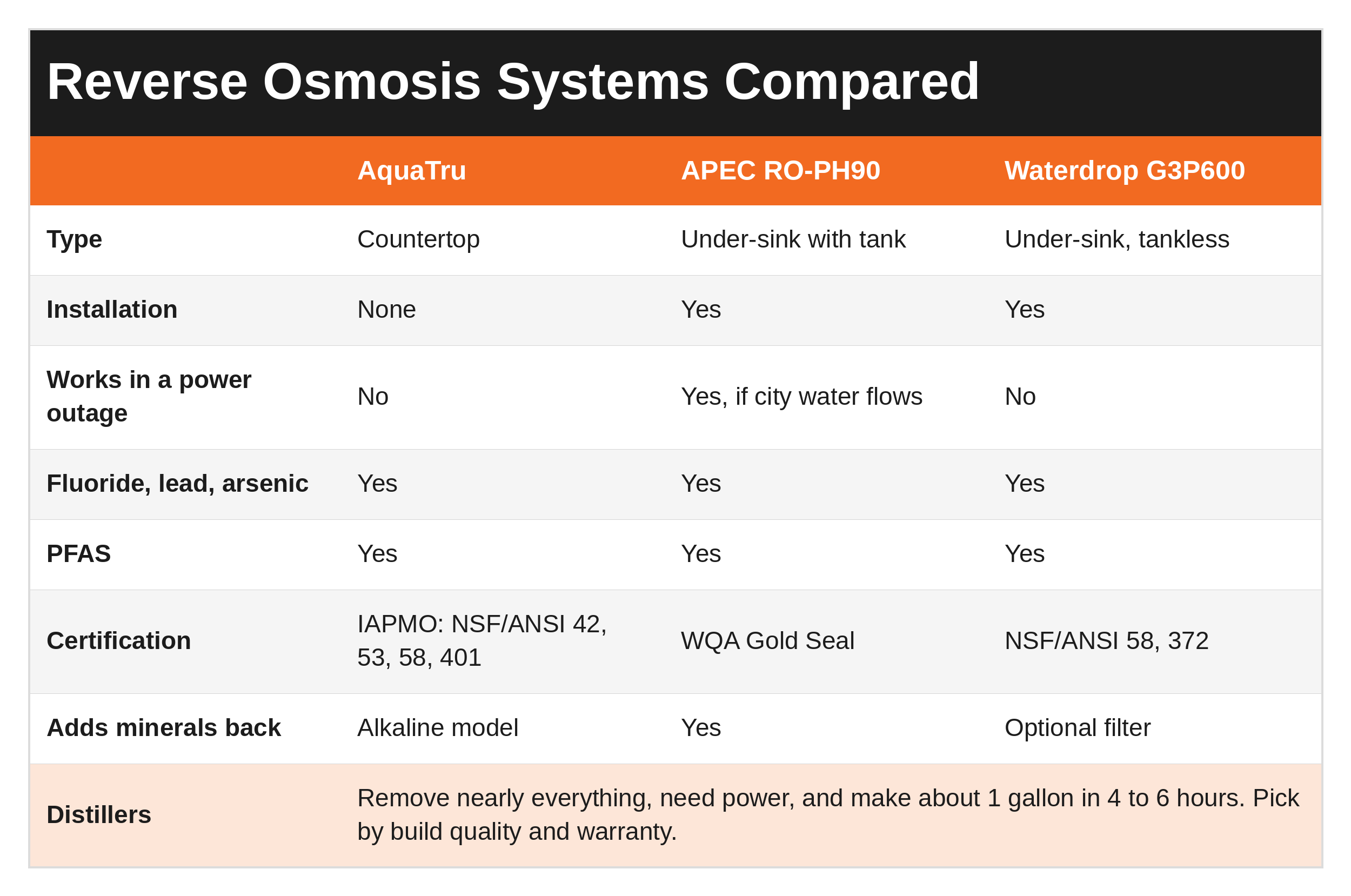
In an emergency: A standard under-sink RO with a storage tank runs on your home's water pressure, not electricity, so it keeps working in a power outage as long as the city water is still flowing. Tankless and countertop RO units have electric pumps and stop when the power goes out. If you're on a well, your well pump needs power too. Either way, RO is your everyday system, and your gravity filter is your backup.
Reverse Osmosis Systems
AquaTru Countertop Water Purifier: The AquaTru brings reverse osmosis to your countertop with no installation, which makes it ideal for renters or anyone with limited kitchen space. It's certified by IAPMO to NSF/ANSI Standards 42, 53, 58, and 401, which is rare for a countertop unit. It uses a multi-stage process (sediment and carbon pre-filter, RO membrane, and carbon post-filter) to remove lead, fluoride, PFAS, chlorine, VOCs, and much more. An alkaline model adds minerals back for taste. It plugs into an outlet and requires regular filter changes.
APEC Water Systems Ultimate RO-PH90: This is a 6-stage reverse osmosis system that delivers up to 90 gallons per day. It removes up to 99% of contaminants, including chlorine, fluoride, lead, arsenic, and chromium. It includes carbon block filters, a high-rejection RO membrane, and a final carbon filter. Its pH+ stage adds calcium back into the water for better taste. The RO-PH90 is WQA Gold Seal certified, uses US-made filters, lead-free components, and food-grade tubing, and comes with a brushed nickel faucet. Because it uses a storage tank, it runs on water pressure and doesn't need electricity.
Waterdrop G3P600 Reverse Osmosis System: This is a tankless, under-sink system with 8 stages of filtration that removes dissolved solids, chromium, PFAS, fluoride, arsenic, radium, nitrates, chlorine, and heavy metals. It delivers 600 gallons per day (it fills an 8-ounce cup in about 8 seconds) with an efficient 2:1 pure-to-drain ratio, reducing water waste. Waterdrop lists it as certified to NSF/ANSI 58 and 372. The smart faucet shows real-time water quality and filter life. It needs electricity to run, so pair it with a gravity filter for outages.
Here's how the three compare.
Water Trends: What's Worth It and What's Hype
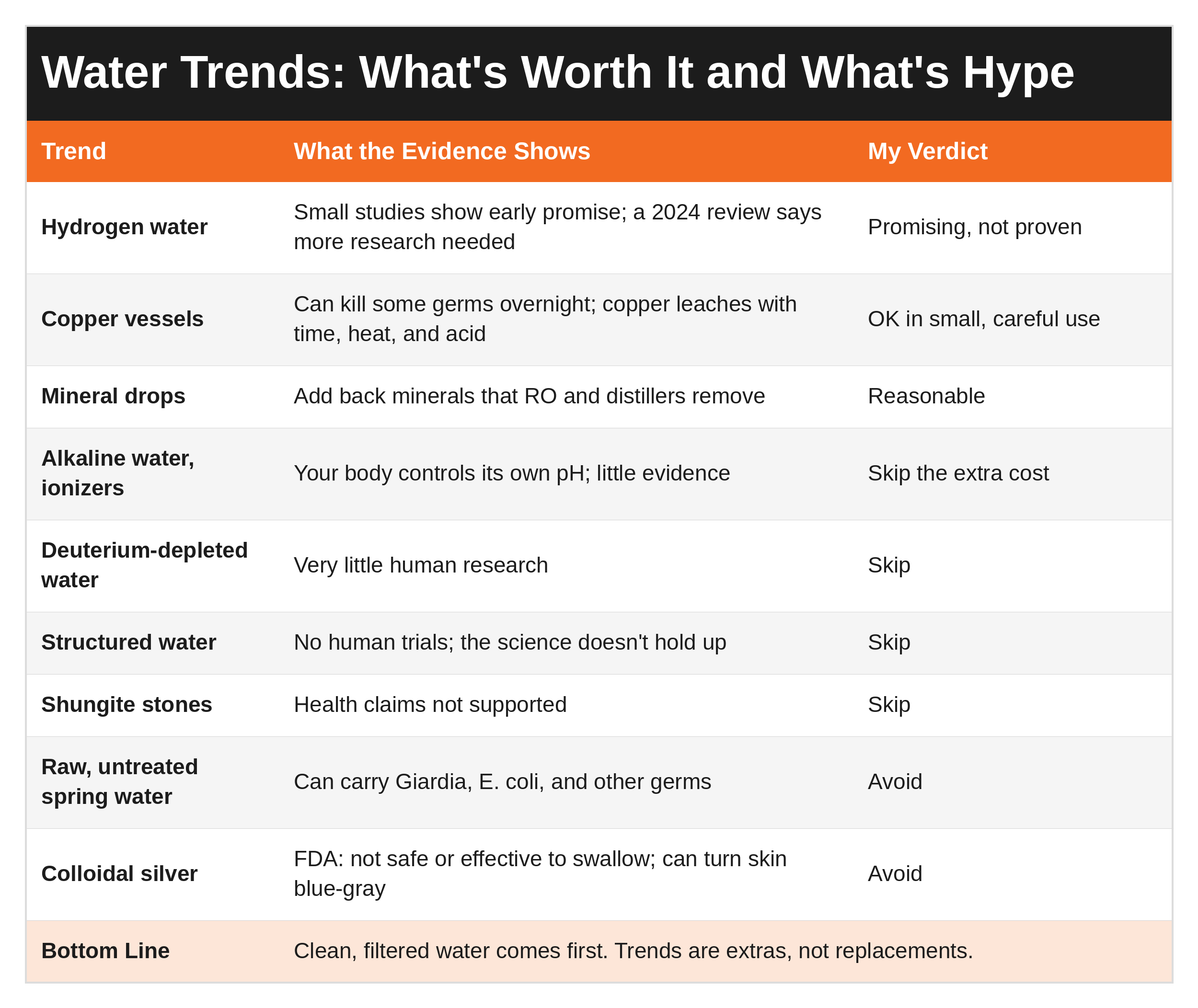
Walk into any health store or scroll social media, and you'll see water sold as medicine: hydrogen bottles, copper cups, alkaline machines, "structured" water. Some of these have real early research behind them. Some are harmless but overpriced. A few can actually hurt you. Here's my scorecard.
Hydrogen Water
Hydrogen water is regular water with extra hydrogen gas dissolved in it, from a special bottle, a tablet, or a can. The idea is that hydrogen acts as an antioxidant. A 2024 systematic review in the International Journal of Molecular Sciences looked at 25 studies and found encouraging early results for exercise recovery, oxidative stress, and liver health. The studies were small, and the authors said larger, better studies are still needed.
If you try it:
Drink it fresh. Hydrogen escapes quickly once the bottle is opened.
Choose a brand that publishes independent test results for how much hydrogen it actually delivers.
Hydrogen tablets usually contain magnesium. If you have kidney disease, talk with your doctor first.
Start with clean water. Hydrogen doesn't filter anything. Put filtered water in the bottle.
My verdict: promising, not proven. It's a reasonable extra if it fits your budget, but it doesn't replace clean, filtered water.
Copper Vessels (Small Amounts)
Storing water in a copper cup or bottle is a centuries-old practice. There's some real science here: a 2012 study found that drinking water stored overnight in copper pots killed several types of bacteria that cause diarrhea. But copper also dissolves into the water, and more dissolves the longer it sits, the warmer it is, and the more acidic the drink. Too much copper causes nausea, vomiting, and stomach pain, and over time it can harm the liver. The EPA's action level for copper in tap water is 1.3 milligrams per liter.
How to use copper safely:
Plain, room-temperature water only. Never lemon water, juice, other acidic drinks, or hot water.
Small amounts, short times. Fill it the night before and drink it in the morning, ideally within about 8 hours.
Clean it regularly, and stop using it if a green or blue-green film forms inside.
Don't use copper if you have Wilson's disease (a condition where the body can't clear copper) or liver or kidney disease. Ask your pediatrician before giving copper-stored water to young children.
Not for emergency storage. For water you store for months, use food-grade containers (see Part 4).
My verdict: fine in small, careful amounts for healthy adults. It is not a water purifier.
Mineral Drops
Reverse osmosis and distillation remove nearly everything, including calcium and magnesium. Adding trace mineral drops (or using an RO system with a remineralizing stage) brings some back and improves the taste. My verdict: reasonable, especially if your family drinks RO or distilled water every day. Most of your minerals still come from food.
Alkaline Water and Water Ionizers
Alkaline water has a higher pH than regular water. The claims say it neutralizes acid in your body. But your body tightly controls its own pH no matter what you drink, and your stomach acid neutralizes alkaline water within minutes. One small lab study in 2012 suggested alkaline water may help some people with acid reflux, but that's a long way from the health claims. Ionizer machines can cost thousands of dollars.
My verdict: skip the extra cost. Spend it on a certified filter.
Deuterium-Depleted Water
This is water with less of a heavy form of hydrogen. It's expensive and marketed for energy, aging, and even cancer. There's very little human research to support any of it. My verdict: skip it.
Structured Water
Sellers claim water can be rearranged into a special "hexagonal" form that hydrates better. Water molecules don't hold a shape like that for more than a tiny fraction of a second, and there are no human trials. My verdict: skip it.
Shungite Stones
Shungite is a black, carbon-rich rock sold to "purify" or "energize" water. Its health claims aren't supported, and it hasn't been certified to remove contaminants the way a real filter is. My verdict: skip it.
Raw, Untreated Spring Water
"Raw water" is sold as natural and unprocessed. That's exactly the problem. Untreated water can carry Giardia, Cryptosporidium, E. coli, and other germs, which is the reason we treat water in the first place. My verdict: avoid it. If you collect spring water, treat it like any unknown source: filter, then disinfect.
Colloidal Silver
Colloidal silver is sold as a natural antibiotic you drink. The FDA has said it isn't safe or effective for treating any disease when taken by mouth. Swallowing it over time can cause argyria, a permanent blue-gray color of the skin. My verdict: avoid it.
The bottom line on trends: clean, filtered water comes first. Everything else is an extra, not a replacement.
Ask Yourself
Is my filter actually certified for what's in my water, or just "tested to" a standard?
If the power went out tonight, which of my water systems would still work?
Am I spending money on a water trend before I've covered the basics?
Do I use a copper cup the right way: plain water, short times, cleaned often?
Remember
Match your filter to your water, and check the certification, not the box. Use reverse osmosis or a distiller every day, keep a gravity filter for when the power goes out, and treat trends as extras.
Get Started Today
[FREE DOWNLOAD: TO BE CHOSEN AFTER THE BINDER REVIEW]
Go Deeper
The Prepared Not Paranoid Family Nutrition Guide. This post compares the filters and trends. The guide shows you how to match a filter to your own water test results, which certified filters remove PFAS, lead, and microplastics, and how to set up an everyday system plus a no-power backup, with the Emergency Water Purification Card for your kitchen and go-bag. [Get it here: LINK]
Tools I recommend: The certified water filters, gravity filters, reverse osmosis systems, and water test kits I recommend are in my Amazon store. https://amzn.to/4yM747h
Related reading:
Safe Drinking Water, Part 1: What's Really in Your Water https://www.preparednotparanoid.com/pnp-library/water-intro-3j5am
Safe Drinking Water, Part 2: How Much Water You Need and How to Make It Safe https://www.preparednotparanoid.com/pnp-library/water-intro
Safe Drinking Water, Part 4: Water Storage https://www.preparednotparanoid.com/pnp-library/water-storage
Toxic Chemicals to Avoid, Part 6: Microplastics https://www.preparednotparanoid.com/pnp-library/toxic-chemicals-lesson-1-9axkp-mxse9-ekwcw-bdger
References
NSF International. Water filter standards and certified product listings. https://www.nsf.org/
IAPMO R&T and Water Quality Association (WQA). Certified product listings.
U.S. Environmental Protection Agency. Stop Sale, Use, or Removal Orders: Berkey filters (2022 to 2023).
Sharma P, Dhillon G, Buddhavarapu V, et al. Hydrogen Water: Extra Healthy or a Hoax? A Systematic Review. International Journal of Molecular Sciences, 2024. https://nutrition-evidence.com/article/490832/hydrogen-water-extra-healthy-or-a-hoax-a-systematic-review
Sudha VBP, et al. Storing drinking-water in copper pots kills contaminating diarrhoeagenic bacteria. Journal of Health, Population and Nutrition, 2012.
The Week. Fact check: Could storing hot or lemon water in a copper bottle be toxic? June 2026. https://www.theweek.in/news/health/2026/06/12/fact-check-never-store-lemon-water-or-hot-water-in-a-copper-bottle-could-be-toxic.html
U.S. Environmental Protection Agency. Lead and Copper Rule (copper action level 1.3 mg/L).
World Health Organization. Nutrients in Drinking Water. 2005.
Koufman JA, Johnston N. Potential benefits of pH 8.8 alkaline drinking water as an adjunct in the treatment of reflux disease. Annals of Otology, Rhinology and Laryngology, 2012.
Skeptoid. Deconstructing Structured Water (Episode 1006). September 2025. https://skeptoid.com/episodes/1006
U.S. Food and Drug Administration. Over-the-Counter Drug Products Containing Colloidal Silver Ingredients or Silver Salts: final rule. 1999.
Centers for Disease Control and Prevention. Making Water Safe in an Emergency.
Disclaimer
This article is for general informational and educational purposes only. It is not medical advice. Product features and certifications change, so check the current NSF, IAPMO, or WQA listing before you buy. If you have kidney, liver, or heart disease, or Wilson's disease, talk with your doctor before trying hydrogen tablets, copper vessels, or mineral supplements. Affiliate disclosure: I've linked to products from my Amazon store that I personally recommend. As an Amazon Associate, I earn from qualifying purchases, at no extra cost to you. Thank you for supporting my work.
If someone has severe vomiting, stomach pain, or signs of dehydration after drinking questionable water, call 911.
Awareness gives you time. Time gives you options.
The prepared protector is someone who's decided that loving someone means being ready for them, not just hoping things go fine.
Prepared Not Paranoid. Protecting the Most Vulnerable Among Us.