Nutrition Basics- Part 13: How to Read a Nutrition Facts Panel
The 5/20 Rule, the Label Traps, and a 60-Second Routine for Every Shopping Trip
By Larry Betz | Prepared Not Paranoid https://www.preparednotparanoid.com/
Sixty seconds with the back of the box tells you more than the whole front of it.
Understanding what you eat begins with reading food labels. These labels provide essential information about the nutritional content and ingredients in the food products we consume. By learning to read and interpret these labels, you can make informed decisions that contribute to your health and well-being.
It's not just about calories and nutrients; it's also about identifying potentially harmful ingredients. Many processed foods contain toxic chemicals and artificial additives that can have adverse effects on your health. By scrutinizing food labels for these harmful substances, you can avoid consuming ingredients that may pose risks to your health. Taking the time to read food labels and looking for toxic chemicals is a powerful step towards healthier eating habits and better overall health.
The front of a package is advertising. It's designed by a marketing team to get the box into your cart. The back of the package is different. The Nutrition Facts panel and the ingredients list are required by federal law, and they follow rules set by the FDA. That makes them the most honest information in the grocery store.
The problem is that most people were never taught how to read them. They glance at calories, maybe sugar, and move on.
Why does this matter for preparedness? Because the foods you stock for an emergency are almost all packaged: canned goods, grains, nut butters, powdered milk, protein bars. If you can read a label in under a minute, you can build a pantry that keeps your family healthy on a normal Tuesday and strong during a two-week power outage.
Start at the Top: Serving Size
Everything on the panel is based on the serving size. Miss this line and every number below it is wrong.
The serving size isn't a recommendation. The FDA says it reflects the amount people typically eat or drink at one time. Ask yourself one question: "How much of this will I really eat?" If the serving is 1 cup of cereal and you pour 2 cups, double every number on the panel.
Servings per container tells you how many servings are in the whole package. A bag of chips that looks like one snack might hold 3 servings. Many packages that could be eaten in one sitting now use a dual-column label, one column per serving and one for the whole package. Use it.
The pantry math: for emergency planning, servings per container is your best friend. A can of chili with 2 servings at 250 calories each gives you 500 calories. Multiply by the number of cans and you know how many days of food you have. (We'll do this step by step in Part 17.)
Calories
Calories are listed in large, bold type, per serving. The FDA uses 2,000 calories a day as a general reference, but your needs depend on your age, size, sex, and activity level.
Calories tell you how much energy is in a food. They don't tell you whether that energy comes with protein, fiber, and vitamins or with refined starch and added sugar. That's why we keep reading.
% Daily Value and the 5/20 Rule
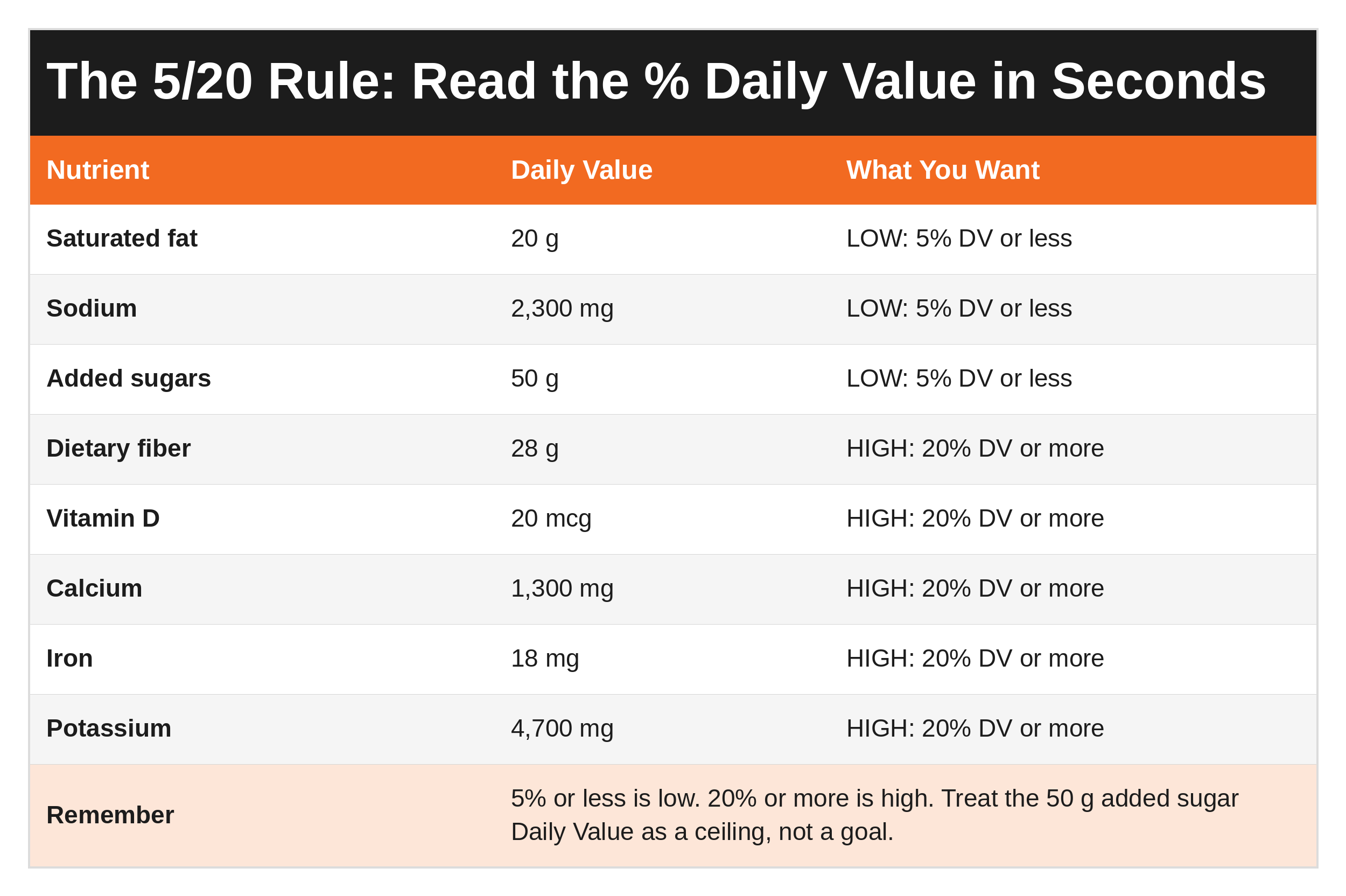
The % Daily Value (%DV) column shows how much one serving contributes to a full day's worth of each nutrient. You don't need to memorize the Daily Values.
You need one simple rule from the FDA: 5% DV or less per serving is low. 20% DV or more is high. Use it in both directions.
The Lines That Matter Most
Saturated fat is the fat line to watch. Total fat on its own isn't the enemy. Olive oil, avocados, nuts, and fatty fish are some of the best foods you can eat (see Part 4: Fats and Oils).
Sodium is where packaged food hits hardest. Canned soups, frozen meals, deli meats, sauces, and snacks can carry a third of a day's sodium in one serving. Canned foods are the backbone of most emergency pantries, and during an emergency you may also have less water to drink. Choose "low sodium" or "no salt added" cans when you can, and rinse canned beans to wash away a good share of the salt. If you have high blood pressure, heart failure, or kidney disease, follow your doctor's sodium limit.
Dietary fiber is a nutrient most Americans fall short on. 20% DV or more per serving is a high-fiber food. Look for it in beans, whole grains, oats, and canned or frozen vegetables (see Part 8: Fiber and Gut Health).
Added sugars is one of the most useful lines on the modern label. Total sugars include sugar that's naturally in the food, like the lactose in milk. Added sugars shows only the sugar the manufacturer put in. Plain yogurt and sweetened yogurt might show similar total sugars, but the added sugars line tells you which one had sugar poured in. The label's Daily Value is 50 grams, but the new Dietary Guidelines are much stricter: no added sugar for children younger than 11, and no more than 10 grams per meal for teens and adults. Treat the 50 grams as a ceiling, not a goal (see Part 10: Sugar and HFCS).
Protein is listed in grams, often with no %DV, which is allowed unless the package makes a protein claim. The label's Daily Value is 50 grams, far below what I recommend. My standard is 1 gram of protein per pound of your goal body weight per day. If you have kidney disease, talk to your doctor before increasing protein. So ignore the %DV and ask: "How many grams of protein do I get for these calories?" A can of tuna gives you a lot. A granola bar with "protein" on the front often gives you a little protein wrapped in a lot of sugar (see Part 2: Protein).
Vitamin D, calcium, iron, and potassium sit at the bottom of the panel. Americans often don't get enough of these four. Use the 5/20 rule: 20% DV or more is a good source.
The Ingredients List: Read It Every Time
The Nutrition Facts panel tells you how much. The ingredients list tells you what.
Ingredients must be listed in order by weight, most to least. That simple rule tells you a lot:
If sugar or a syrup is one of the first three ingredients, it's a sweet food, no matter what the front says.
If "enriched flour" comes before "whole wheat flour," the product is mostly refined flour, even if it says "made with whole grains."
Watch for split sugars. Manufacturers can use several sweeteners so none of them lands at the top. Sugar, brown rice syrup, cane juice, and dextrose might each be small, but together they may be the main ingredient.
Short lists usually win. Plain oats: one ingredient. Canned black beans: beans, water, maybe salt. When the list runs to 30 items you can't pronounce, slow down and read (see Part 9: Ultra-Processed Foods).
The allergen statement: U.S. law requires labels to identify the nine major food allergens: milk, eggs, fish, shellfish, tree nuts, peanuts, wheat, soybeans, and sesame. If anyone in your family has a food allergy, read it every time, even on a brand you always buy. Recipes change, and in an emergency stores often substitute brands.
The "0 g Trans Fat" Loophole
Here's a rule most shoppers don't know. FDA rules allow a product with less than 0.5 grams of trans fat per serving to list "0 g" on the label. Partially hydrogenated oils, the main source of artificial trans fat, have been removed from the U.S. food supply, which is good news. But the rounding rule still applies, servings are small, and people eat several of them.
Half a gram here and half a gram there adds up.
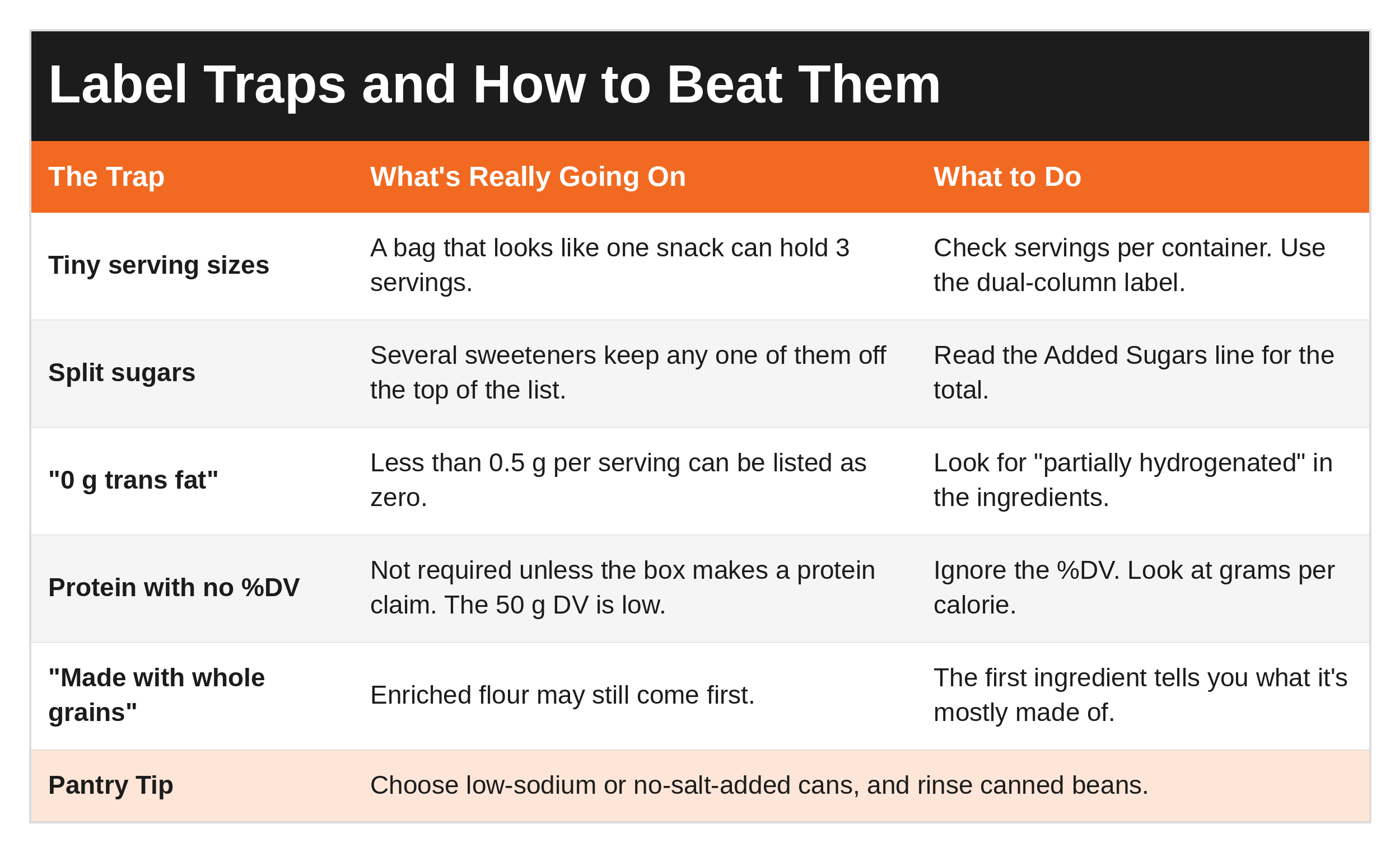
How to protect yourself: read the ingredients. If you see "partially hydrogenated" oil on an older or imported product, put it back (see Part 6: Trans Fats and Seed Oils).
A Label Change That Might Be Coming
In January 2025, the FDA proposed a small "Nutrition Info" box for the front of most packaged foods. It would rate saturated fat, sodium, and added sugars as Low, Med, or High, using the same 5/20 rule you just learned.
Where it stands: it's still a proposal. In March 2026, the FDA said it was reviewing comments and that "everything is on the table," including revising or dropping the rule. As of mid-October 2026, no final rule has been published.
Whatever happens on the front of the package, the Nutrition Facts panel on the back isn't going anywhere. The skills in this post work today and will keep working.
Your 60-Second Label Routine
Here's the order I want you to read every new product.
It becomes automatic after a week.
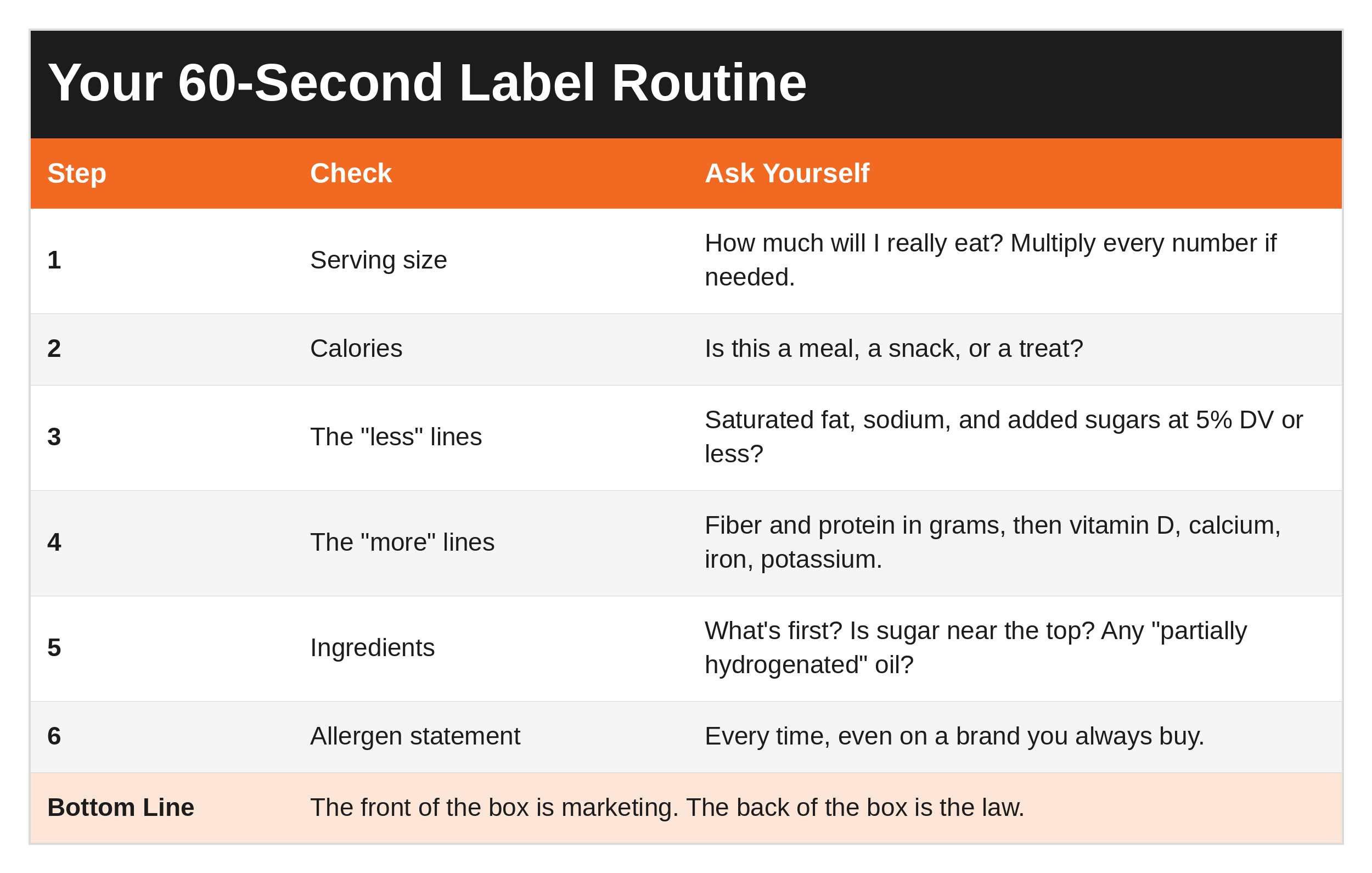
Step 1: Serving size. How much will I really eat? Multiply if needed.
Step 2: Calories. Is this a meal, a snack, or a treat?
Step 3: The "less" lines. Saturated fat, sodium, added sugars. Use the 5/20 rule.
Step 4: The "more" lines. Fiber and protein in grams, then vitamin D, calcium, iron, potassium.
Step 5: The ingredients. What's first? Is sugar near the top? Any "partially hydrogenated" oil?
Step 6: The allergen statement. Every time, if your family has allergies.
Ask Yourself
Do I know how many servings I really eat of the foods I buy most often?
Am I reading the added sugars line, or just total sugars?
Is my emergency pantry high in sodium, and do I have enough water stored to match it?
Am I trusting the front of the box more than the back?
Remember
The front of the box is marketing. The back of the box is the law. Read serving size first, use the 5/20 rule, and always read the ingredients list.
Get Started Today
[FREE DOWNLOAD: TO BE CHOSEN AFTER THE BINDER REVIEW]
Go Deeper
The Prepared Not Paranoid Family Nutrition Guide. This post teaches you to read the label. The guide puts it in your pocket: the One-Page Food Label Cheat Sheet for the fridge and your phone, the "Ingredients to Avoid" wallet card, full chapters on additives and dyes, the barcode-scanning apps that do some of the work for you, and step-by-step pantry math for 30 days of food and water. Buyers also get free updates when these FDA rules change. [Get it here: LINK]
Tools I recommend: The food storage containers and pantry organizers I recommend are in my Amazon store. https://amzn.to/4yM747h
Related reading:
Nutrition Basics, Part 14: Food Label Claims https://www.preparednotparanoid.com/pnp-library/nutrition-lesson-8
Nutrition Basics, Part 9: Ultra-Processed Foods https://www.preparednotparanoid.com/pnp-library/ultra-processed-foods
Toxic Chemicals to Avoid, Part 1: Reading Food Labels and Identifying Toxic Chemicals https://www.preparednotparanoid.com/pnp-library/toxic-chemicals-lesson-1
Toxic Chemicals to Avoid, Part 5: Use Tools Like Yuka https://www.preparednotparanoid.com/pnp-library/toxic-chemicals-lesson-1-9axkp-mxse9-ekwcw-bdger
References
U.S. Food and Drug Administration. How to Understand and Use the Nutrition Facts Label. https://www.fda.gov/food/nutrition-facts-label/how-understand-and-use-nutrition-facts-label
U.S. Food and Drug Administration. The Lows and Highs of Percent Daily Value on the Nutrition Facts Label.
U.S. Food and Drug Administration. Daily Value on the Nutrition and Supplement Facts Labels.
U.S. Food and Drug Administration. Added Sugars on the Nutrition Facts Label.
U.S. Food and Drug Administration. Trans Fatty Acids in Nutrition Labeling: Small Entity Compliance Guide.
U.S. Food and Drug Administration. Food Allergies: What You Need to Know.
U.S. Food and Drug Administration. Food Labeling: Front-of-Package Nutrition Information, Proposed Rule. Federal Register, January 16, 2025.
Truli. FDA Front-of-Package Nutrition Label Rule: 2026 Status Guide. August 2026. https://trytruli.com/blog/fda-front-of-package-nutrition-labeling-rule
U.S. Department of Agriculture and U.S. Department of Health and Human Services. Dietary Guidelines for Americans, 2025 to 2030. January 2026. https://www.dietaryguidelines.gov/
Disclaimer
This article is for general informational and educational purposes only. It is not medical advice and is not a substitute for guidance from your physician or a registered dietitian. If someone in your family has food allergies, high blood pressure, kidney disease, or diabetes, follow your doctor's guidance on sodium, protein, and sugar. Affiliate disclosure: I've linked to products from my Amazon store that I personally recommend. As an Amazon Associate, I earn from qualifying purchases, at no extra cost to you. Thank you for supporting my work.
If someone has trouble breathing, swelling of the face or throat, or other signs of a severe allergic reaction, use their epinephrine auto-injector if they have one and call 911.
Awareness gives you time. Time gives you options.
The prepared protector is someone who's decided that loving someone means being ready for them, not just hoping things go fine.
Prepared Not Paranoid. Protecting the Most Vulnerable Among Us.