Nutrition Basics- Part 9: Ultra-Processed Foods
The Big Picture: How to Spot Them, Swap Them, and Keep Your Pantry Ready
By Larry Betz | Prepared Not Paranoid https://www.preparednotparanoid.com/
Do you know what you are eating?
There have been significant advances in food preparation over the last century. Walk into a typical supermarket today and most of the shelf space is taken up by foods that are pre-packaged or prepared, foods that need little to no preparation before you eat them. That convenience comes with a hidden cost.
Many of these foods are built from refined starches, sugars, and oils, then held together with emulsifiers, flavors, colors, and preservatives. Some of those ingredients are known to cause problems, and others have shown harmful effects in laboratory animals. If a substance can harm animals in controlled studies, there's good reason to be cautious about eating it every day for years.
This post opens the "What to Limit and Avoid" section of the series, because it ties everything else together. Sugar, refined oils, additives, and dyes aren't separate problems. They show up together, in the same kinds of products. Learn to recognize those products and you've already solved most of the problem.
What Are Ultra-Processed Foods?
Almost everything you eat has been processed in some way. Washing lettuce is processing. So is freezing peas, grinding wheat, or canning tomatoes. Processing itself is not the enemy.
The question is how much, and what was added. The most widely used system for answering that is called NOVA, developed by researchers at the University of São Paulo in Brazil. NOVA sorts foods into four groups.
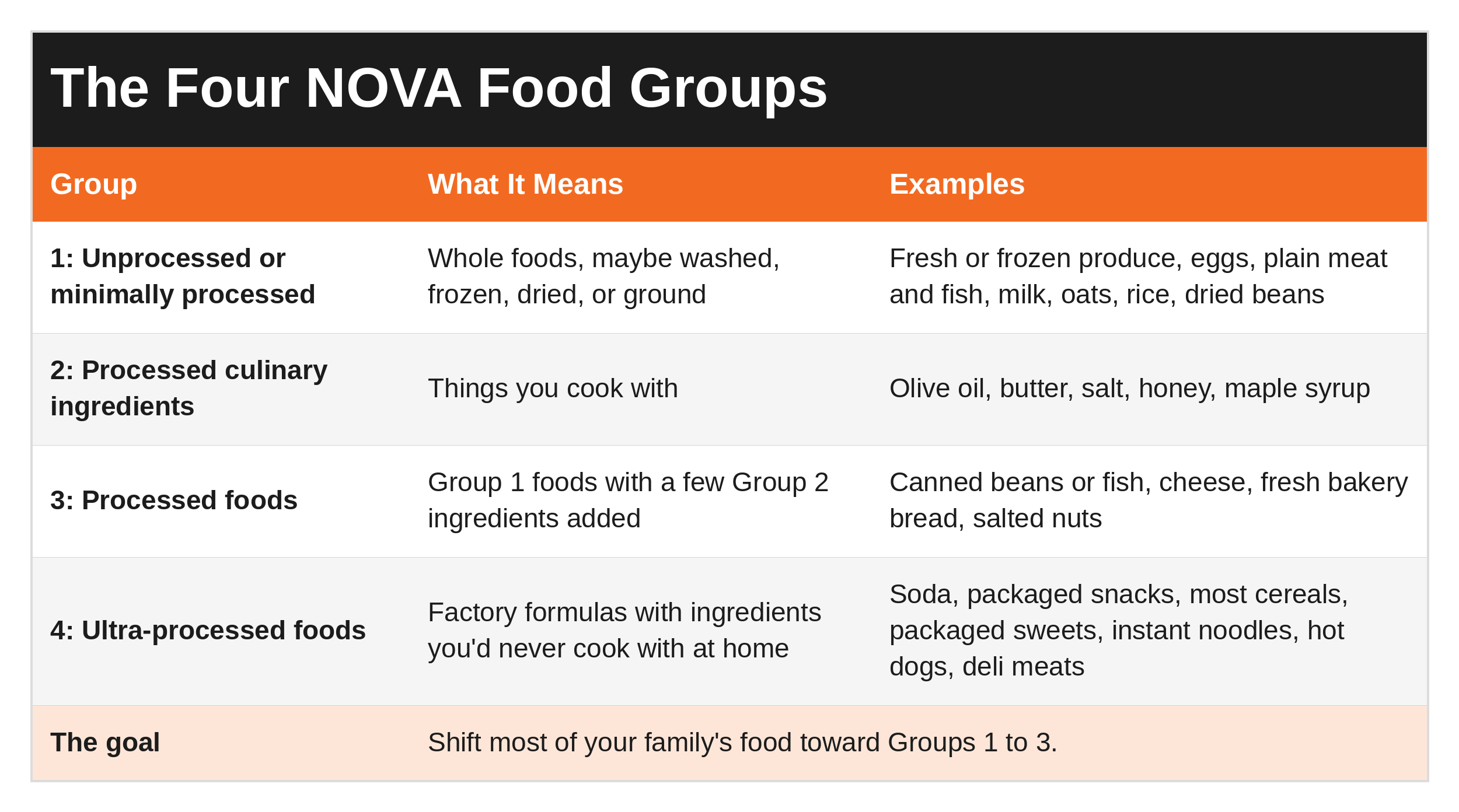
In plain terms: if it couldn't exist without a factory and a list of chemical-sounding ingredients, it's probably ultra-processed.
Is there an official U.S. definition? (Checked October 2026) Not yet. On August 10, 2026, HHS and USDA sent a proposed definition to the White House for final review. The agencies describe it as a research tool, not a regulation, and as of mid-October the text hadn't been released. Until it is, NOVA is the standard most researchers use.
How Much of the American Diet Is Ultra-Processed?
According to the CDC's August 2025 report, 55 percent of the calories Americans eat come from ultra-processed food. For kids and teens ages 1 to 18, it's about 62 percent.
Read that again. For the average American child, nearly two out of every three calories come from ultra-processed food.
The biggest sources for both kids and adults were sandwiches and burgers, sweet bakery products, savory snacks, and sweetened drinks, plus pizza for kids. There's one piece of good news: the share has come down a little since its peak around 2017 to 2018. Families are paying attention. You can be one of them.
Why It Matters for Your Health
Ultra-processed foods are usually high in added sugar, refined starch, sodium, and refined oils, and low in fiber and protein. That alone would be a problem. But the research suggests the issue goes beyond the nutrition label.
They make it easy to overeat. In a tightly controlled 2019 study at the National Institutes of Health, adults spent two weeks on an ultra-processed diet and two weeks on a minimally processed diet. Both offered the same calories, sugar, fat, fiber, and sodium, and people could eat as much as they wanted. On the ultra-processed diet, people ate about 500 more calories a day and gained about two pounds in two weeks. On the minimally processed diet, they lost about the same amount. Same nutrients on paper. Very different result.
The long-term links are consistent. A large 2024 review in the BMJ pulled together studies covering close to 10 million people. Higher intake of ultra-processed food was linked with 32 health problems. The strongest evidence was for death from heart disease, type 2 diabetes, and anxiety and common mental health disorders. These studies show association, not proof that one food causes one disease. But when the pattern is this consistent, the safe bet is to eat less of it.
The health of our nation is directly impacted by what we consume. The consumption of processed foods and additives contributes significantly to the healthcare system's burden as more people suffer from diseases related to poor dietary choices.
What the New Dietary Guidelines Say
The Dietary Guidelines for Americans, 2025 to 2030, released January 7, 2026, are the first edition to call out "highly processed foods" as a category to cut back on. The message is simple: eat real, whole food. They tell families to:
Replace highly processed foods with nutrient-dense meals, at home or eating out.
Avoid sugar-sweetened drinks and salty or sweet packaged snacks.
Significantly reduce refined carbohydrates like white bread.
Limit foods with artificial flavors, petroleum-based dyes, artificial preservatives, and low-calorie sweeteners.
Added sugar: no added sugar for children younger than 11, and no more than 10 grams per meal for teens and adults.
The guidelines don't use the word "ultra-processed," but the foods they tell you to cut are the same Group 4 foods.
How to Spot Ultra-Processed Food on a Label
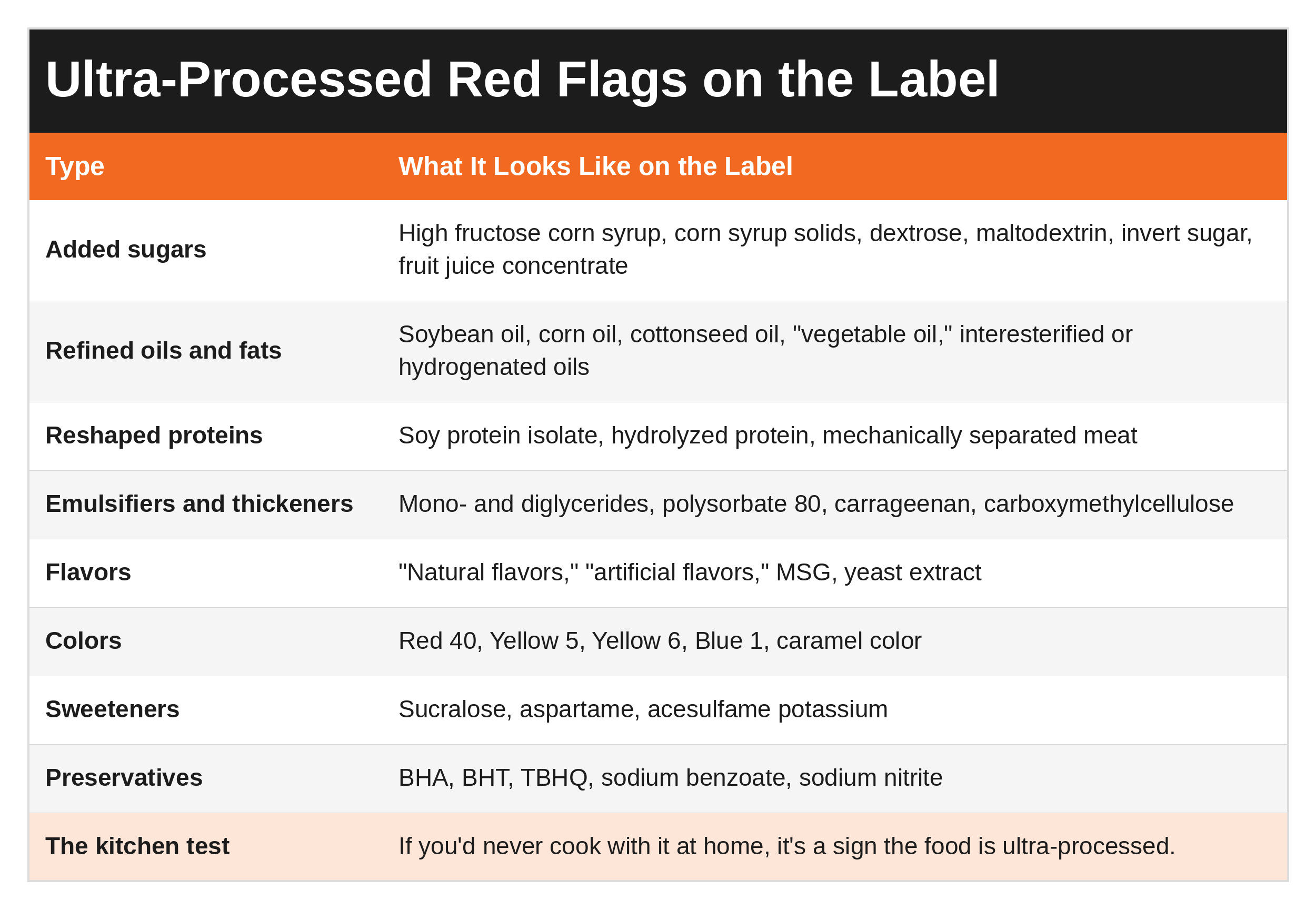
Understanding what you eat begins with reading food labels, and the ingredient list tells you more than the calorie count ever will. You don't need to memorize hundreds of chemicals. Use these five checks.
Step 1: Count the ingredients. A short list of foods you recognize is a good sign. A long list, especially one that runs into a second paragraph, is a warning.
Step 2: Ask, "Would I cook with this?" Olive oil, salt, and garlic, yes. Maltodextrin, soy protein isolate, and mono- and diglycerides, no.
Step 3: Look for the usual suspects. These ingredients show up again and again in ultra-processed foods.
Step 4: Check where sugar sits. Ingredients are listed by weight, most to least. If a sugar is in the first three, or you see three or more different sugars, put it back.
Step 5: Ignore the front of the box. "Natural," "made with whole grains," "keto," "plant-based," and "high protein" are marketing. A protein bar can be every bit as ultra-processed as a candy bar. The ingredient list is the truth.
Shop the Edges, but Stay Alert
One of the most effective ways to reduce your exposure is to shop mostly in the produce, dairy, meat, and seafood sections, the outer edges of most stores, where whole and minimally processed foods are more common.
However, vigilance is still necessary. Additives, antibiotics, and pesticide residues can still be found in conventionally produced meats, dairy products, and even some fruits and vegetables. Deli meats, flavored yogurts, and marinated "ready to cook" meats sit in those same outer aisles and are often ultra-processed.
Whenever possible, choose organic, locally sourced, and pasture-raised options. But be aware: the label "Certified Organic" doesn't always mean what it used to. Many small organic farms have been bought by large food companies, and practices can change while the label stays the same. Organic junk food is still junk food.
Stay vigilant. Know your farmer when you can. Question your labels. And stay informed, because what's allowed today might not be safe tomorrow.
Simple Swaps That Make a Big Difference
You don't have to overhaul your kitchen in a weekend. Start with the foods your family eats most often:
Soda or sweet tea: sparkling water with citrus, or unsweetened iced tea
Flavored yogurt: plain whole-milk yogurt with berries and a little honey
Sugary cereal: plain or steel-cut oats with fruit and nuts
Deli meat and hot dogs: home-roasted chicken or beef, sliced for the week
Chips and snack cakes: nuts, cheese, fruit, or popcorn popped at home
Bottled dressing: olive oil, vinegar or lemon, salt, pepper, and herbs
The one-swap rule: pick one swap a week. In three months, you've changed a dozen habits, and nobody in the house felt like they were "on a diet." And let the kids help cook. Kids eat what they help make.
Why This Matters in an Emergency
Here's where most preparedness advice goes wrong. People hear "emergency food" and fill a closet with whatever lasts longest: snack cakes, sugary cereal, ramen, and buckets of meals full of maltodextrin and refined oil.
Shelf-stable doesn't have to mean ultra-processed. Many of the best emergency foods are minimally processed foods that happen to last a long time.
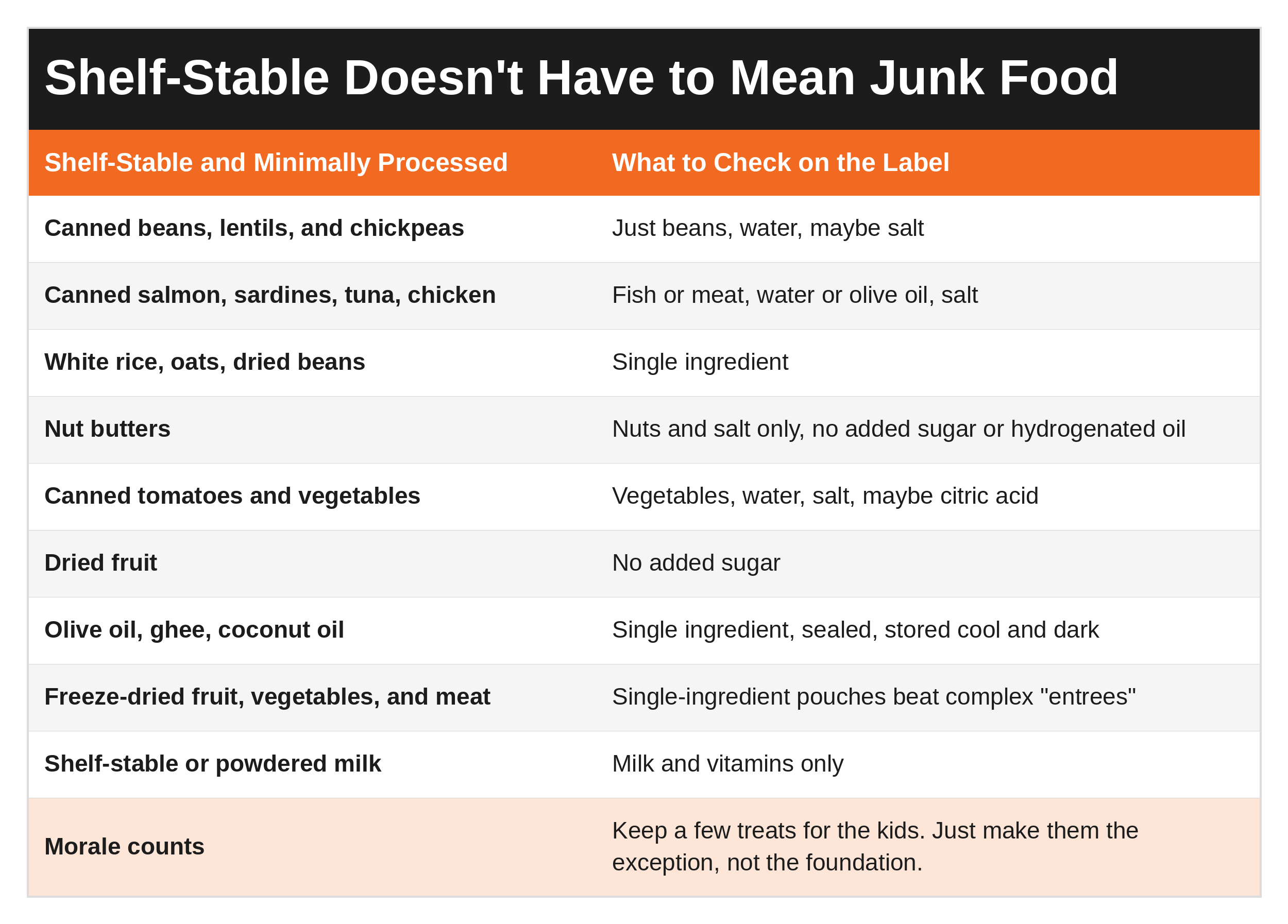
Why does this matter when the power is out? Because stress, poor sleep, and physical work all increase what your body needs. A diet of sugar and refined starch leaves you with energy crashes, poor focus, and constipation right when you need to think clearly. Real food keeps you steady. And keep your rotation going: new food goes to the back, older food moves to the front, and you eat from the front.
Ask Yourself
How many of the calories in my house come from a box, bag, or bottle?
Which ultra-processed food does my family lean on most, and what would we swap it for?
If the power went out tonight, would my pantry keep us healthy, or just keep us full?
Remember
You don't need to fear every package in the store. Learn to read the ingredient list, build your meals around real food, and let shelf-stable mean whole food, not junk food.
Get Started Today
[FREE DOWNLOAD: TO BE CHOSEN AFTER THE BINDER REVIEW]
Go Deeper
The Prepared Not Paranoid Family Nutrition Guide. This post teaches you to spot ultra-processed food. The guide gives you the tools to live without it: a complete swap table for every meal, a One-Page Food Label Cheat Sheet and "Ingredients to Avoid" wallet card for the store, full chapters on sugar, additives, and dyes, eating well on a budget, and a whole-food emergency pantry plan with 15 shelf-stable recipes. [Get it here: LINK]
Tools I recommend: The food storage containers and kitchen tools I recommend are in my Amazon store. https://amzn.to/4yM747h
Related reading:
Toxic Chemicals to Avoid: Introduction https://www.preparednotparanoid.com/pnp-library/toxic-chemicals-intro
Nutrition Basics, Part 6: Trans Fats and Seed Oils https://www.preparednotparanoid.com/pnp-library/nutrition-lesson-5
Nutrition Basics, Part 10: Sugar and High Fructose Corn Syrup https://www.preparednotparanoid.com/pnp-library/nutrition-lesson-6-8gd54
Toxic Chemicals to Avoid, Part 5: Use Tools Like Yuka https://www.preparednotparanoid.com/pnp-library/toxic-chemicals-lesson-1-9axkp-mxse9-ekwcw-bdger
References
Centers for Disease Control and Prevention, National Center for Health Statistics. Ultra-processed Food Consumption in Youth and Adults: United States, August 2021 to August 2023. NCHS Data Brief No. 536, August 2025. https://www.cdc.gov/nchs/products/databriefs.htm
U.S. Department of Agriculture and U.S. Department of Health and Human Services. Dietary Guidelines for Americans, 2025 to 2030. Released January 7, 2026. https://www.dietaryguidelines.gov/
Centers for Disease Control and Prevention. Get the Facts: Added Sugars. https://www.cdc.gov/nutrition/data-statistics/added-sugars.html
Monteiro CA, et al. Ultra-processed foods: what they are and how to identify them. Public Health Nutrition 22(5):936 to 941, 2019.
Hall KD, et al. Ultra-Processed Diets Cause Excess Calorie Intake and Weight Gain: An Inpatient Randomized Controlled Trial of Ad Libitum Food Intake. Cell Metabolism 30(1):67 to 77, 2019.
Lane MM, et al. Ultra-processed food exposure and adverse health outcomes: umbrella review of epidemiological meta-analyses. BMJ 384:e077310, 2024.
Greenberg Traurig. More Than Research: Why the Coming Federal Definition of Ultra-Processed Foods Matters. October 2026. https://www.gtlaw.com/en/insights/2026/10/more-than-research-why-the-coming-federal-definition-of-ultra-processed-foods-matters
Disclaimer
This article is for general informational and educational purposes only. It is not medical advice and is not a substitute for guidance from your physician or a registered dietitian. If someone in your family has diabetes, kidney disease, food allergies, or takes medications that interact with food, talk with your doctor before making big changes. Affiliate disclosure: I've linked to products from my Amazon store that I personally recommend. As an Amazon Associate, I earn from qualifying purchases, at no extra cost to you. Thank you for supporting my work.
In a medical emergency, call 911.
Awareness gives you time. Time gives you options.
The prepared protector is someone who's decided that loving someone means being ready for them, not just hoping things go fine.
Prepared Not Paranoid. Protecting the Most Vulnerable Among Us.