Nutrition Basics- Part 11: Caffeine and Energy Drinks
Safe Limits for Every Family Member, What to Say to Your Teen, and Coffee for When the Power Goes Out
By Larry Betz | Prepared Not Paranoid https://www.preparednotparanoid.com/
Your morning coffee is fine. The can in your teenager's backpack is a different story.
For most healthy adults, a reasonable amount of caffeine is not a problem. It sharpens focus and makes an early morning more bearable.
The trouble starts when we lose track of how much we're getting. Caffeine now shows up in coffee, tea, soda, energy drinks, pre-workout powders, "energy" waters, and even some medicines. A single large energy drink or scoop of pre-workout can deliver as much caffeine as three or four cups of coffee. And the people most likely to be drinking those products, teenagers, are the people least able to handle it.
This post gives you the numbers, the limits for each family member, and a plan for your emergency pantry.
How Much Is Too Much?
The FDA cites 400 milligrams (mg) a day for healthy adults as an amount not generally associated with negative effects. That's roughly two to three 12-ounce cups of brewed coffee. People vary widely in how sensitive they are and how fast they clear caffeine from the body, so your personal limit may be lower.
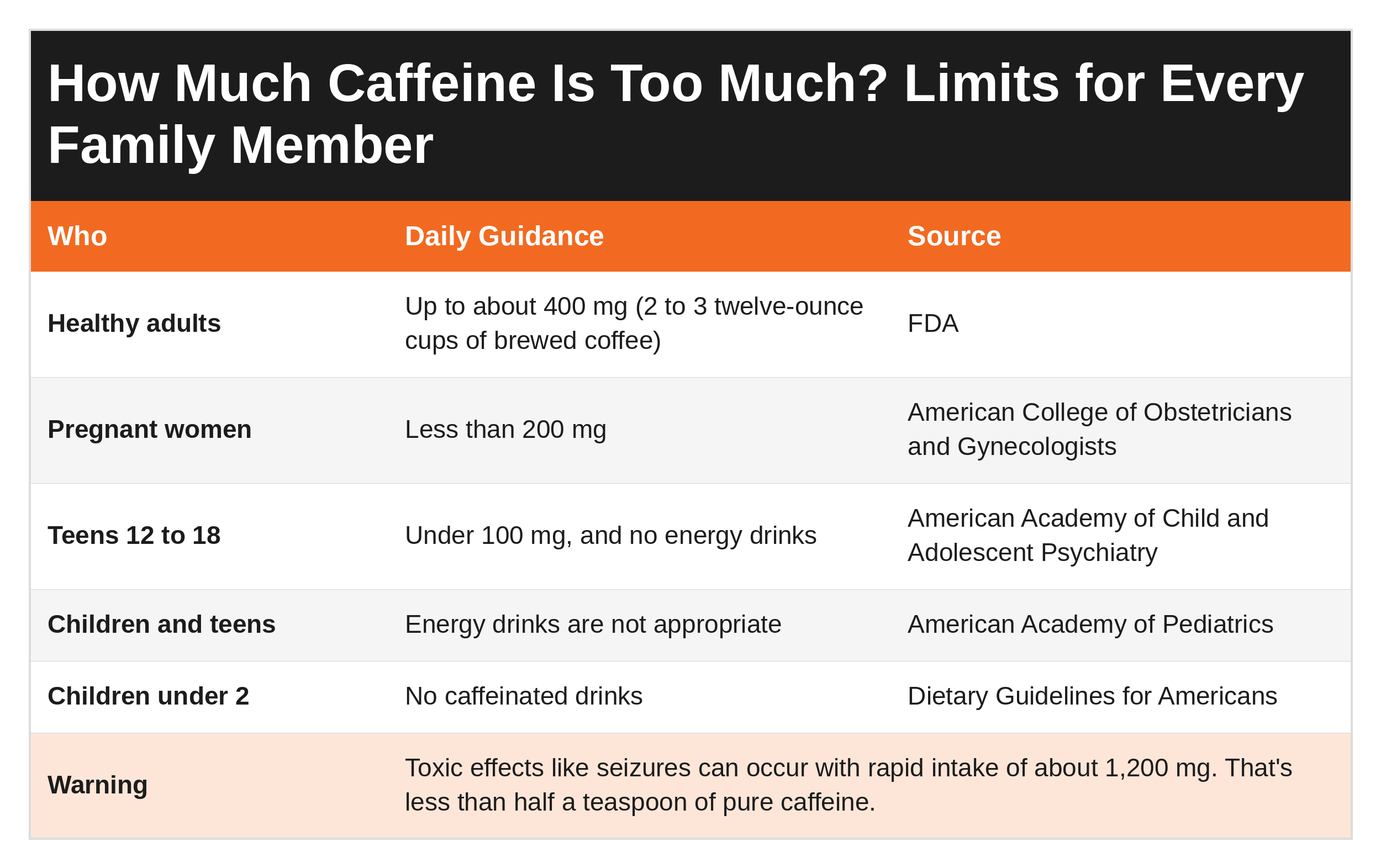
If you are pregnant, trying to become pregnant, or breastfeeding, talk with your doctor about your caffeine limit. The same goes if you have a heart rhythm problem, high blood pressure, or anxiety, or if you take medicines that interact with caffeine.
How Much Caffeine Is in Your Drink?
These are typical amounts. The real number can vary a lot by brand, brewing method, and serving size, so check the label when you can.
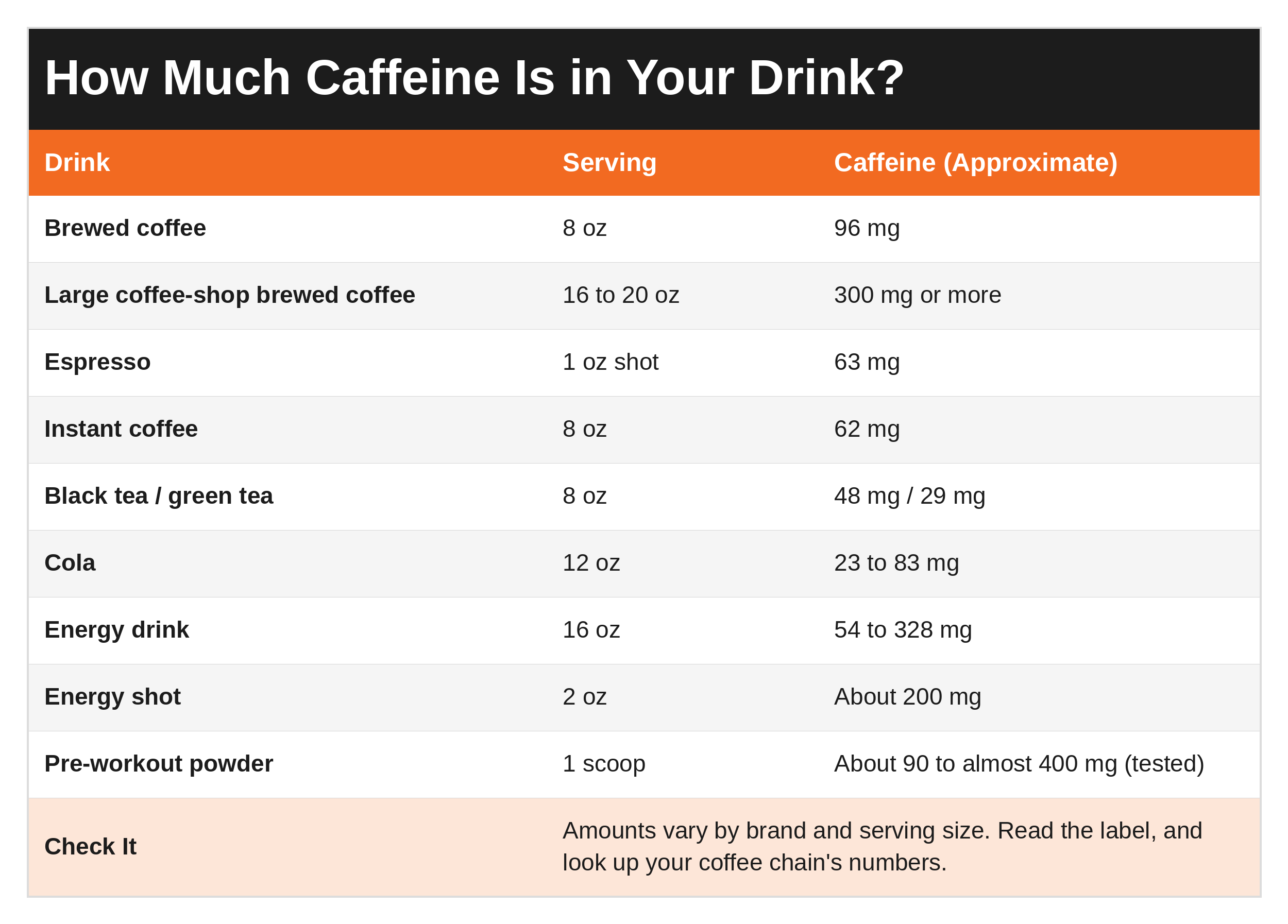
Pay attention to the last row. When Griffith University researchers in Australia tested 15 popular pre-workout supplements, they measured anywhere from about 90 mg to almost 400 mg of caffeine per serving, and the amount varied even between batches of the same product. Some labels didn't list the caffeine content at all. One scoop can put you near a full day's limit before you've had your first cup of coffee.
The coffee-shop trap: a large brewed coffee from a coffee chain can carry 300 mg or more on its own. Add an afternoon energy drink and you're past the limit.
Why Energy Drinks Are a Family Safety Issue
In 2011, the American Academy of Pediatrics concluded that energy drinks are not appropriate for children and adolescents and should not be consumed by them. The FDA says the same: medical experts advise against energy drinks for children and teens.
Why the concern?
Kids are more sensitive. Smaller bodies and developing brains make caffeine's effects stronger.
The doses are high and easy to stack. Some large cans carry 300 mg, and a teen might add a coffee drink and a pre-workout on the same day.
The side effects are real. Johns Hopkins Medicine lists sleep problems, anxiety and panic attacks, rapid heart rate, high blood pressure, irregular heart rhythms, and, after heavy use, seizure
The FDA estimates that toxic effects like seizures can occur with rapid consumption of about 1,200 mg of caffeine. Few people get there with coffee, but it can happen fast with energy drinks, energy shots, and caffeine pills during exam cramming or a long overnight drive.
Pure powdered and concentrated liquid caffeine have no place in a family home. According to the FDA, 1,200 mg is less than half a teaspoon of pure caffeine. If you find one of these products, get rid of it.
Energy drinks and alcohol are a dangerous mix. Caffeine can mask how drunk you feel without lowering how drunk you are, which makes people more likely to keep drinking, drive, or take other risks. Talk with your college-age kids about this one specifically. (More on this in Part 12: Alcohol.)
Other countries are acting. In July 2026, the UK government confirmed that England will ban the sale of high-caffeine energy drinks to anyone under 16, starting in April 2027. There's no similar law in the U.S. Here, the protection starts at home.
What to Say to Your Teen
Teens respond better to straight talk than to a lecture. Try something like:
"One of those cans can have as much caffeine as three cups of coffee. That's an adult's whole day."
"If you're tired, the problem is sleep. Caffeine just borrows energy from tomorrow."
"If your heart is ever racing or you feel shaky and panicky after one of those, stop and tell me right away."
For young athletes, the AAP's advice is simple: for most kids doing routine physical activity, plain water is best.
Caffeine, Sleep, and Your Readiness
Caffeine's biggest hidden cost is sleep, and sleep is the foundation of your readiness.
In a 2013 study in the Journal of Clinical Sleep Medicine, researchers at Henry Ford Hospital and Wayne State University gave healthy adults 400 mg of caffeine at bedtime, 3 hours before bed, or 6 hours before bed. Even caffeine taken 6 hours before bed cut total sleep by more than an hour, and the participants didn't realize how much sleep they had lost.
The practical rule: set a caffeine cutoff at least six hours before bedtime. If you go to bed at 10 p.m., your last cup is at 4 p.m. or earlier. For teens, earlier is better.
If you depend on caffeine to function, you are only as ready as your supply.
Coffee and Tea in Your Emergency Pantry
Morale matters. In a power outage or any long stretch of stress, a hot cup of coffee or tea is a small piece of normal life that brings the family to the table.
There's a practical side, too. Daily coffee drinkers who suddenly stop can get withdrawal headaches, fatigue, and irritability. The FDA notes that withdrawal isn't dangerous, but an emergency is the worst time to feel foggy and short-tempered.
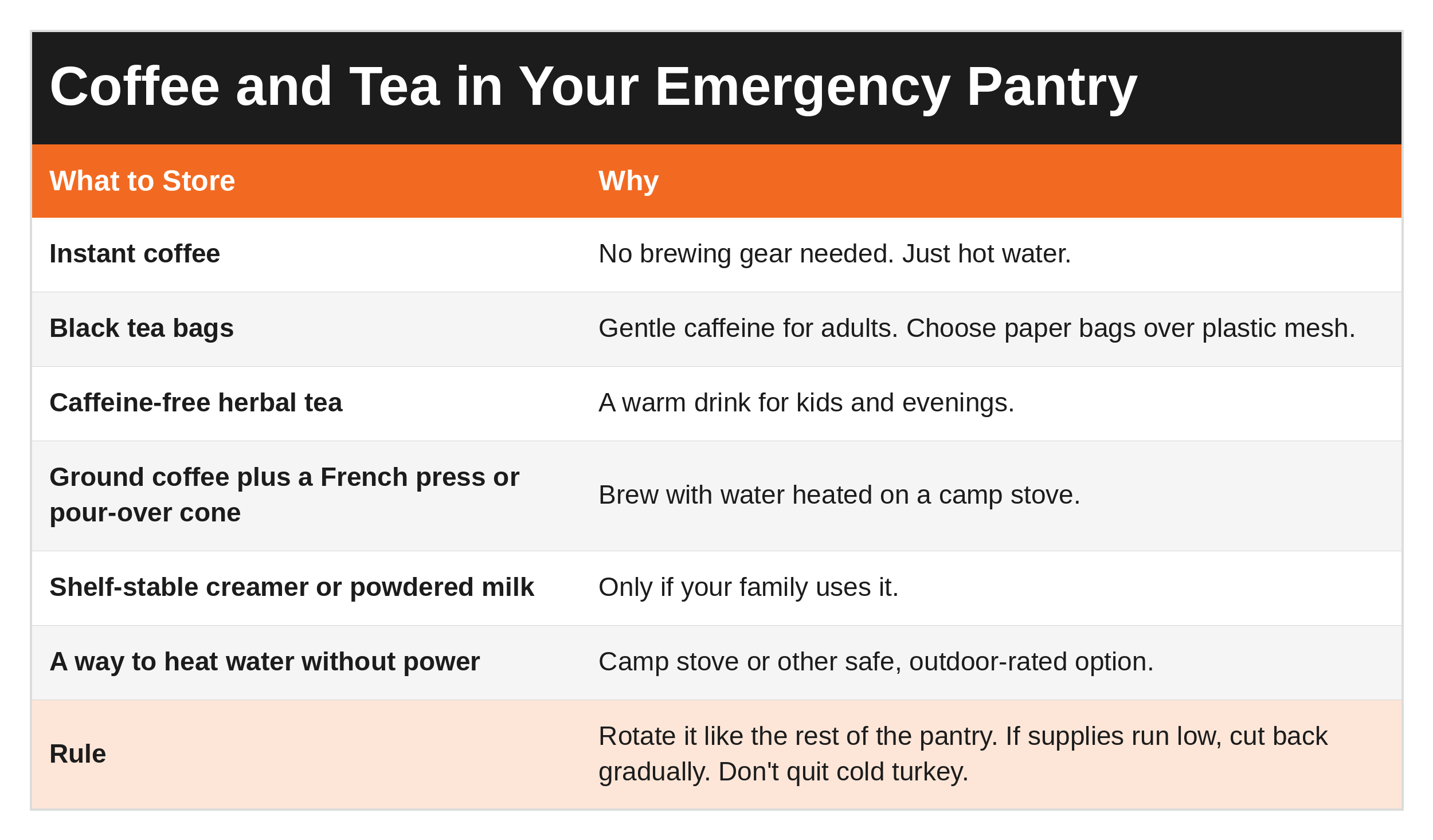
Ration caffeine, don't quit it. If supplies are tight, cut back gradually instead of stopping all at once. Going from three cups a day to one is much easier on your head than going from three to zero. And keep your rotation going: new food goes to the back, older food moves to the front, and you eat from the front.
Start Here This Week
Step 1: Add up your caffeine for one normal day, including coffee, soda, tea, and any supplements. Are you under 400 mg?
Step 2: Check every energy drink and pre-workout product in your house for caffeine per serving.
Step 3: Have the energy drink conversation with your teens, using the lines above.
Step 4: Set a caffeine cutoff time at least six hours before bed.
Step 5: Add instant coffee and tea to your emergency pantry, plus a way to heat water without power.
Ask Yourself
Do I know how much caffeine is in the drinks my kids buy on their own?
Am I using caffeine to cover up a sleep problem?
If my coffee supply ran out in an emergency, how would I feel on day two?
Remember
Caffeine is a tool, not a substitute for sleep. Keep adults under 400 mg, keep energy drinks away from kids, and keep a jar of instant coffee in the pantry for the morning the power goes out.
Get Started Today
[FREE DOWNLOAD: TO BE CHOSEN AFTER THE BINDER REVIEW]
Go Deeper
The Prepared Not Paranoid Family Nutrition Guide. This post covers caffeine. The guide covers everything else your family drinks and eats, with full chapters on sugar and sweeteners, alcohol, feeding teens and young athletes, cooking when the power is out, and a whole-food emergency pantry plan your family will actually use. [Get it here: LINK]
Tools I recommend: The French press, camp stove, and food storage gear I recommend are in my Amazon store. https://amzn.to/4yM747h
Related reading:
Nutrition Basics, Part 10: Sugar and High Fructose Corn Syrup https://www.preparednotparanoid.com/pnp-library/nutrition-lesson-6-8gd54
Nutrition Basics, Part 12: Alcohol https://www.preparednotparanoid.com/pnp-library/nutrition-lesson-9
Nutrition Basics, Part 9: Ultra-Processed Foods https://www.preparednotparanoid.com/pnp-library/ultra-processed-foods
References
U.S. Food and Drug Administration. Spilling the Beans: How Much Caffeine Is Too Much? https://www.fda.gov/consumers/consumer-updates/spilling-beans-how-much-caffeine-too-much
American College of Obstetricians and Gynecologists. Committee Opinion No. 462: Moderate Caffeine Consumption During Pregnancy. 2010 (reaffirmed).
Committee on Nutrition and the Council on Sports Medicine and Fitness. Sports Drinks and Energy Drinks for Children and Adolescents: Are They Appropriate? Pediatrics 127(6):1182 to 1189, 2011.
Johns Hopkins Medicine. Energy Drinks and Kids: What You Need to Know.
Mayo Clinic. Caffeine Content for Coffee, Tea, Soda and More.
Desbrow B, et al. Caffeine content of pre-workout supplements commonly used by Australian consumers. Drug Testing and Analysis, 2019. https://research-repository.griffith.edu.au/items/8a532f50-d25b-4a47-b1fa-33af6bc00038
Drake C, et al. Caffeine Effects on Sleep Taken 0, 3, or 6 Hours before Going to Bed. Journal of Clinical Sleep Medicine 9(11):1195 to 1200, 2013.
Grocery Gazette. England to ban energy drink sales to under-16s from April 2027. July 17, 2026. https://www.grocerygazette.co.uk/2026/07/17/england-to-ban-energy-drink-sales/
Disclaimer
This article is for general informational and educational purposes only. It is not medical advice and is not a substitute for guidance from your physician. If you are pregnant or breastfeeding, have a heart condition, high blood pressure, or anxiety, or take medications, talk with your doctor about caffeine. Affiliate disclosure: I've linked to products from my Amazon store that I personally recommend. As an Amazon Associate, I earn from qualifying purchases, at no extra cost to you. Thank you for supporting my work.
If someone has a racing heart, chest pain, seizure, or trouble breathing after caffeine or an energy drink, call 911.
Awareness gives you time. Time gives you options.
The prepared protector is someone who's decided that loving someone means being ready for them, not just hoping things go fine.
Prepared Not Paranoid. Protecting the Most Vulnerable Among Us.