Nutrition Basics- Part 17: Your Food P.A.C.E. Plan
How Much to Store, How to Store It, and How to Rotate It
By Larry Betz | Prepared Not Paranoid https://www.preparednotparanoid.com/
Most families who store food have no idea how long it would last. They have "a lot of cans" and "a few cases of water." That feels prepared until you do the math and find out it's nine days, not thirty.
This is the last post in the Nutrition Basics series, and it pulls everything together: what you eat (Parts 1 to 12), how you shop (Parts 13 to 15), and how you store it (Part 16). By the end, you'll have a simple plan with layers and a real number for your family.
Build Your Food P.A.C.E. Plan
PACE stands for Primary, Alternate, Contingency, and Emergency. It's a simple planning tool used in emergency communications: if your first plan fails, you already know your second, third, and fourth.
It works just as well for food. Here's how the four layers work for food.
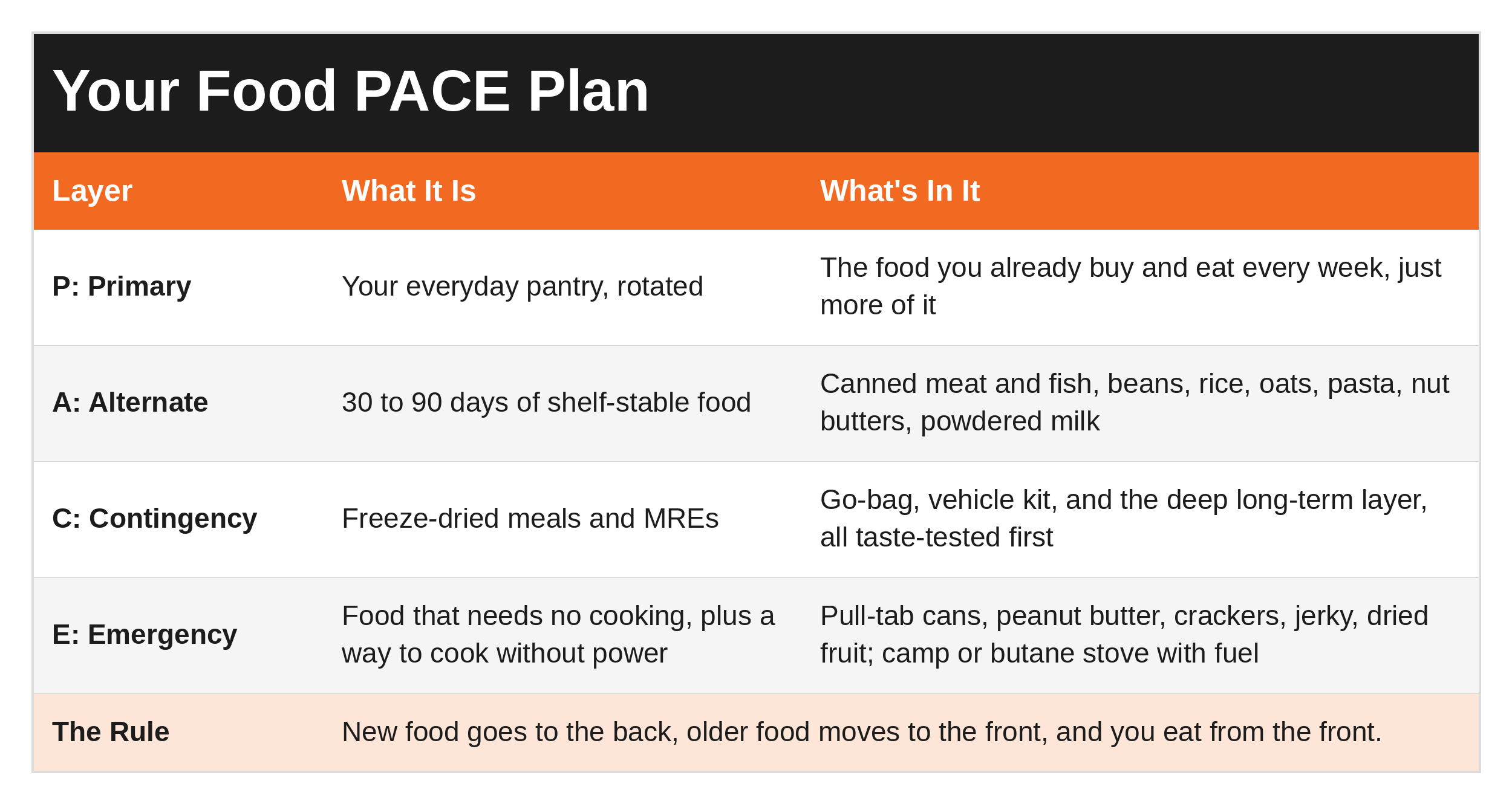
Why layers matter: each layer is complete on its own. Start with 14 days in your Primary pantry, then build toward 30 and 90 in your Alternate layer. Add Contingency food as your budget allows. And make sure your Emergency layer is ready tonight, because the power doesn't wait for you to finish your plan.
The rotation rule ties all four layers together: new food goes to the back, older food moves to the front, and you eat from the front. (For what to buy, how to store it, and how to choose between freeze-dried food and MREs, see Part 16.)
Calculating Food Necessities
Calculating how much food two people would need for a 30-day emergency supply involves both reading food serving labels and considering personal eating habits. Here's a step-by-step approach to ensure you have enough to not just survive but thrive during an emergency:
Understanding Serving Sizes
First, familiarize yourself with food serving labels. Each label provides information about the number of servings per container and the nutritional content per serving. For example, a can of Costco canned roast beef might indicate that it contains four servings. However, serving sizes on labels are often smaller than what people typically consume in a single meal. (See Part 13: How to Read a Nutrition Facts Panel.)
Estimating Personal Consumption
Next, assess your personal consumption. If you know from experience that you typically eat an entire can of roast beef in one meal, adjust the serving size accordingly. This means that instead of the label's four servings, you should consider it as one serving for your planning purposes. Track your typical daily intake for various foods over a week to get a realistic picture of your needs.
Calculating Total Needs
To calculate the total amount of food needed for two people for 30 days, follow these steps:
Step 1: List Daily Food Items. Identify the specific foods you plan to include in your emergency supply. Include breakfast, lunch, dinner, and snacks.
Step 2: Adjust for Actual Consumption. Note the actual amount you and your partner eat for each item. For example, if you both eat a can of roast beef for one meal, that's two cans per meal.
Step 3: Daily Totals. Sum up the total servings needed per day for both people. For instance, if you need two cans of roast beef for one meal and plan to eat it three times a week, that's six cans per week.
Step 4: Multiply by 30 Days. Multiply your daily totals by 30 to determine the monthly requirement. Using the roast beef example, six cans per week works out to 6 x 30 / 7 = 25.7, so you'll need 26 cans for the month. (It's tempting to multiply by 4 weeks and get 24, but 30 days is about 4.3 weeks. Always work in daily amounts and multiply by 30. If something is weekly, divide by 7 first, and round up.)
Step 5: Consider Nutritional Balance. While calculating quantities, ensure a balanced diet by including a variety of foods with proteins carbohydrate, fat, fruit, and vegetable options. This not only ensures nutritional adequacy but also prevents monotony; both make it easier to maintain good health and morale during an emergency. (Use the shopping list in Part 16.)
Step 6: Adjust and Monitor. Regularly review and adjust your calculations based on actual consumption and preferences. Conduct periodic checks of your food supply, ensuring you have enough variety and quantity to sustain you through an emergency.
Example Calculation (Two People, 30 Days)
Breakfast: Oatmeal: 1 cup per person, 2 cups per day (60 cups for 30 days). Canned fruit: 1 can per person, 2 cans per day (60 cans for 30 days).
Lunch: Canned soup: 2 cans per person, 4 cans per day (120 cans for 30 days).
Dinner: Roast beef: 1 can per person, 2 cans per day (60 cans for 30 days). Canned vegetables: 1 can per person, 2 cans per day (60 cans for 30 days).
Snacks: Granola bars: 2 bars per person, 4 bars per day (120 bars for 30 days).
Check It Against Real Targets
Counting cans is a great start. To know your food will actually keep your family strong, check it against two numbers: calories and protein.
Know Your Daily Targets
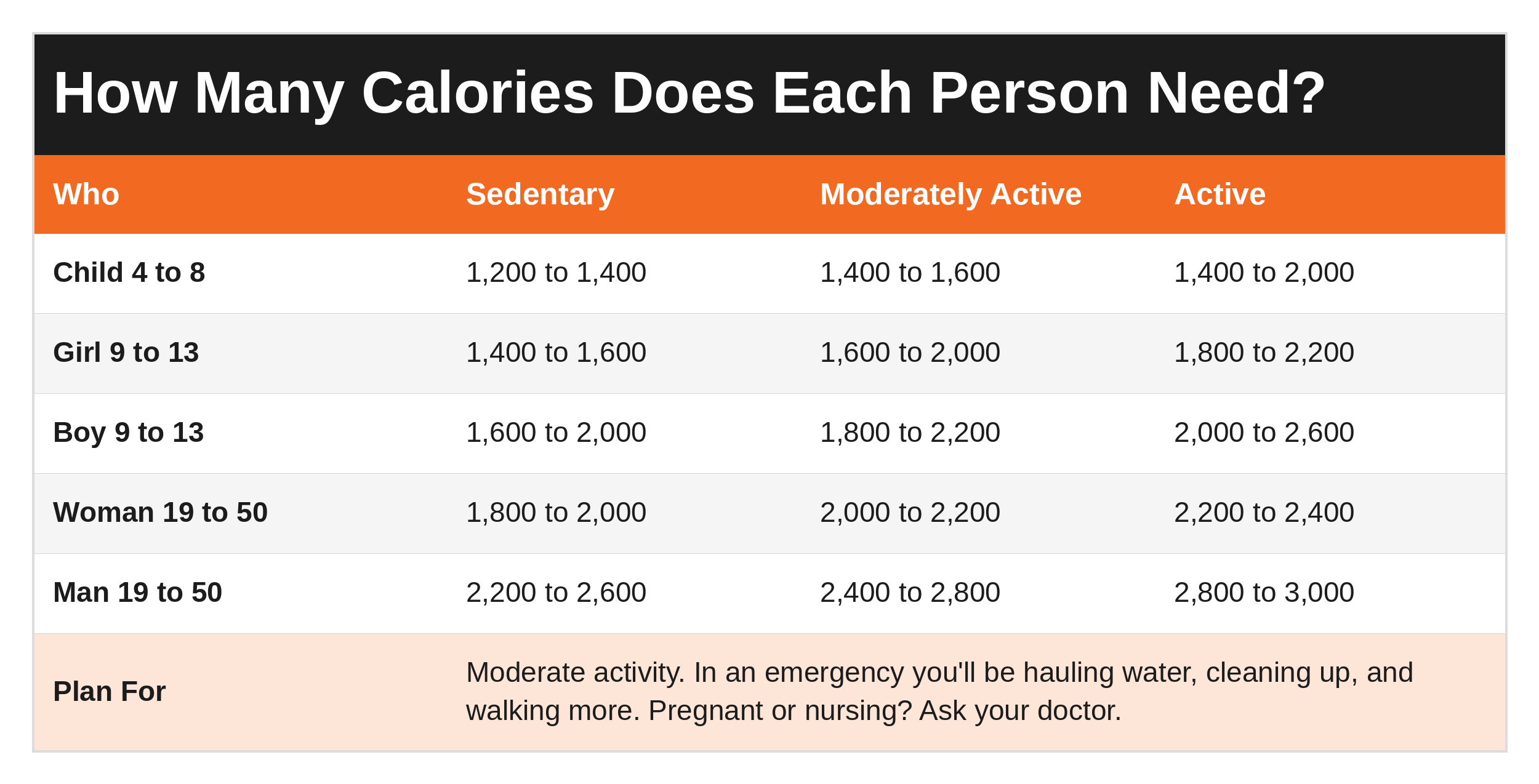
Calories are fuel. During an emergency, plan for at least moderate activity: you'll be hauling water, cleaning up, walking more, and dealing with heat or cold. The Dietary Guidelines for Americans publish estimated calorie needs by age, sex, and activity.
Here's a shortened version.
Protein protects muscle, supports your immune system, and keeps you full. My standard is 1 gram of protein per pound of goal body weight per day for adults. Kids need less: plan about 0.5 gram per pound of their current healthy weight, and check with your pediatrician if you have questions. If you have kidney disease, talk to your doctor before increasing protein.
Here's what that looks like: a family of four (Dad, Mom, a 12-year-old, and a 9-year-old) needs about 8,400 calories and 400 grams of protein a day. For 30 days, that's about 252,000 calories. Add up the calories and protein on your labels and see how many days your pantry really covers.
Don't Forget Water
Plan on 1 gallon per person per day as the minimum, and up to 2 gallons in a hot climate like Arizona or if you're physically active.
The CDC says to store more for pregnant or nursing women, people who are sick, and pets. Add your pets.
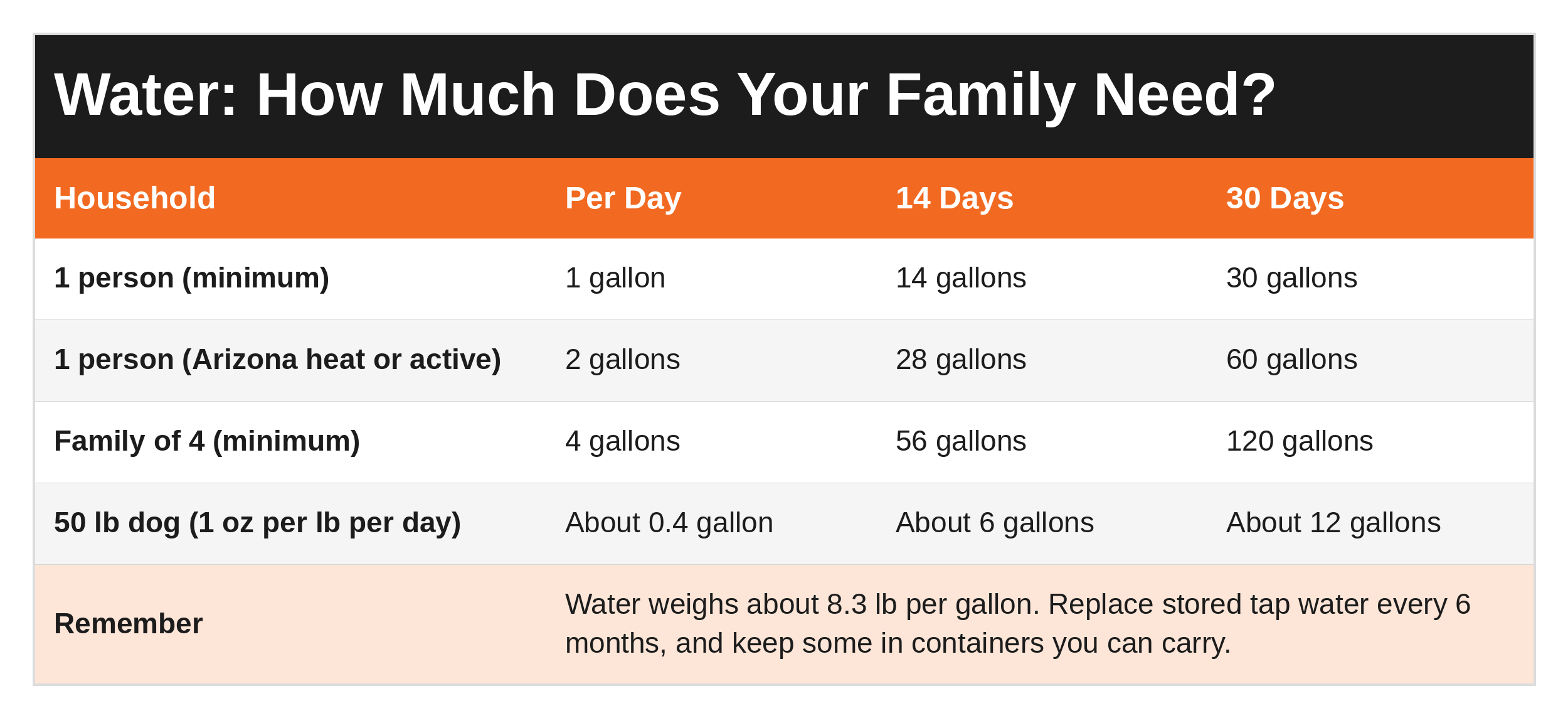
My recommended minimum is 14 days of food and water. The 30-day number is the goal you build toward.
By carefully calculating your needs based on actual consumption rather than just relying on serving sizes, you can ensure you have a well-stocked emergency supply that will keep you healthy and satisfied during any crisis.
Start Here This Week
Step 1: Write down each family member's age, goal weight, and activity level.
Step 2: Look up daily calories for each person and add them up.
Step 3: Track one normal week of the shelf-stable foods your family eats.
Step 4: Fill in the free Family Food Supply Worksheet below.
Step 5: Set a calendar reminder to review your plan every 3 months.
Ask Yourself
How many days would our current food really last, by calories, not by counting cans?
Are we planning by what's on the label or by what we really eat?
Is our Emergency layer ready tonight if the power goes out?
How many gallons of water do we have right now, and how many days is that?
Remember
Work in daily amounts, multiply by your number of days, and round up. A real number beats a good feeling every time.
Get Started Today
FREE DOWNLOAD: The Family Food Supply Worksheet. Five simple steps to turn "we should have some food put away" into a real number for 14, 30, or 90 days. It includes a household calorie and protein table, a one-day food builder, a shopping list converter, a water calculator for people and pets, your Food PACE Plan checklist, and a rotation log. Print it, grab a pencil, and sit down with your family. [Download it here: LINK]
Go Deeper
The Prepared Not Paranoid Family Nutrition Guide. The worksheet gives you the numbers. The guide shows you exactly how to fill them in, with a complete worked example for a family of four plus a dog (every food, every can, every gallon), the full Shelf-Life Chart, a 14-Day Shelf-Stable Menu, 15 no-power pantry recipes, cooking when the power is out, and special diets in an emergency. [Get it here: LINK]
Tools I recommend: The water containers, food-grade buckets, can rotation racks, and camp stoves I recommend are in my Amazon store. https://amzn.to/4yM747h
Related reading:
Nutrition Basics: Introduction https://www.preparednotparanoid.com/pnp-library/nutrition-lesson-intro
Nutrition Basics, Part 16: Shop for Emergencies the Smart Way https://www.preparednotparanoid.com/pnp-library/nutrition-lesson-10
Nutrition Basics, Part 15: Eating Well on a Budget https://www.preparednotparanoid.com/pnp-library/eating-well-on-a-budget
Nutrition Basics, Part 2: Protein https://www.preparednotparanoid.com/pnp-library/nutrition-lesson-2
Water Series, Part 3: Water Storage https://www.preparednotparanoid.com/pnp-library/water-storage
References
U.S. Department of Agriculture and U.S. Department of Health and Human Services. Dietary Guidelines for Americans, Estimated Calorie Needs per Day by Age, Sex, and Physical Activity Level. https://www.dietaryguidelines.gov/
U.S. Department of Agriculture, Agricultural Research Service. FoodData Central. https://fdc.nal.usda.gov/
Centers for Disease Control and Prevention. Creating and Storing an Emergency Water Supply.
FEMA, Ready.gov. Water and Food. https://www.ready.gov/water and https://www.ready.gov/food
American Red Cross. Survival Kit Supplies.
Disclaimer
This article is for general informational and educational purposes only. It is not medical advice. Calorie and protein needs vary. If anyone in your family is pregnant, breastfeeding, has kidney disease, diabetes, food allergies, or follows a medical diet, talk with your doctor before making changes. Affiliate disclosure: I've linked to products from my Amazon store that I personally recommend. As an Amazon Associate, I earn from qualifying purchases, at no extra cost to you. Thank you for supporting my work.
In a medical emergency, call 911.
Awareness gives you time. Time gives you options.
The prepared protector is someone who's decided that loving someone means being ready for them, not just hoping things go fine.
Prepared Not Paranoid. Protecting the Most Vulnerable Among Us.