Nutrition Basics- Part 8: Fiber and Gut Health
The Nutrient Almost Every Family Is Short On, and One of the Easiest to Fix
By Larry Betz | Prepared Not Paranoid https://www.preparednotparanoid.com/
Protein gets the headlines. Fiber does the quiet work.
Fiber keeps you regular, feeds the healthy bacteria in your gut, slows the rise in blood sugar after a meal, helps lower cholesterol, and keeps you full longer. Large studies link higher fiber intake with a lower risk of heart disease, stroke, type 2 diabetes, and colorectal cancer.
And yet most American families get only about half the fiber they need.
In an emergency, fiber matters even more. Stress, travel, changes in routine, less water, and a diet of packaged food are a recipe for constipation, and constipation is miserable when the power is out or the plumbing isn't working. A family that eats enough fiber every day, and stores fiber-rich foods they already like, is a family that stays comfortable when life gets disrupted.
The good news? Fiber is cheap, it stores well, and many of the best sources, like beans, lentils, oats, and chia seeds, are already the backbone of a smart emergency pantry.
How Much Fiber Do You Need?
The National Academies set fiber targets at about 14 grams for every 1,000 calories you eat. For most adults under 50, that works out to:
Women: about 25 grams a day
Men: about 38 grams a day
After 50, targets drop slightly (21 grams for women, 30 for men) because calorie needs usually drop. Kids need anywhere from 19 to 38 grams depending on age.
The quick math: take your daily calories, divide by 1,000, and multiply by 14. A 2,000-calorie day needs about 28 grams of fiber.
Most Americans Fall Short
More than 90 percent of women and about 97 percent of men don't meet the recommended fiber intake, according to the federal Dietary Guidelines. The average adult gets about 15 grams a day, roughly half the target.
Why? Because the standard American diet is built on refined grains, packaged snacks, and meat, with too few beans, vegetables, fruits, nuts, seeds, and whole grains. Fiber gets stripped out in processing.
And it matters. A major 2019 review in The Lancet found that people eating 25 to 29 grams of fiber a day had a 15 to 30 percent lower risk of dying early and of heart disease, stroke, type 2 diabetes, and colorectal cancer, compared with people eating the least.
What's new (checked October 2026): The Dietary Guidelines for Americans, 2025 to 2030, tell Americans to "prioritize fiber-rich whole grains" and cut back sharply on refined carbohydrates. For the first time, they include a section on gut health, explaining that highly processed foods can disrupt the gut microbiome, while vegetables, fruits, fermented foods, and high-fiber foods support a healthier one.
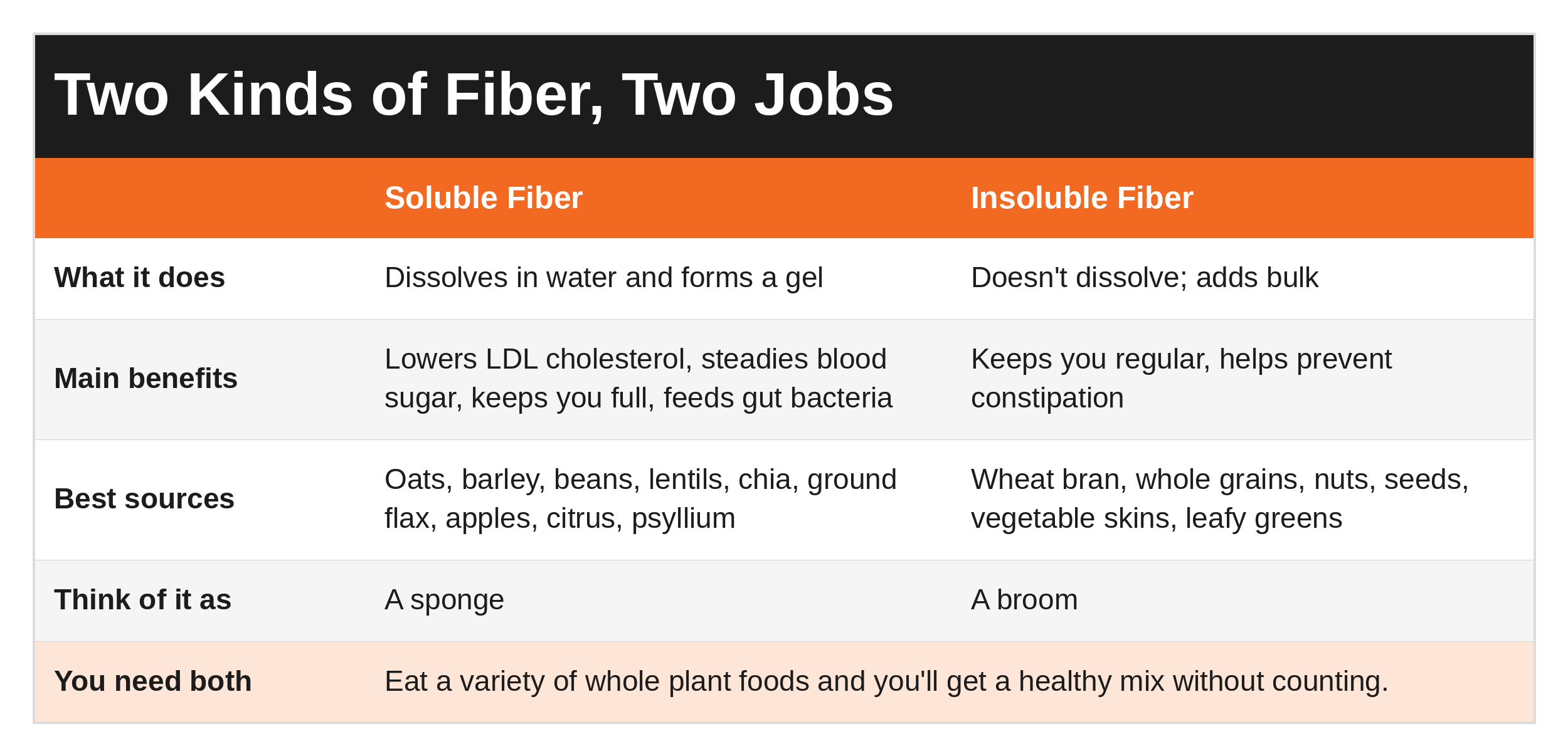
Two Kinds of Fiber, Two Jobs
Fiber is the part of plant foods your body can't digest. Instead of being absorbed, it travels through your gut and does its work along the way. Most plant foods contain some of both kinds.
Your Gut Microbiome: Why Fiber Feeds Your Health
Your gut is home to trillions of bacteria and other microorganisms, known as the gut microbiome. These bacteria help digest food, make certain vitamins, train your immune system, and protect the lining of your gut.
When gut bacteria ferment fiber, they produce compounds that nourish the cells lining your colon and help calm inflammation. In simple terms: feed your good bacteria, and they take care of you.
Prebiotics are the types of fiber that feed your good bacteria: garlic, onions, leeks, asparagus, slightly green bananas, oats, barley, beans, lentils, and the resistant starch in cooked-and-cooled potatoes and rice (Part 3 covers that).
Probiotics are the live beneficial bacteria themselves, and fermented foods are a natural way to get them.
Yogurt and kefir: plain, with "live and active cultures," no added sugar
Sauerkraut and kimchi: the refrigerated, "raw" kind (shelf-stable jars are pasteurized and have no live cultures)
Miso: add it after cooking, since boiling kills the cultures
Tempeh: fermented soybeans and a great plant protein
What the research shows: in a 2021 Stanford University study, healthy adults who ate about six servings of fermented foods a day for 10 weeks had a more diverse gut microbiome and lower markers of inflammation. Fiber and fermented foods work best together.
A few cautions: sauerkraut, kimchi, and miso can be high in salt, so watch portions if you have high blood pressure or kidney disease. If you're pregnant, choose yogurt and kefir made from pasteurized milk. If you have a weakened immune system, talk to your doctor before adding probiotics.
How to Increase Fiber Without the Discomfort
Here's the mistake most people make. They go from 15 grams to 35 grams overnight, get gassy and bloated, and quit. Go slow, and drink more water.
Step 1: Find your starting point. For two or three days, roughly track how much fiber you eat. Most people are surprised how low it is.
Step 2: Add about 3 to 5 grams at a time. Add one fiber-rich food, like half a cup of beans or a tablespoon of chia, and stay there for several days.
Step 3: Build up over 2 to 3 weeks. Your gut bacteria need time to adjust.
Step 4: Drink more water as fiber goes up. Fiber pulls water into your gut. More fiber without more water can make constipation worse, not better.
Step 5: Spread it out. Get some fiber at every meal instead of one giant bowl of bran.
Step 6: Help beans be kinder. Rinse canned beans, soak and drain dried beans, start with small portions, and try lentils and split peas, which tend to cause less gas.
Talk to your doctor first if you have Crohn's disease, ulcerative colitis, a recent diverticulitis flare, a history of bowel obstruction or bowel surgery, gastroparesis, or kidney disease. If you have diabetes, more fiber can lower your blood sugar, so check your numbers if you take insulin or medication that causes lows.
High-Fiber Foods
The fastest way to raise fiber is with beans, lentils, berries, seeds, and whole grains.
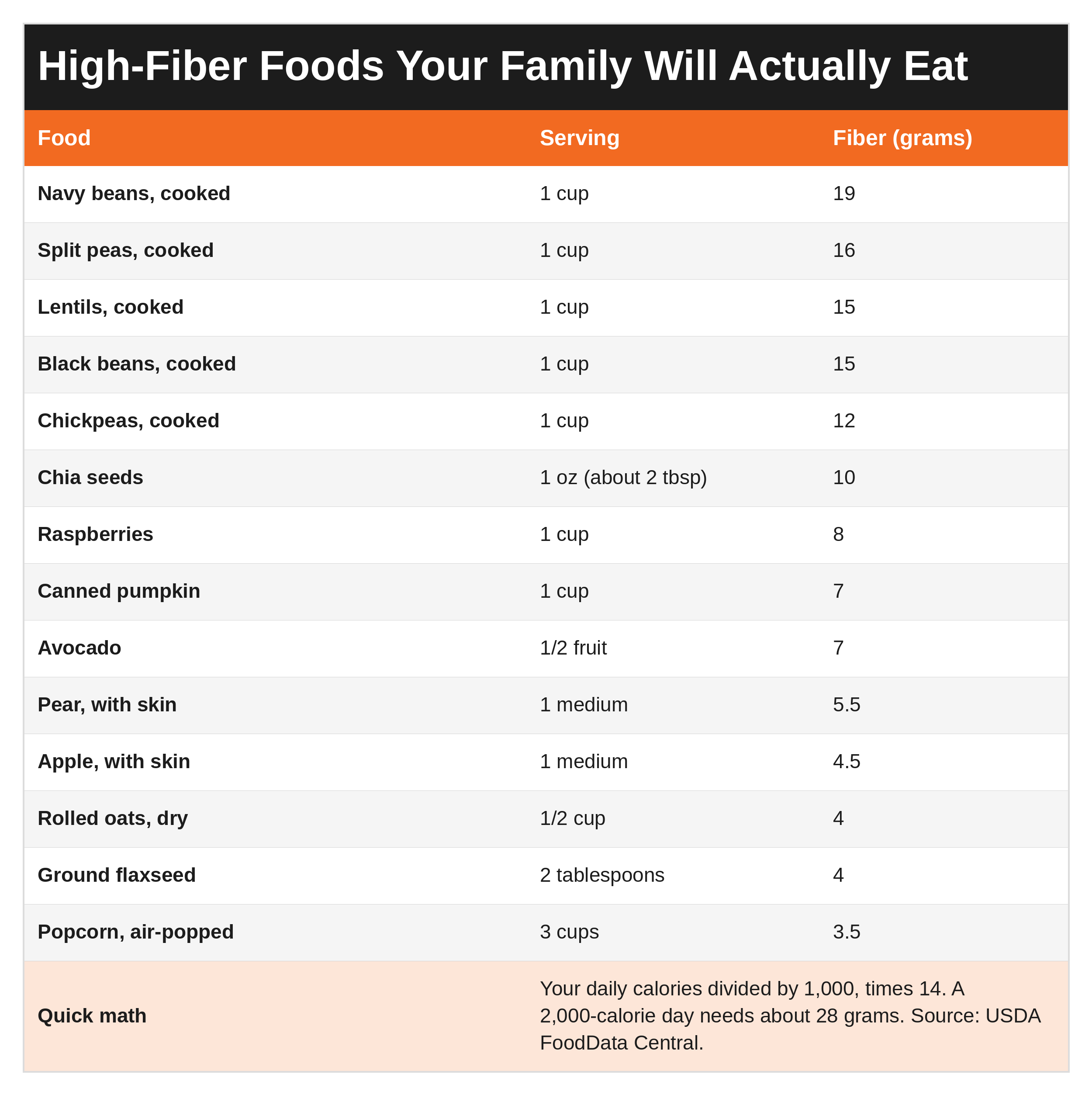
Put a few of these together and it adds up fast. Half a cup of oats with a tablespoon of chia and half a cup of raspberries is about 13 grams before 8 a.m.
What About Fiber Supplements?
Food comes first, because whole foods bring vitamins, minerals, and phytonutrients along with the fiber. But a supplement like psyllium husk can help fill a gap, especially in an emergency or while traveling.
Psyllium safety: always take it with a full glass of water. Without enough liquid, it can swell and cause choking or a blockage, which is why the FDA requires a warning on the label. Don't take it if you have trouble swallowing. Fiber supplements can also slow the absorption of some medications, so take your medications at least 2 hours before or after, and check with your pharmacist.
Fiber in Your Emergency Pantry
Many of the best fiber foods are also some of the cheapest, most shelf-stable foods you can buy. Build your pantry around them and your family stays regular, full, and steady even when fresh food runs out.
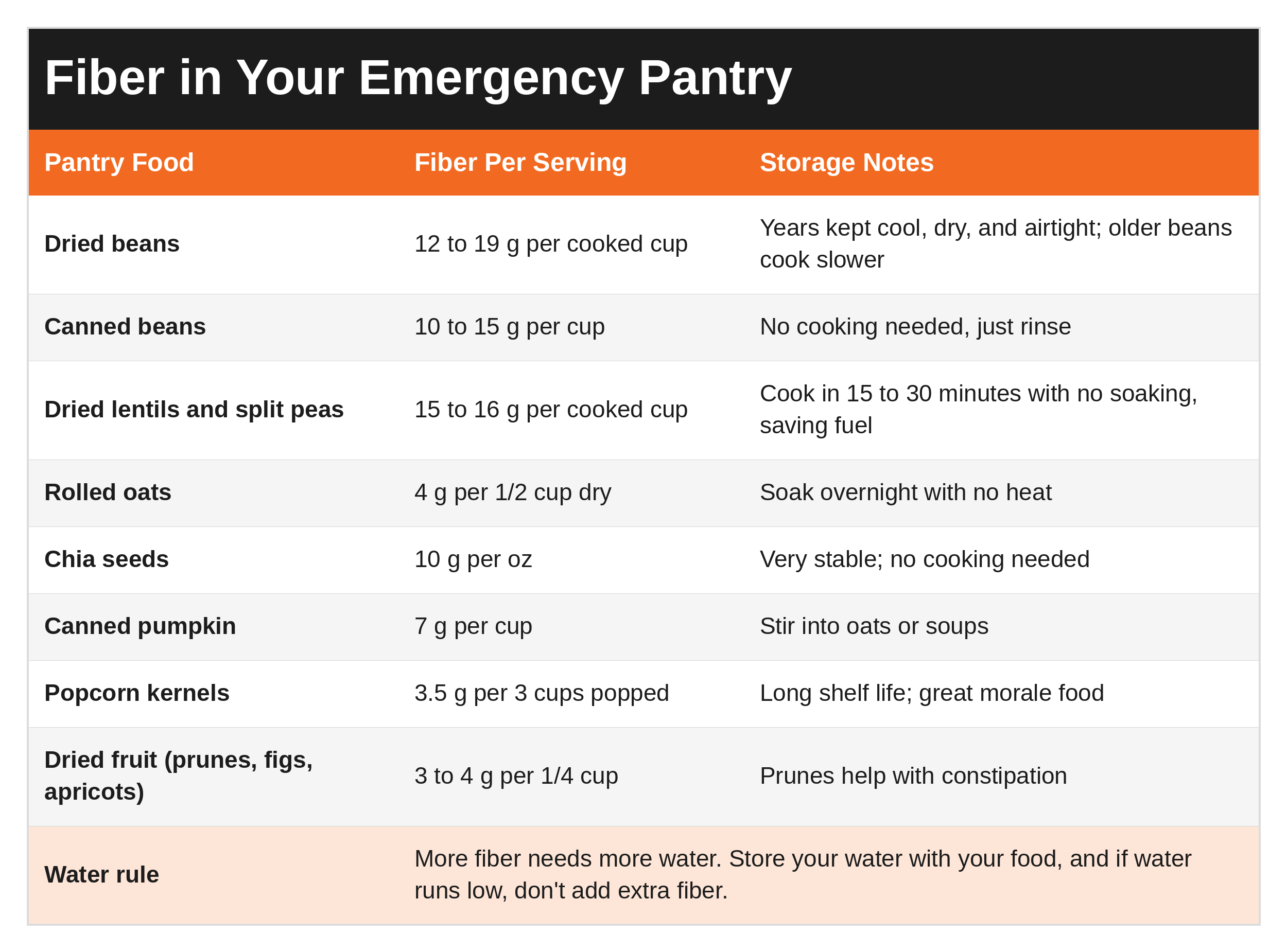
Store what you eat, and eat what you store. If your family never eats lentils, cook them twice a month now so they're a comfort food later, not a shock to the system. A sudden jump from a low-fiber diet to beans three times a day is a guaranteed stomachache. And keep rotating: new bags and cans go to the back, older ones move to the front, and you eat from the front.
One more research note. You may have seen headlines that fiber can "flush microplastics" out of your body. A 2025 rat study in Japan and a 2026 mouse study in South Korea showed some promise, but there's no human proof yet. Eat fiber for the benefits we know about, and focus on cutting the plastic that comes in. My Toxic Chemicals series covers microplastics in detail.
Ask Yourself
How close is my family to the fiber target for our ages?
Where does most of our fiber come from now, and what easy food could we add?
Do the fiber foods in my pantry match what my family actually likes to eat?
If our water supply were limited, would our food plan still keep us comfortable and regular?
Remember
Fiber is the most overlooked nutrient in the American diet, and one of the cheapest to fix. Add it slowly, drink your water, feed your gut, and stock the beans, oats, and chia your family already loves.
Get Started Today
[FREE DOWNLOAD: TO BE CHOSEN AFTER THE BINDER REVIEW]
Go Deeper
The Prepared Not Paranoid Family Nutrition Guide. This post gets your family started on fiber. The guide gives you the full plan: fiber targets for every age in your family, a sample high-fiber day, a complete pantry shelf-life chart, no-power recipes like overnight oats and chia pudding, a full chapter on cooking when the power is out, and the complete research picture on microplastics and how to cut your exposure. [Get it here: LINK]
Tools I recommend: The food storage containers, oxygen absorbers, and kitchen tools I recommend are in my Amazon store. https://amzn.to/4yM747h
Related reading:
Nutrition Basics, Part 3: Carbohydrates and the Glycemic Index https://www.preparednotparanoid.com/pnp-library/nutrition-lesson-3
Nutrition Basics, Part 7: Phytonutrients https://www.preparednotparanoid.com/pnp-library/nutrition-lesson-6
Toxic Chemicals to Avoid, Part 4: Endocrine Disruptors and Microplastics https://www.preparednotparanoid.com/pnp-library/toxic-chemicals-lesson-1-9axkp-mxse9-ekwcw
Safe Drinking Water, Part 3: Water Storage https://www.preparednotparanoid.com/pnp-library/water-storage
References
National Academies (Institute of Medicine). Dietary Reference Intakes for Energy, Carbohydrate, Fiber, Fat, Fatty Acids, Cholesterol, Protein, and Amino Acids. 2005.
U.S. Department of Agriculture and U.S. Department of Health and Human Services. Dietary Guidelines for Americans, 2020 to 2025. https://www.dietaryguidelines.gov/
U.S. Department of Agriculture and U.S. Department of Health and Human Services. Dietary Guidelines for Americans, 2025 to 2030. Released January 7, 2026. https://www.dietaryguidelines.gov/
Reynolds A, et al. Carbohydrate quality and human health: a series of systematic reviews and meta-analyses. The Lancet 393(10170):434 to 445, 2019.
Wastyk HC, et al. Gut-microbiota-targeted diets modulate human immune status. Cell 184(16):4137 to 4153, 2021.
U.S. Department of Agriculture, Agricultural Research Service. FoodData Central. https://fdc.nal.usda.gov/
U.S. Food and Drug Administration. 21 CFR 201.319: Warning statements for water-soluble gums, hydrophilic gums, and hydrophilic mucilloids (psyllium).
Tokai University (Japan). Rat study on dietary fiber, chitosan, and microplastic excretion, 2025.
World Institute of Kimchi. Mouse study on a kimchi-derived bacterium and plastic particle excretion. Bioresource Technology, 2026.
Disclaimer
This article is for general informational and educational purposes only. It is not medical advice and is not a substitute for guidance from your physician or a registered dietitian. If you have a digestive condition, kidney disease, diabetes, a weakened immune system, or trouble swallowing, or if you take medications, talk to your doctor before adding fiber, fermented foods, or fiber supplements. Affiliate disclosure: I've linked to products from my Amazon store that I personally recommend. As an Amazon Associate, I earn from qualifying purchases, at no extra cost to you. Thank you for supporting my work.
If you have severe belly pain, can't pass gas or stool, or have vomiting with a swollen belly, get medical help right away or call 911.
Awareness gives you time. Time gives you options.
The prepared protector is someone who's decided that loving someone means being ready for them, not just hoping things go fine.
Prepared Not Paranoid. Protecting the Most Vulnerable Among Us.