Nutrition Basics- Part 15: Eating Well on a Budget
Healthy Food Doesn't Have to Cost More. It Has to Be Bought Smarter.
By Larry Betz | Prepared Not Paranoid https://www.preparednotparanoid.com/
Ask families why they don't eat healthier, and the most common answer is cost. Grocery prices have climbed, and when the budget is tight it feels like the cheap food is the junk food and the good food is out of reach.
The pressure is real. USDA expects grocery prices to rise another 2.4 percent in 2026, and beef is up even more, about 9 percent. But here's the good news: some of the healthiest foods in the store are also some of the cheapest. Eggs, beans, lentils, oats, rice, canned fish, frozen vegetables, bananas, cabbage, and carrots cost far less per serving than chips, sugary cereal, and frozen pizza.
There's a second payoff, and it's a big one for a Prepared Not Paranoid family. The same habits that stretch your grocery budget also build your emergency pantry. Buying staples in bulk, stocking canned and frozen foods, and rotating what you have is the foundation of food storage. Every smart purchase works twice.
Think in Cost Per Serving, Not Cost Per Package
The sticker price tells you what you pay at the register. It doesn't tell you what you pay for each meal.
Use the unit price. Most shelf tags show a unit price in small print: price per ounce, per pound, or per count. Two jars of peanut butter might be $3.49 and $5.99, but if the larger one is more than twice the size, it's the better deal.
Then go one step further: cost per serving.
Step 1: Find the price. Example: a 1-pound bag of dry black beans.
Step 2: Find servings per container on the Nutrition Facts panel (see Part 13). A 1-pound bag of dry beans is usually about 12 to 13 servings.
Step 3: Divide price by servings. That's your cost per serving.
Run this on a few items and you'll see the pattern. Dry beans, rice, oats, and eggs usually cost a fraction of what a serving of packaged snacks costs, and they come with protein and fiber instead of added sugar.
Frozen and Canned Aren't Second Best
Many people believe fresh is always healthier. That's not what the research shows. Studies from the University of California, Davis, found that canned and frozen fruits and vegetables can be nutritionally comparable to fresh, and sometimes better. Frozen produce is usually picked ripe and frozen within hours. "Fresh" produce may spend days in trucks and on shelves, losing some vitamins along the way.
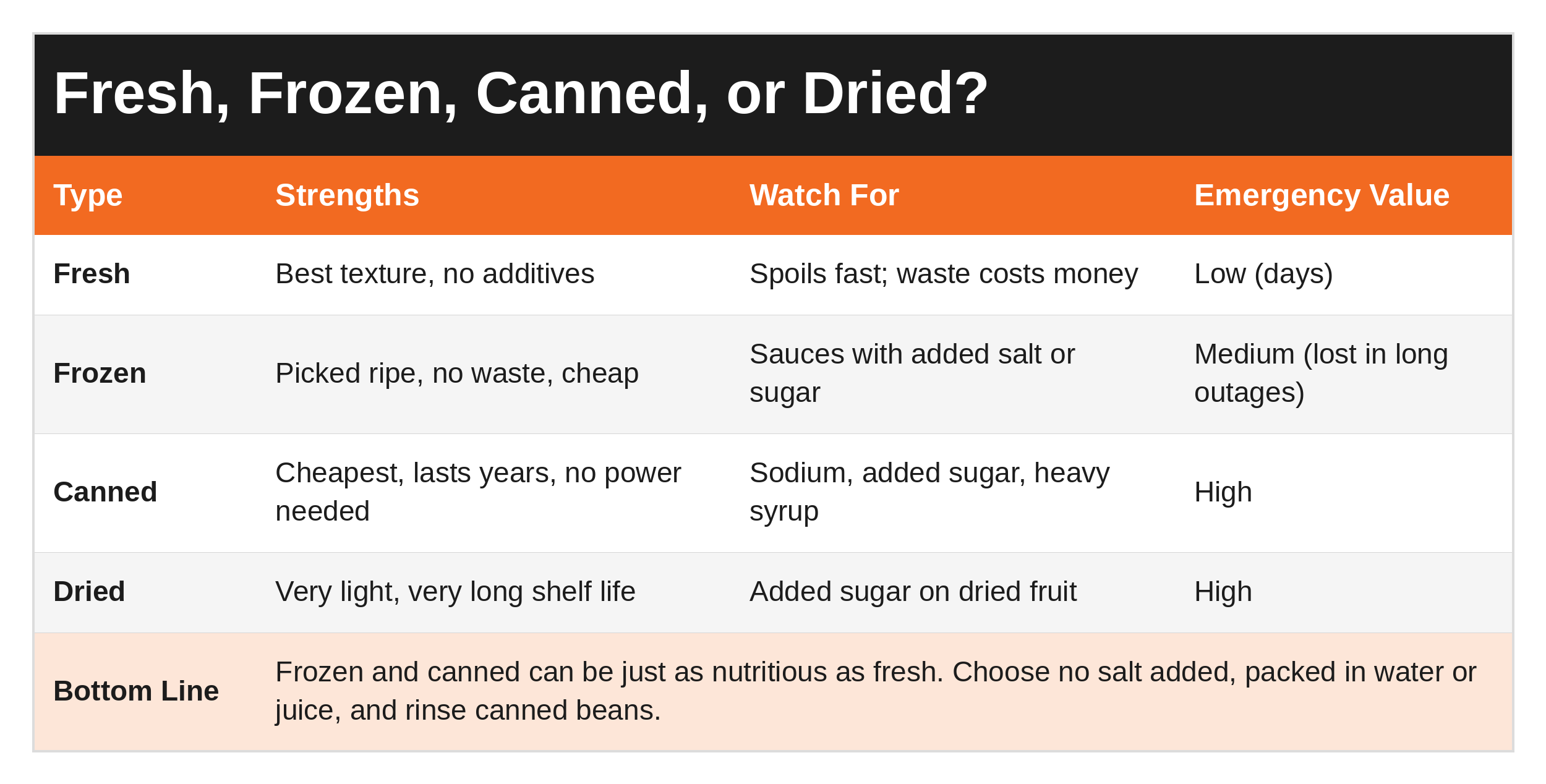
How to buy them right:
Frozen: plain vegetables and fruit with no sauce, butter, or added sugar.
Canned vegetables and beans: "no salt added" or "low sodium," and rinse beans before using.
Canned fruit: packed in water or its own juice, not "heavy syrup."
Can linings: some have contained BPA. Many brands now say "BPA-free" on the label. If it matters to you, look for it, but don't let it stop you from eating canned vegetables and beans.
Buy in Season, Buy in Bulk, Buy the Store Brand
In season: strawberries in June and apples in October cost less than strawberries in January. When something is on sale in season, buy extra and freeze it. Berries, peaches, and chopped peppers freeze well.
Bulk staples are where your grocery budget and your emergency pantry meet: rice, rolled oats, dry beans and lentils, pasta, peanut butter, canned tomatoes, canned fish and chicken, powdered milk, olive oil, honey, salt, and spices.
Bulk buying rules:
Only buy in bulk what your family already eats. A 25-pound bag of something nobody likes isn't a deal.
Check the unit price. Bulk isn't always cheaper. Sometimes the sale price on a regular package beats the warehouse store.
Store it right. Move dry goods into airtight containers. In hot climates like Arizona, where I live, keep them in the coolest part of the house, never the garage. Heat shortens shelf life.
Store brands are often made in the same kinds of facilities as name brands and must meet the same federal safety and labeling rules. For plain staples like oats, rice, beans, frozen vegetables, and canned tomatoes, the store brand is often the same food for less. Compare the labels side by side the first time, then buy with confidence.
Where Organic Matters Most
Organic produce costs more. If you can't buy everything organic (most families can't), spend your organic dollars where they matter most. Each year the Environmental Working Group (EWG) analyzes USDA and FDA pesticide testing data and publishes two lists: the Dirty Dozen (produce with the most pesticide residues) and the Clean Fifteen (produce with the least).
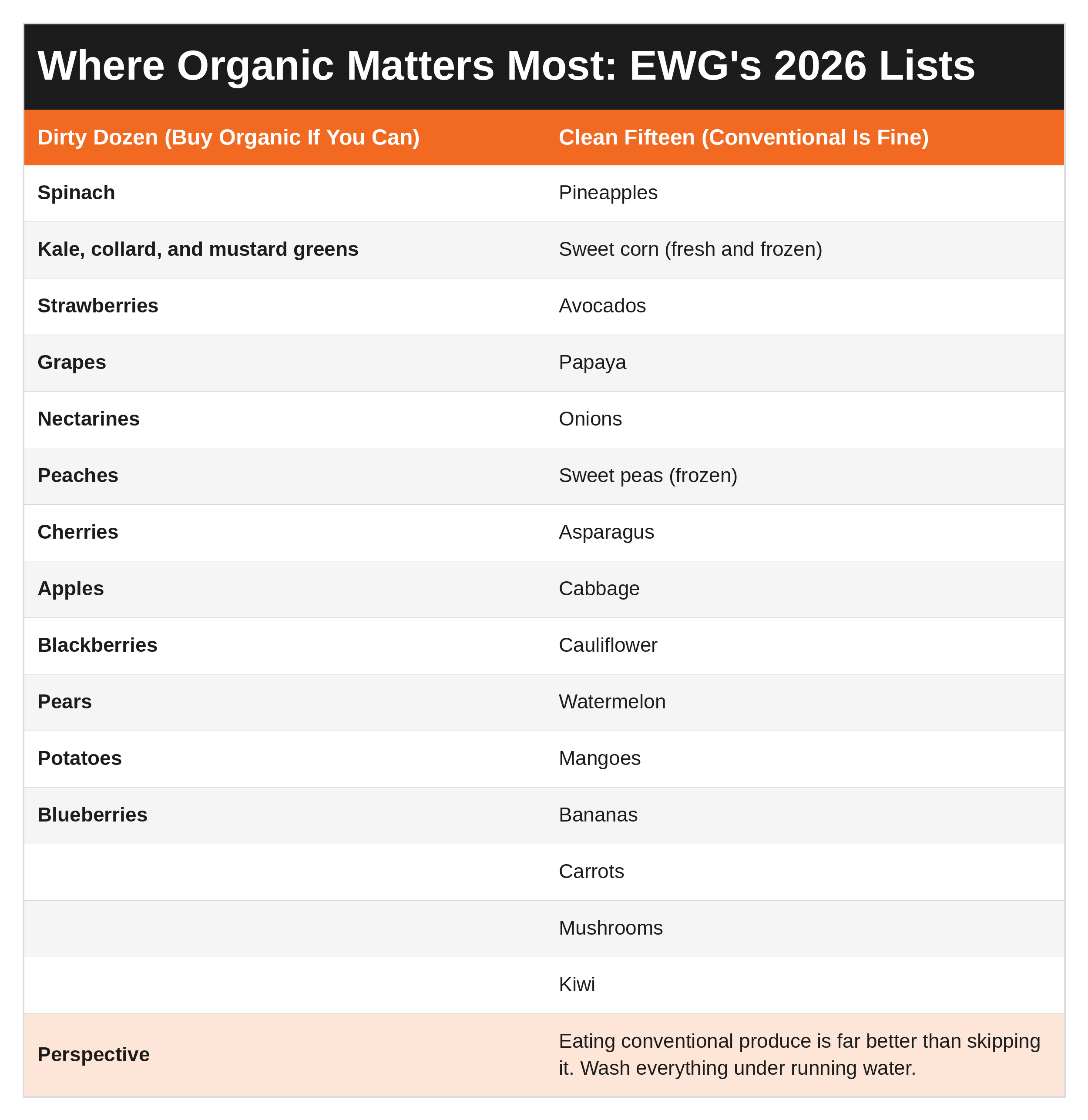
Keep the lists in perspective. EWG's standards are stricter than the government's, and USDA reports that most residues it finds are below EPA safety limits. Even EWG says eating conventional fruits and vegetables is far better than not eating them at all. Use the Dirty Dozen to decide where to spend extra, not as a reason to skip produce.
Cheap Protein: The Budget All-Stars
Protein is usually the most expensive part of a meal, and it's the part I don't want you to skimp on. My standard is 1 gram of protein per pound of your goal body weight per day. If you have kidney disease, talk to your doctor before increasing protein (see Part 2: Protein). These foods give you the most protein for your dollar.
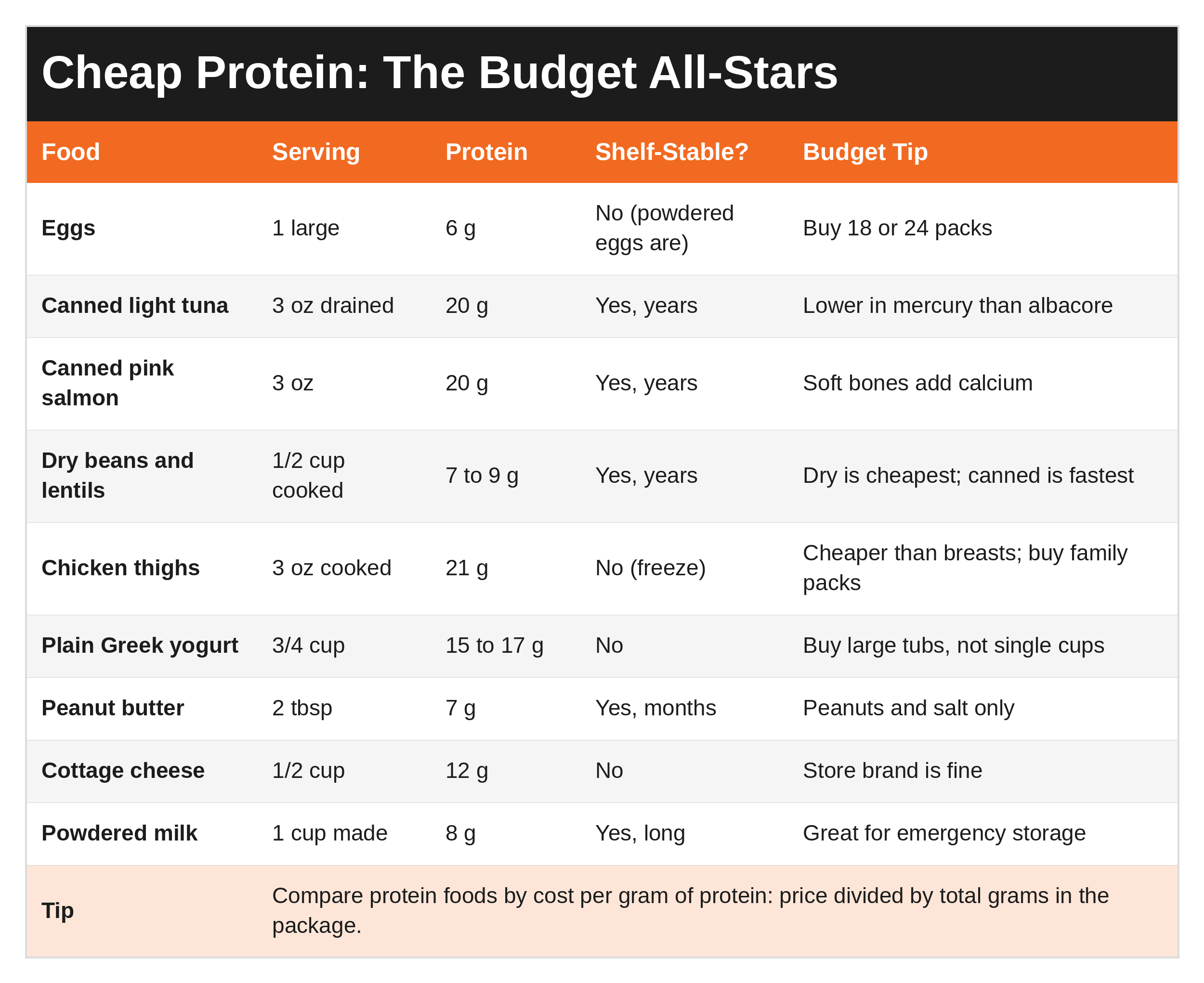
Fish and mercury: the FDA and EPA list canned light tuna and salmon as "Best Choices" for low mercury. Albacore (white) tuna has more, so limit it for children and anyone who's pregnant or breastfeeding.
Your Budget Pantry Is Your Emergency Pantry
This is where the Prepared Not Paranoid approach pays off. Families often think of emergency food as a separate, expensive project: buckets of freeze-dried meals stashed in a closet. Those have their place. But the cheapest, most reliable emergency food supply is the one you build a little at a time from the foods you already eat.
Buy one extra. When canned beans, tuna, tomatoes, or peanut butter are on sale, buy one or two more than you need. Over a few months your pantry grows without a big bill.
Store what you eat, eat what you store. New food goes to the back, older food moves to the front, and you eat from the front.
Favor no-cook foods. Canned fish, canned beans, peanut butter, and canned fruit can be eaten without power.
Balance it. A pantry full of pasta will fill you up but won't keep you strong. Make sure the cheap protein list is well represented.
Match salt with water. Canned foods carry sodium. Store enough water for your family.
We'll build the full plan, and the math for how much your family needs, in Parts 16 and 17.
Meal Planning to Cut Waste
USDA estimates that 30 to 40 percent of the U.S. food supply is wasted. For a family, much of that is food that spoils in the fridge before anyone eats it. Throwing away food is throwing away money.
Step 1: Check what you have. Look in the fridge, freezer, and pantry, and build meals around what needs to be used first.
Step 2: Plan five dinners, not seven. Leave room for leftovers and the nights plans change.
Step 3: Cook once, eat twice. A pot of chili or a tray of roasted chicken thighs becomes tomorrow's lunch.
Step 4: Share ingredients across meals. If you buy cilantro for tacos, plan a rice bowl that uses the rest.
Step 5: Write the list and stick to it. Shopping without a list is how impulse snacks end up in the cart.
Step 6: Use the freezer. Freeze bread, cooked rice, chopped onions, ripe bananas, and leftovers before they go bad.
Step 7: Know your dates. "Best by" dates on most foods (other than infant formula) are about quality, not safety. Use your senses, and when in doubt, throw it out.
Ask Yourself
Am I comparing price per package or price per serving?
Am I paying extra for fresh produce that ends up in the trash?
Does my everyday pantry double as my emergency pantry?
Am I getting enough protein, or cutting it to save money?
Remember
Eating well on a budget isn't about buying less. It's about buying smarter: cost per serving, frozen and canned, in season, in bulk, and with a plan. Every smart purchase feeds your family today and protects them tomorrow.
Get Started Today
[FREE DOWNLOAD: TO BE CHOSEN AFTER THE BINDER REVIEW]
Go Deeper
The Prepared Not Paranoid Family Nutrition Guide. This post shows you how to buy smarter. The guide gives you the system: the Family Food Planner with a weekly menu planner and a menu-to-shopping-list converter, a full meal prep and batch cooking chapter, a seasonal produce guide, the Shelf-Life Chart, and the 30-Day Food and Water Calculator so your budget pantry becomes a real emergency plan. [Get it here: LINK]
Tools I recommend: The airtight storage containers and bulk food bins I recommend are in my Amazon store. https://amzn.to/4yM747h
Related reading:
Nutrition Basics, Part 2: Protein https://www.preparednotparanoid.com/pnp-library/nutrition-lesson-2
Nutrition Basics, Part 13: How to Read a Nutrition Facts Panel https://www.preparednotparanoid.com/pnp-library/nutrition-facts-label
Nutrition Basics, Part 14: Food Label Claims Decoded https://www.preparednotparanoid.com/pnp-library/nutrition-lesson-8
Nutrition Basics, Part 16: Shop for Emergencies the Smart Way https://www.preparednotparanoid.com/pnp-library/nutrition-lesson-10
References
USDA Economic Research Service. Food Price Outlook: Summary Findings. September 2026. https://www.ers.usda.gov/data-products/food-price-outlook/summary-findings
Rickman JC, Barrett DM, Bruhn CM. Nutritional comparison of fresh, frozen and canned fruits and vegetables. Journal of the Science of Food and Agriculture, 2007.
Li L, et al. Selected nutrient analyses of fresh, fresh-stored, and frozen fruits and vegetables. Journal of Food Composition and Analysis, 2017.
Environmental Working Group. 2026 Shopper's Guide to Pesticides in Produce. March 2026. https://www.ewg.org/foodnews/
U.S. Department of Agriculture, Agricultural Marketing Service. Pesticide Data Program Annual Summary.
U.S. Department of Agriculture. FoodData Central. https://fdc.nal.usda.gov/
U.S. Food and Drug Administration and U.S. Environmental Protection Agency. Advice About Eating Fish. https://www.fda.gov/food/consumers/advice-about-eating-fish
U.S. Department of Agriculture. Food Waste FAQs. https://www.usda.gov/foodwaste/faqs
U.S. Department of Agriculture, Food Safety and Inspection Service. Food Product Dating.
Disclaimer
This article is for general informational and educational purposes only. It is not medical or financial advice and is not a substitute for guidance from your physician or a registered dietitian. If someone in your family has kidney disease, food allergies, or is pregnant, talk with your doctor about protein, fish, and diet changes. Affiliate disclosure: I've linked to products from my Amazon store that I personally recommend. As an Amazon Associate, I earn from qualifying purchases, at no extra cost to you. Thank you for supporting my work.
In a medical emergency, call 911
Awareness gives you time. Time gives you options.
The prepared protector is someone who's decided that loving someone means being ready for them, not just hoping things go fine.
Prepared Not Paranoid. Protecting the Most Vulnerable Among Us.