Attention, Transition Zones, and SCAN
By Larry Betz | Prepared Not Paranoid https://www.preparednotparanoid.com/
Most of the moments that matter happen in transition zones: getting out of the car, walking to your door, stepping into an elevator. That's where attention slips, and that's where a few seconds of awareness count the most. This post turns the whole series into habits you can use today.
Years ago, I drove a tow truck. A lot of my work happened on the shoulder of busy highways, with traffic flying past a few feet away.
You learn fast out there. Before you get out of the truck, you look. You read the scene: where the traffic is coming from, where the shoulder narrows, where you'd go if a car drifted toward you. Not because you're scared, but because the few seconds you spend paying attention are the seconds that give you options.
That's what this whole series comes down to.
In Part 8, we saw that people form quick impressions from how someone moves. In Part 9, we saw that cameras can, too. Now let's make it practical. You don't need a special walk. You need to stay present. Here's how.
1. Attention: The Real Lesson Behind the Research
When you look closely at the gait research, a lot of what it picked up on comes back to one thing: whether someone looks connected to their surroundings.
The biggest thing that disconnects us today is in our pockets.
Phones and earbuds weren't part of the original studies; there were no smartphones in 1981. But they matter because they take your attention. When your eyes and mind are on a screen, you can miss:
Someone closing distance
Someone lingering or following
A person mirroring your movement
A blocked path or a change in the crowd
That uneasy feeling that something's off
There's a name for this: inattentional blindness. Your eyes can be pointed right at something, and your brain still doesn't register it, because your attention is somewhere else.
The phone isn't the problem. Losing track of what's around you is.
Simple habits
Finish navigation before you start walking or driving.
Pause a call or text when walking to your car, your door, or an elevator.
Keep one ear free when you're somewhere awareness matters.
Don't stand next to an unlocked car digging through a bag. Get organized before you leave the store.
If you need to use your phone, move somewhere visible, staffed, and less exposed first.
2. Transition Zones: Where Attention Slips
A transition zone is anywhere you're moving from one space to another: getting in or out of a car, walking to your front door, stepping into an elevator, leaving a store, arriving at a hotel, or moving through a parking garage.
These moments are risky for a simple reason: they're when our attention is most divided. Keys, bags, kids, phones, directions, and weather all compete for your attention at once.
Before you enter a transition zone, slow it down in your head:
Put away what you don't need.
Have your keys ready before you reach the car or door.
Look up and take in the area.
Keep enough space to change direction if something doesn't feel right.
It takes about ten seconds, and those are ten seconds of awareness at the moments that count.
3. Isolation: Where You Are Matters as Much as How You Move
Risk isn't only about behavior. It's also about opportunity. Isolation can mean being physically alone, but it can also mean being in a place where few people can see you or help.
Examples include:
Parking garages and the far corners of parking lots
Stairwells, elevators, and apartment hallways
Poorly lit walkways
Rideshare pickup spots
Empty train or bus platforms
Hotel hallways and side entrances
Getting separated from your group at a party or event
The answer isn't to stop living your life. It's to notice when a place gives you fewer witnesses, fewer exits, and fewer sources of help, and to adjust early. Park closer. Walk with a friend. Use the main entrance. Ask for an escort. Wait inside until your ride arrives.
4. Head Up, Not Hard
You'll hear self-defense instructors say "keep your head up" and "make eye contact." Those weren't measured in the original gait studies, but the idea behind them is sound if you do it right.
You don't need to stare people down. That can create tension that wasn't there.
What you want is calm acknowledgment. A natural glance around. Noticing who's near you. Eyes moving instead of locked on a screen or the ground. It quietly says, "I'm here, and I'm paying attention."
Remember: You don't need to look tough. You need to look present.
5. Your Voice and Your Boundaries
Awareness doesn't stop at noticing. Sometimes it means saying something.
People who intend harm often test small boundaries first: standing too close, ignoring a "no thanks," pushing a conversation you don't want, or making you feel rude for pulling away. Gavin de Becker wrote about this in The Gift of Fear, and it's something I've seen over and over in my years teaching self-defense. (Part 2 of this series covers how to tell a boundary respecter from a boundary tester.)
Many of us, especially women, were raised to be polite above all else.
Politeness should never trap you in a situation that feels wrong.
What to Say
Safe and non-engaging
"No thanks, I'm good."
"I'm all set."
Keep walking toward people and light.
Setting boundaries
"No."
"I'm not interested."
"Please give me some space."
If they persist
"Back up."
"Do not touch me."
"I said no. I'm leaving."
Say it louder, step back, hands up in front of you, palms out, and move toward other people.
You don't need to explain or apologize.
"No" is a complete sentence, and it's a powerful one.
A personal alarm or flashlight in your hand gives your "No" some backup, drawing attention and helping you create space. The free Choose Your Tool guide helps you compare your options side by side. Get it free here.
6. When Movement Is Harder
If you, an aging parent, or someone you love has a disability, injury, chronic pain, or mobility limitation, none of this research means you're at fault for anything. It means you plan a little differently.
Choose accessible, well-traveled routes.
Give yourself enough time so you're not rushing.
Use mobility devices consistently.
Keep your hands as free as you can.
Walk with a companion on the more exposed side when possible.
Use curbside pickup or an escort when it helps.
Know where the staffed spots, seating, and rest stops are.
Carry medical and contact information.
Protecting someone means respecting their dignity and independence, not taking it away.
7. Put It All Together With SCAN
I teach a simple framework called SCAN in Navigating the Red Zone and Beyond. It turns everything in this series into four habits you can use anywhere.
Here's what SCAN looks like while you move.
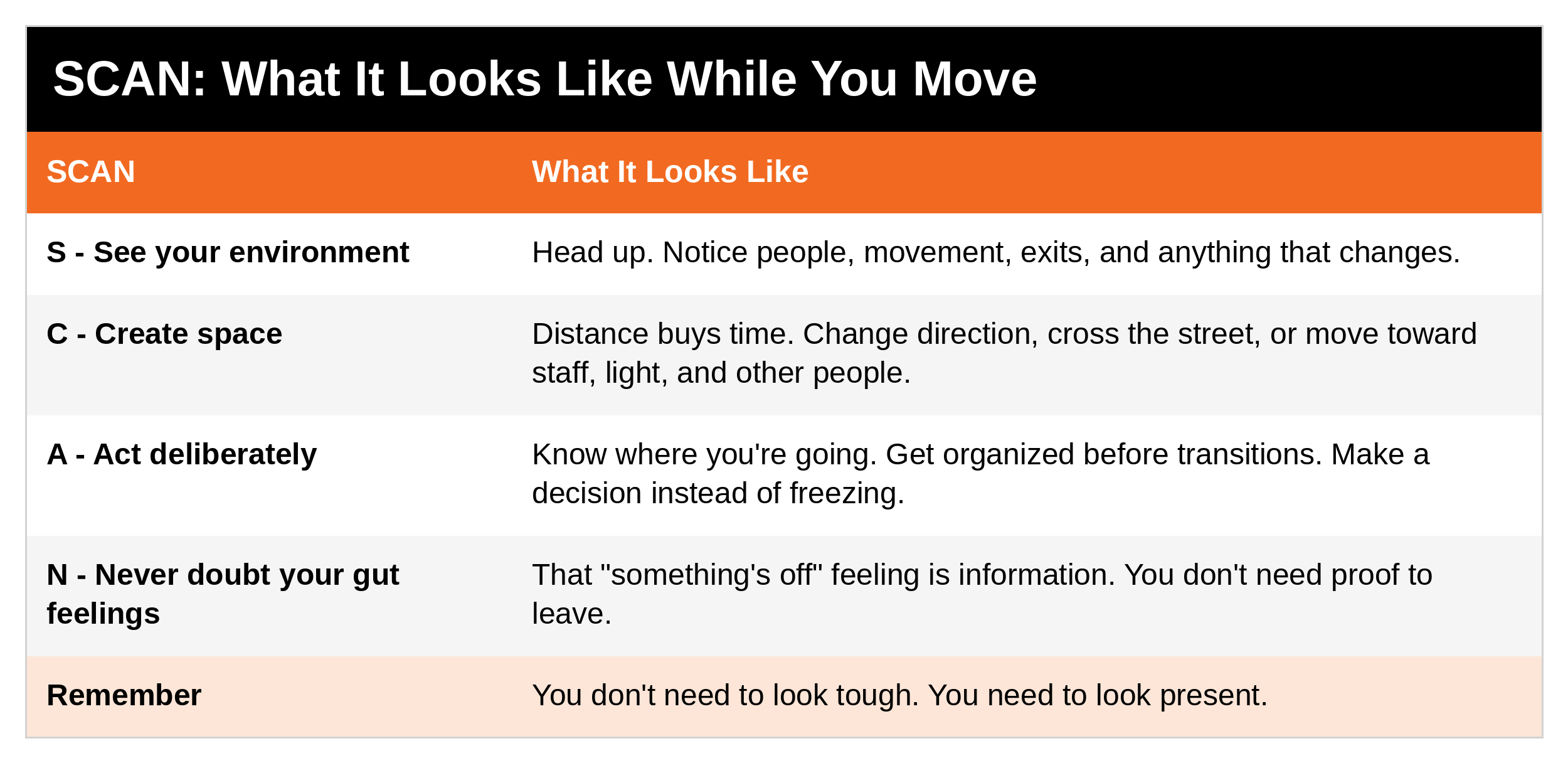
Put SCAN in your pocket. The free SCAN Family Card gives the whole family a simple way to read their surroundings. Get it free here.
Try This: The 10-Minute Awareness Walk
This week, pick a familiar route: your grocery store parking lot, an office hallway, a hotel lobby, or a transit stop. Walk it once without your phone.
Here's what to look for.
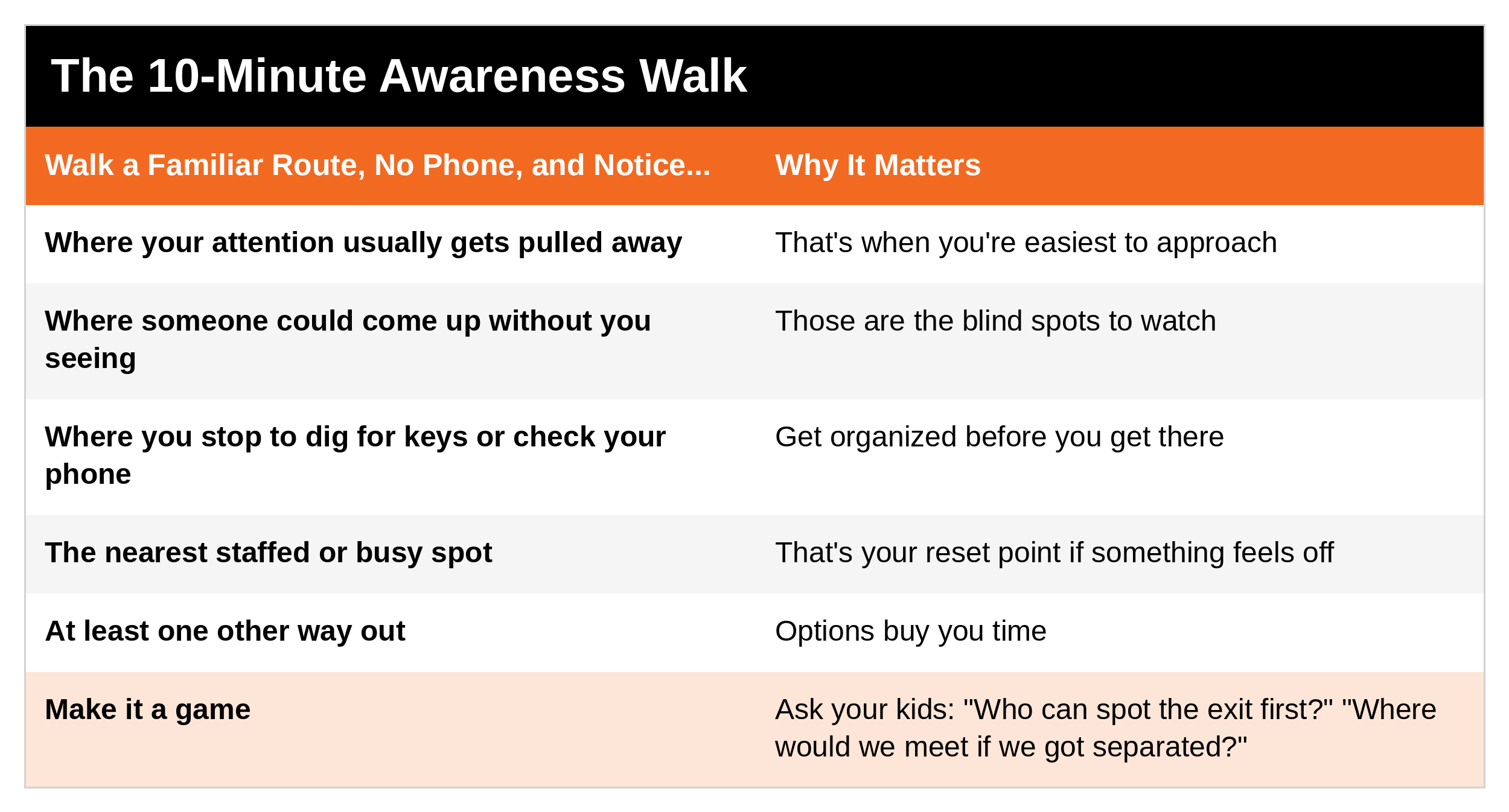
While you're at it, notice where visibility is limited, and what you could get organized before you walk through.
The goal isn't to look for danger. It's to see how your everyday routines affect your attention, and make small fixes before you ever need them.
Do it with your kids, too. Make it a game: "Who can spot the exit first?" "Where would we meet if we got separated?"
Get the walk on paper. The free 10-Minute Awareness Walk lays out the route, what to look for, and how to turn it into a family game. Get it free here.
5 Quick Wins You Can Start Today
Set your navigation before you move. Then put the phone away.
Keys out before the door. Car, house, or hotel room.
Take ten seconds at every transition. Look up, take in the area, then go.
Park for the walk back. Closer, better lit, and near other people, even if it's a longer search for a spot.
Practice "No." Say it out loud, calm and firm. It's easier to find under stress when you've used it before.
Want your family to stay present in the parking lots, doorways, and elevators where attention slips? The free SCAN Family Card is a pocket card that teaches the whole family a simple way to read their surroundings.
Ask Yourself
Where do I usually have my head down: the parking lot, the elevator, my front door?
Do I get organized before I walk out of the store, or next to my car?
Have I shown my kids how to spot exits and pick a meeting spot?
Remember
The research tells us that people, and now cameras, notice how we move. But the real lesson isn't about your stride or your arm swing. It's about being present.
No walk guarantees safety, and nothing you do makes you responsible for someone else's choice to cause harm. But awareness gives you the chance to notice a change, make a decision, and act while you still have time and distance on your side.
That's not paranoia. That's being prepared for the people who count on you.
The Prepared Protector is someone who's decided that loving someone means being ready for them, not just hoping things go fine. Ten seconds of attention at the right moment is part of that.
Coming Up in Part 11: Staying Aware at Large Events
In Part 11, the final part of the series, I'll take everything we've covered into concerts, games, festivals, and other big crowds, where exits, meeting spots, and your family plan matter most.
Next in the series: Situational Awareness- Part 11: Staying Aware at Large Events
Get Started Today
Get the free SCAN Family Card. A pocket card that teaches the whole family a simple way to read their surroundings. Get it free here.
Get the free 10-Minute Awareness Walk. It lays out the route, what to look for, and how to turn it into a family game. Get it free here.
The Greyman Pocket Guide is a bonus inside The Family Safety Toolkit, along with the Public Safety Checklist for Everyone. For a comprehensive family safety guide, pick up your copy of The Family Safety Toolkit.
Quick Answers
What is a transition zone?
A transition zone is anywhere you move from one space to another, like getting out of the car, walking to your front door, stepping into an elevator, or leaving a store. Your attention is most divided there, so a few seconds of awareness count the most.
How does phone use affect situational awareness?
When your eyes and mind are on a screen, you can miss someone closing distance, following you, or blocking your path. This is called inattentional blindness. Finish navigation before you move and pause calls at transitions.
Should I make eye contact with strangers?
Aim for calm acknowledgment, not a stare-down. A natural glance around and noticing who is near you quietly says you are paying attention, without creating tension that wasn't there.
What is the 10-Minute Awareness Walk?
Pick a familiar route, like your grocery store parking lot or a transit stop, and walk it once without your phone. Notice exits, lighting, where visibility is limited, and what you could get organized before you walk through. Do it with your kids as a game.
Go Deeper
Situational Awareness and Safe Family Travel Strategies. This series gives you the short version. The book gives you the whole thing: the manipulation tactics with scripts for each one, the reactionary gap and fighting distances, Cooper's Color Code and the OODA Loop in everyday situations, the Hostile Planning Cycle, how to keep from being targeted, more than 40 pre-event indicators, and de-escalation. Then it takes those skills on the road: vehicle safety, road rage, carjacking, family travel, overseas travel, hotels and Airbnbs, and digital safety. Get the book here.
The Family Safety Toolkit. 20 ready-to-use checklists for kids, travel, home, and emergencies, including the Public Safety Checklist for Everyone and Witness Skills: How to Describe a Suspect, so your family has the steps in front of you instead of trying to remember them under stress.
Tools I recommend: For flashlights, pepper spray, personal alarms, and other personal safety tools, see my Personal Safety Tools Amazon store. For the everyday carry gear I recommend, see my Everyday Carry Amazon store. The flashlights I carry and recommend are in my Flashlights Amazon store.
The Full Series
Situational Awareness- Part 2: How Predators Get You to Lower Your Guard
Situational Awareness- Part 8: What the Research Shows About How You Walk
Situational Awareness- Part 9: Can Cameras Recognize Your Walk?
Situational Awareness- Part 11: Staying Aware at Large Events
Related Reading
Situational Awareness- Part 8: What the Research Shows About How You Walk
Situational Awareness- Part 9: Can Cameras Recognize Your Walk?
References
de Becker, G. (1997). The gift of fear: Survival signals that protect us from violence. Little, Brown.
Grayson, B., and Stein, M. I. (1981). Attracting assault: Victims' nonverbal cues. Journal of Communication, 31(1), 68 to 75. https://doi.org/10.1111/j.1460-2466.1981.tb01206.x
Gunns, R. E., Johnston, L., and Hudson, S. M. (2002). Victim selection and kinematics: A point-light investigation of vulnerability to attack. Journal of Nonverbal Behavior, 26(3), 129 to 158.
Book, A., Costello, K., and Camilleri, J. A. (2013). Psychopathy and victim selection: The use of gait as a cue to vulnerability. Journal of Interpersonal Violence, 28(11), 2368 to 2383. https://doi.org/10.1177/0886260512475315
Betz, L. Navigating the Red Zone and Beyond (SCAN framework).
Disclaimer
This article is for general informational and educational purposes only. It is not a guarantee of safety and is not a substitute for professional self-defense training, legal advice, medical advice, or law enforcement guidance. No behavior or movement style can prevent every crime, and responsibility for violence always belongs to the offender. Prepared Not Paranoid and Larry Betz are not responsible for the content of third-party websites or resources linked here. Affiliate disclosure: I've linked to products from my Amazon store that I personally recommend. As an Amazon Associate, I earn from qualifying purchases, at no extra cost to you. Thank you for supporting my work.
If you're in danger right now, get to a safe place and call 911.
Awareness gives you time. Time gives you options.
The Prepared Protector is someone who's decided that loving someone means being ready for them, not just hoping things go fine.
Prepared Not Paranoid. Protecting the Most Vulnerable Among Us.