Part 2: Awareness, Movement, and Vulnerability
Cameras Can Recognize Your Walk: What Gait Recognition Can and Can't Do
By Larry Betz | Prepared Not Paranoid https://www.preparednotparanoid.com/
In Part 1, we looked at research showing that people form fast impressions from the way someone walks. Now let's look at something newer: machines doing the same thing.
Most of us know cameras can recognize faces. Fewer people know that some systems can try to identify a person by the way they walk, even from a distance, from behind, or when their face is covered.
It sounds like a spy movie. Some of it is real, some of it is overhyped, and all of it is worth understanding, because the cameras in stores, parking garages, airports, and on doorbells are recording more than most people think.
Three Different Things People Mix Up
Before we go further, it helps to separate three subjects that often get blended together online:
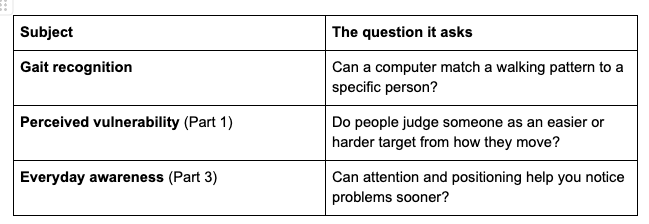
They all involve movement, but they're different fields with different questions. One doesn't prove the other.
How Gait Recognition Works
Gait recognition is a type of behavioral biometrics. Instead of measuring something you have, like a fingerprint, it measures something you do. Here's the simple version of how most systems work:
Capture: a camera records a few seconds of someone walking
Separate: software isolates the person from the background, either as an outline (silhouette) or as a stick figure of the joints (skeleton)
Measure: it measures things like stride, timing, cadence, joint angles, and how the body moves through each step
Build a pattern: those measurements become a digital "signature" of the walk
Compare: the system compares that signature to other footage or stored records and produces a similarity score
That last point is important. The result is a score, not proof. It says "these two walks look alike," not "this is definitely the same person."
Why It's Getting Attention
Gait recognition has a few features that make it appealing to researchers and security systems:
It can work at a distance
It doesn't need the person to face the camera
It can work when a face is covered by a hat, hood, or mask
People usually don't know it's happening
On its own, a walk rarely identifies someone by name. But combined with other information, like time and place, clothing, direction of travel, vehicle, or other camera views, it can help investigators connect the same unknown person across several locations and build a timeline.
How Accurate Is It, Really?
You'll see claims online that gait is "as unique as a fingerprint." I'd be careful with that.
There's no single honest accuracy number for gait recognition. Results in a controlled research lab, with good lighting, clear angles, and cooperative subjects, don't automatically carry over to a dark parking garage or a crowded train station. Things that can throw it off include:
Camera angle, distance, and video quality
Low light, glare, shadows, and bad weather
Crowds and people blocking the view
Coats, backpacks, and carried bags
Shoes and walking surfaces
Walking speed, fatigue, pain, or injury
Changes with age or mobility aids
Not enough footage
A confident-looking match score is still just a computer's best guess. Responsible use requires a human to check it and other evidence to back it up.
Can You Change Your Walk?
Here's where it gets interesting, and where I want to bring in a perspective I often enjoy: the tradecraft world.
RDCTD, a site that writes about covert-operative tradecraft, talks about what they call "dynamic gait pattern" work: deliberately adjusting the way you walk to fit your surroundings and avoid standing out. Their point is that a distinctive walk can be a giveaway, both to a person watching and to a camera. Their advice is to match your movement to your environment: purposeful and confident where that's normal, more relaxed and casual in a crowd. They also stress that any change has to be comfortable enough to keep up, because an awkward, forced walk stands out even more.
I want to be honest about what that is and isn't. It's a tradecraft perspective, not scientific research, and nobody should think a changed walk can reliably beat modern camera systems. Gait naturally changes with speed, shoes, terrain, fatigue, and mood, and modern systems look at many features at once.
But the core idea lines up with something I teach all the time: don't stand out for the wrong reasons.
The GreyMan Lesson
In the safety world, there's a concept called the "greyman": the person who blends into the environment, draws no attention, and gives a would-be predator or thief nothing to notice.
That's not about hiding or being sneaky. It's about not advertising yourself as a target:
Not flashing expensive jewelry, cash, or electronics
Not wandering with your head buried in your phone, looking lost
Not wearing clothing or gear that screams "tourist" or "I have something worth taking"
Moving like you belong there and know where you're going
Put it together with Part 1 and the lesson is the same one: people notice how you move. A person who looks present, calm, and like they fit in gives an opportunist much less to work with than someone who looks distracted, lost, or out of place.
You don't need spy training for that. You need awareness.
Your Privacy Matters Too
Gait recognition raises fair questions about privacy, because people often don't know they're being analyzed. If you're a business owner, HOA board member, or school leader looking at security systems, ask:
Do people know this technology is being used?
How long is the footage and movement data kept?
Has the system been independently tested in real-world conditions?
How are mistakes and false matches handled?
Who can access and share the results?
How can someone challenge a wrong identification?
For families, the takeaway is simpler: assume cameras may be collecting more than your face, and don't assume every match a system produces is correct.
Remember: Cameras may notice how you walk. So might people. You don't need to fake a walk. You need to look like you belong and know where you're going.
Ask Yourself
When I travel or go somewhere new, do I look like I know where I'm going?
Is there anything about how I dress or carry myself that makes me an obvious target?
Do I put my phone away when I'm moving through unfamiliar places?
Coming Up in Part 3
We'll turn all of this into everyday habits: attention, transition zones, phone distraction, boundaries, and how to use SCAN while you move, plus a simple exercise you can try on your next trip to the grocery store.
Get the Free GreyMan Pocket Guide
Want to practice blending in and staying aware? My free GreyMan Pocket Guide gives you simple, practical habits for traveling and moving through public places without drawing the wrong kind of attention.
[CTA: Comment or DM "[KEYWORD]" to get your free copy / or download it here: LINK]
For the full picture, read Situational Awareness and Safe Family Travel Strategies. [Get the book here: LINK]
References
Connor, P., & Ross, A. (2018). Biometric recognition by gait: A survey of modalities and features. Computer Vision and Image Understanding, 167, 1-27. https://doi.org/10.1016/j.cviu.2018.01.007
Munusamy, V., et al. (2024). Emerging trends in gait recognition based on deep learning: A survey. PubMed Central. https://pmc.ncbi.nlm.nih.gov/articles/PMC11323174/
RDCTD. (2024). Dynamic Gait Pattern Tradecraft. https://rdctd.pro/dynamic-gait-pattern-tradecraft/ (Tradecraft perspective; not peer-reviewed research.)
Grayson, B., & Stein, M. I. (1981). Attracting assault: Victims' nonverbal cues. Journal of Communication, 31(1), 68-75. https://doi.org/10.1111/j.1460-2466.1981.tb01206.x
Disclaimer
This article is for general informational and educational purposes only. It is not a guarantee of safety and is not a substitute for professional training, legal advice, or law enforcement guidance. Nothing in this article is intended to help anyone avoid lawful identification or investigation. Prepared Not Paranoid and Larry Betz are not responsible for the content of third-party websites or resources linked here.
If you are in immediate danger, call 911.
Prepared Not Paranoid. Protecting the Most Vulnerable Among Us.