Using Noise to Disrupt an Attack and Call for Help
By Larry Betz | Prepared Not Paranoid https://www.preparednotparanoid.com/
One of the most overlooked tools in the self-defense toolbox is noise. Most criminals want an easy win. They don't want to get caught, draw attention, or raise the risk of being identified. A personal safety alarm or an air horn takes all of that away in a second. These tools don't work by hurting anyone. They work by disrupting the attacker's plan and alerting everyone around you that something is wrong.
Remember the three things the bad guy doesn't want: to get caught, to take too long, or to get hurt. Noise attacks the first two. Suddenly everyone is looking, and every second he stays makes it more likely someone calls 911.
Personal Alarms
Personal alarms are small, easy-to-carry devices that let out a loud, high-pitched siren, usually between 120 and 140 decibels, when you activate them. They're designed to startle an attacker and get the attention of anyone nearby. Some models also have strobe lights to make you more visible in low light.
Activation: Most are activated by pulling a pin or pressing a button.
Portability: They clip easily to a keychain, bag, backpack, or waistband for quick access.
Non-confrontational: They're ideal for people who may not be ready or physically able to fight back, including kids, seniors, and college students. Want to see how an alarm compares with the other tools for each person in your family? The free Choose Your Tool guide helps you compare your options side by side. Get it free here.
A loud personal alarm can interrupt an attacker's mental plan and give you the critical seconds you need to escape or draw help.
How to Carry and Use One
Keep it where your hand already is: on your keys, your backpack strap, or your purse handle, not buried inside.
Practice pulling it so you know how much force it takes and which way it comes out.
Test it once a month and change the battery on schedule. An alarm with a dead battery is just a keychain.
Pull it, then move. The alarm is your signal to get away toward people and light, not to stand still.
Pair it with your voice. The alarm gets attention. Your words tell people what's happening (see What to Say below).
My Recommended Options
She's Birdie, the Original Personal Safety Alarm: a 130 dB alarm with a strobe light, keychain ready, stylish, and compact. Trusted by thousands.
SABRE Personal Alarm with Key Ring and LED Light: a 130 dB siren that can be heard up to about 1,000 feet, with a built-in light for nighttime safety.
Teaching Kids When to Use It
A personal alarm is a great first safety tool for a child, but only if they know when to use it. Keep it simple:
Pull it if someone grabs you, tries to take you somewhere, or won't let you leave.
Pull it if you're lost and scared and need an adult to find you.
It is not a toy. Pulling it for fun means people may not take it seriously when it matters.
Practice together at home so they hear how loud it is and aren't scared of it.
For Aging Parents: Alarm or Medical Alert?
A personal alarm and a medical alert system are not the same thing. A personal alarm only makes noise. It's great for deterring someone on a walk, but it doesn't call anyone. If your parent lives alone, a medical alert system connects them to a monitoring center or to family, and many offer fall detection. Many families use both: a medical alert for falls and emergencies at home, and a personal alarm on their keys for walks and parking lots. If your parent lives alone, the free Missed Check-In Protocol gives your family a clear plan for when they don't answer. Get it free here.
Air Horns
Air horns aren't just for boats and ballgames. They're powerful, inexpensive tools for self-defense and getting attention. A handheld air horn is easy to keep in your home, your car, or your emergency bag.
Deterrence: The blast is shocking and unmistakable, usually about 115 to 120 decibels or more. It's great for scaring off people or aggressive animals, like a loose dog on your walk.
Home use: In a quiet neighborhood, an air horn can work like an improvised home alarm, startling an intruder and signaling your neighbors that something is wrong.
Getting help: The unusual sound is likely to make a neighbor call 911, even before you've reached your phone.
My Recommended Option
SABRE Compact Sport and Safety Horn: compact, about 115 dB, and can be heard up to about half a mile away. It works in the home, on hikes, or in the car.
Your Car Alarm
You already own one of the loudest alarms in the neighborhood: your car. Most key fobs have a panic button that sets off the horn and flashes the lights
At home: Keep your keys on your nightstand at night. If you hear someone trying to get in, press the panic button. The noise and lights wake your neighbors and tell an intruder that someone is awake and paying attention.
In a parking lot: If someone is following you or hanging around your car, the panic button draws every eye in the lot.
Home Alarms Work the Same Way
The same idea protects your home. Simple door and window alarms, which shriek when a door or window opens, give you early warning and can send an intruder running. To find the weak spots in your home, get the free Home Security SWOT Worksheet. Get it free here.
Protect Your Own Hearing
These tools are loud on purpose, and that means they can hurt your ears too. Hearing experts warn that repeated or long exposure to sounds at 85 decibels or more can cause hearing loss, and something as loud as an alarm or air horn can do damage quickly right next to your ear. Point the alarm or horn away from your face and your child's ears, and don't let kids play with them.
Pick Your Noise
Here's how they compare.
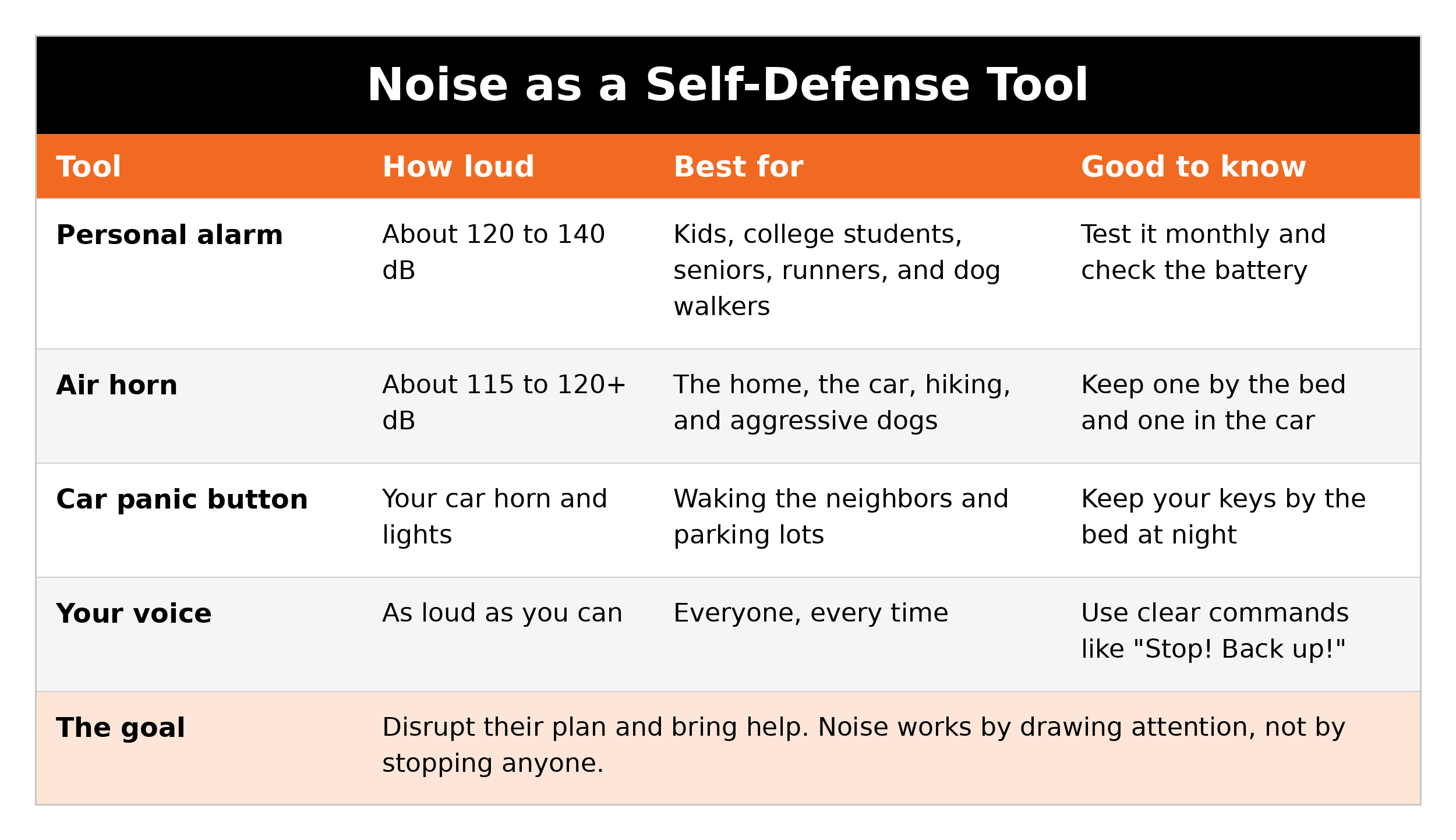
Noise fits right into SCAN. When you See your environment and something feels wrong, an alarm in your hand lets you Act deliberately the moment you need to, and it helps you Create space by making the attacker think twice. If your gut says something's off, never doubt your gut feelings. Pull it.
What to Say
Your voice tells people why the alarm is going off:
"Stop! Get away from me!"
"I don't know this person! Call 911!"
To a specific person nearby: "You in the blue shirt, call 911!"
Picking one person and giving them one job gets help faster than yelling to a crowd.
Not sure whether an alarm, pepper spray, or a flashlight is the right first tool for your child, college student, or aging parent? The free Choose Your Tool guide helps you compare personal safety tools and find the right fit for you and your family.
Ask Yourself
Does my child, my college student, or my aging parent have an alarm they can reach in a second?
When did I last test it and change the battery?
If I heard someone at the door tonight, are my car keys close enough to hit the panic button?
Remember
Noise ruins an attacker's plan. A personal alarm, an air horn, or your car's panic button draws attention and brings help. Pull it, use your voice, and move toward safety.
Coming Up in Part 5: Stun Guns
In Part 5, we look at stun guns: how they work, why they only work on contact, and the real limits you need to know before you rely on one.
Next in the series: Less Than Lethal Self-Defense Options- Part 5: Stun Guns
Get Started Today
Get the free Choose Your Tool guide. Compare personal safety tools and find the right fit for you and your family. Get it free here.
Get the free Missed Check-In Protocol. Know exactly what to do when an aging parent or family member doesn't check in. Get it free here.
Quick Answers
Do personal safety alarms actually work?
Yes, for the right job. A loud alarm draws attention and makes an attack take longer, which are two things a bad guy doesn't want. It doesn't stop someone physically, so pair it with awareness and a plan to get away.
Who should carry a personal alarm?
Alarms are a great fit for kids, college students, seniors, runners, and anyone who isn't ready or able to fight back. They are simple to use and don't hurt anyone.
Is a personal alarm the same as a medical alert system?
No. A personal alarm only makes noise and doesn't call anyone. A medical alert system connects to a monitoring center or family, and many families use both.
Can a personal alarm hurt my hearing?
It can. Alarms and air horns are loud on purpose, so point them away from your ear and don't test them right next to your head.
Go Deeper
The Family Safety Toolkit. 20 ready-to-use checklists for kids, travel, home, and emergencies, so your family has the steps in front of you instead of trying to remember them under stress.
Coming soon: The Family Emergency Preparedness Manual. The blog series cover each topic on its own. The Manual connects your vehicle, go bags, first aid, backup power, and communications into one family plan, with the worksheets, checklists, and drills you won't find on the blog.
Tools I recommend: For flashlights, pepper spray, personal alarms, and other personal safety tools, see my Personal Safety Tools Amazon store. For the everyday carry gear I recommend, see my Everyday Carry Amazon store. The flashlights I carry and recommend are in my Flashlights Amazon store.
The Full Series
Less Than Lethal Self-Defense Options- Intro: Not Every Problem Is a Gun Problem
Less Than Lethal Self-Defense Options- Part 1: The Flashlight
Less Than Lethal Self-Defense Options- Part 2: How Pepper Spray Works and How to Choose One
Less Than Lethal Self-Defense Options- Part 3: Carrying and Using Pepper Spray
Less Than Lethal Self-Defense Options, Part 4: Personal Alarms and Air Horns
Less Than Lethal Self-Defense Options- Part 7: Pepper Ball Launchers
Less Than Lethal Self-Defense Options- Part 8: Laws and Travel
Less Than Lethal Self-Defense Options- Part 9: Choosing the Right Tool
Related Reading
References
National Institute on Deafness and Other Communication Disorders (NIDCD). Noise-Induced Hearing Loss.
Manufacturer specifications: She's Birdie personal safety alarm; SABRE personal alarm; SABRE Compact Sport and Safety Horn.
Disclaimer
These suggestions are intended to help you and your family build awareness, confidence, and safer decision-making habits. No safety plan, checklist, or tool can guarantee 100% protection. This article is for general informational purposes only and is not a substitute for professional training. A personal alarm is not a medical alert system and does not contact emergency services. Affiliate disclosure: I've linked to products from my Amazon store that I personally recommend. As an Amazon Associate, I earn from qualifying purchases, at no extra cost to you. Thank you for supporting my work.
If you are in immediate danger, get to safety and call 911.
Awareness gives you time. Time gives you options.
The Prepared Protector is someone who's decided that loving someone means being ready for them, not just hoping things go fine.
Prepared Not Paranoid. Protecting the Most Vulnerable Among Us.