A Close-Range Tool With Real Limits
By Larry Betz | Prepared Not Paranoid https://www.preparednotparanoid.com/
A stun gun is one of the most misunderstood self-defense tools on the market. The packaging shows millions of volts and lightning bolts, and a lot of people buy one thinking it will drop an attacker instantly from across the room. It won't. A stun gun for self-defense only works when it's pressed against the person, and the effect lasts just a few seconds. Used the right way, with the right expectations, it can still buy you the time you need to get away. In this post, we'll look at how stun guns work, what makes one strong, how to use one, and whether it's the right tool for you.
What Is a Stun Gun?
A stun gun is a handheld, less-lethal self-defense tool designed to stop an attacker by delivering a high-voltage, low-amperage electrical charge. The goal is to temporarily disrupt the attacker's muscle control and cause pain and confusion, giving you the chance to escape or get help.
A stun gun is easy to use. While it requires close contact to work, it can be a powerful deterrent and can stop an attacker long enough for you to get away or call for help.
Stun gun vs. Taser: People often use the names interchangeably, but they're different tools. A stun gun has to touch the person. A Taser fires two darts from a distance. We'll cover Tasers in Part 6.
How a Stun Gun Works
Electric shock: The stun gun releases an electrical charge when its metal prongs touch the attacker's body. That charge interferes with the body's nerve and muscle signals, causing pain, muscle contractions, and temporary loss of control.
Proximity: A stun gun is a contact tool. It must physically touch the person to work, which means you have to be within arm's reach.
Key Features of Stun Guns
Compact and portable: Many are small enough to fit in a pocket, purse, or holster, and light enough to carry every day.
Easy to use: They take minimal training to operate. You usually press a button or switch while the prongs are against the attacker.
Less-lethal: They're designed to stop an attacker without causing permanent harm.
Extra features: Many models include a built-in flashlight, and most use rechargeable or replaceable batteries.
What Makes a Stun Gun Strong: Microcoulombs, Not Volts
Here's the same lesson we learned with pepper spray: the biggest number on the box isn't the one that matters. Stun guns are marketed with huge voltage claims, sometimes in the millions or even billions. Voltage alone doesn't tell you how strong a stun gun is.
The better measure is microcoulombs (µC), which tells you how much electrical charge actually reaches the person. Research cited by the National Institute of Justice found people reported pain at about 0.5 microcoulombs and intolerable pain at about 1.0 microcoulombs. Look for a brand that lists its microcoulomb rating instead of just a giant voltage number.
Benefits of a Stun Gun
An effective deterrent: The loud crackle and visible spark when you press the button can intimidate an attacker and stop a confrontation before it starts.
Immediate effect: When it's used correctly, it causes pain, confusion, and temporary loss of control right away.
Less-lethal: It's a good option for people who want a tool that keeps the risk of fatal harm low.
Widely available: Stun guns are legal in most states, though rules vary, as we'll cover below.
Limitations of Stun Guns
This is the part you need to be honest with yourself about:
You have to be within reach. A stun gun requires direct contact, which means getting close to someone who is already aggressive or threatening. That's a risky place to be.
It may not work on everyone. It can be less effective on people who are drunk, high, or full of adrenaline.
The effect is short. A shock stops an attacker for only a few seconds. You have to use that time to get away.
One attacker at a time. You'd have to make contact with each person separately, which is dangerous if there's more than one.
Legal restrictions: Stun guns aren't legal everywhere or for everyone. Always check your state and county laws before you buy or carry one.
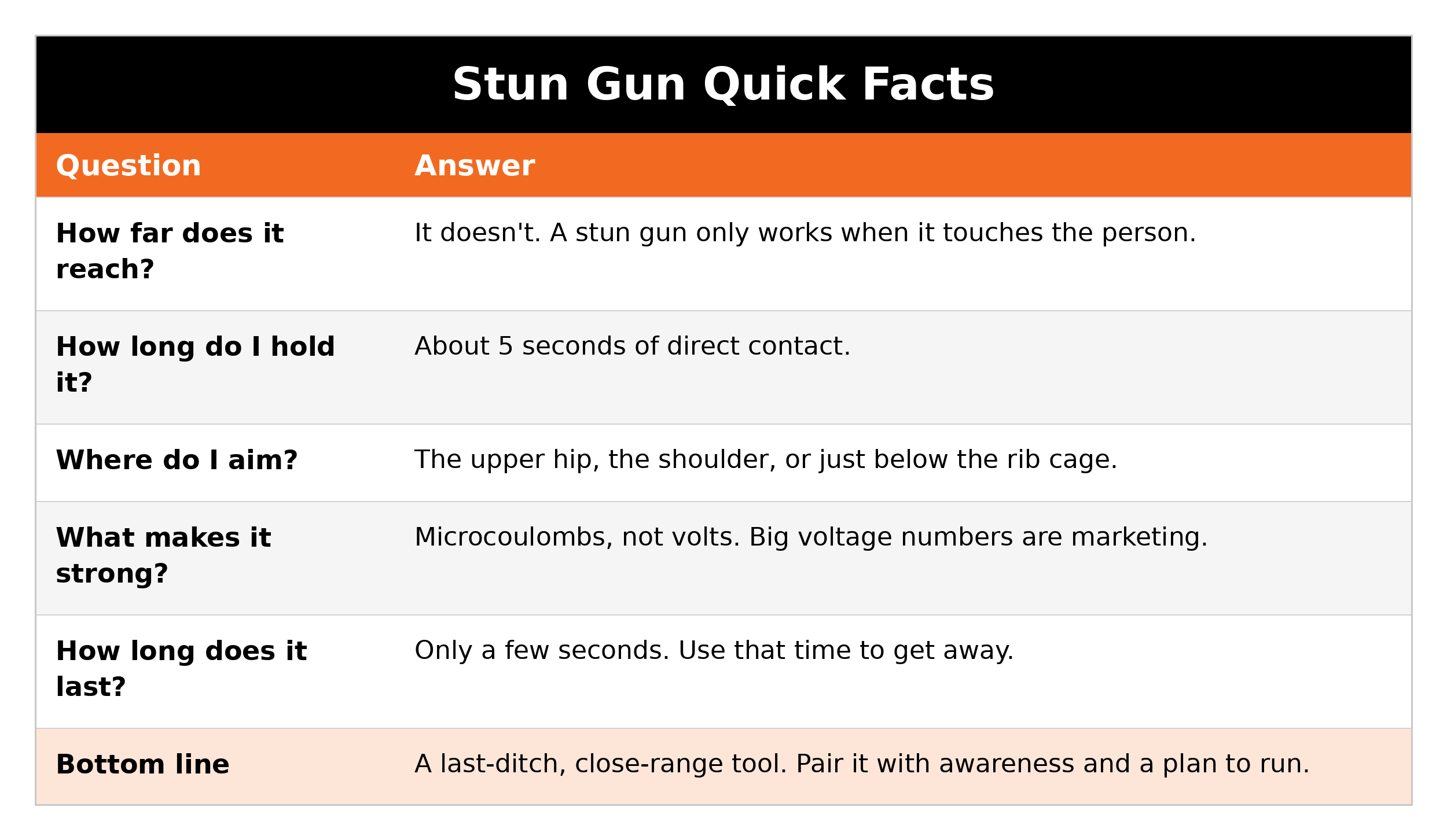
Stun Gun Quick Facts
Here's what you need to know at a glance.
How to Use a Stun Gun
Practice handling it. Learn the controls and the safety switch so you can use it quickly in an emergency. Practice drawing it and turning it on without looking.
Use situational awareness first. The best stun gun encounter is the one you avoid. SCAN your surroundings and create space whenever you can. The free SCAN Family Card puts all four steps on one card for your whole family. Get it free here.
Target the right areas. Aim for the torso, thighs, or arms. SABRE specifically recommends the upper hip, the shoulder, or just below the rib cage.
Hold contact for about 5 seconds. A quick tap won't do much. Press it in and hold.
Then get away. The second the attacker reacts, break contact and run toward people and help.
Keep it charged. A stun gun with a dead battery is just a flashlight, or worse, nothing at all.
Your Plan After You Use It
Just like with pepper spray, the stun gun buys you a few seconds. Your plan is what gets you home. Get away, call 911, and tell them you were attacked and defended yourself. Then describe the person and where they went.
What to Say
Before contact, if you can: "Stop! Back up!" (the crackle of the stun gun can back this up)
To 911: "I was attacked. I used a stun gun to defend myself. I'm at the grocery store parking lot on Main Street. I need police."
Stun Gun Options
These are my independently assessed recommendations. You'll find them in my Personal Safety Tools Amazon store.
A. Stun gun with pepper spray and light: SABRE Self-Defense Kit with pepper spray and a stun gun with flashlight. The spray has about 25 bursts and a 10-foot range, and the stun gun has a 120-lumen light, a rechargeable battery, and a safety switch. Two tools in one kit.
B. Light with stun gun: SABRE 2-in-1 Tactical Stun Gun with LED Flashlight, with a 2.517 µC charge, a 130-lumen light, a safety switch, a belt holster, and a rechargeable battery.
C. Stun gun with light and alarm: Stun Gun TW10, heavy duty, with an LED flashlight and a siren alarm. Ignore the huge voltage number on this one and focus on the light and alarm, which add real value.
D. Stun gun with light: TASER StrikeLight 2, a rechargeable self-defense flashlight with a built-in stun feature, made for running, jogging, and walking the dog. Portable and lightweight.
Is a Stun Gun Right for You?
A stun gun can make sense if you want a less-lethal tool, live where stun guns are legal, and understand you'll have to be within arm's reach to use it. For most people, though, pepper spray or gel gives you more distance, and distance is safety. Many people carry a light with a stun feature as a backup, not as their main tool. Want to compare a stun gun with pepper spray, a flashlight, and the other tools in this series? The free Choose Your Tool guide helps you compare your options side by side. Get it free here.
Not sure whether a stun gun, pepper spray, or a Taser is the right fit for you? The free Choose Your Tool guide helps you compare personal safety tools and find the right fit for you and your family.
Ask Yourself
Am I comfortable letting someone get close enough to touch me before I can use this tool?
Do I know my state and county laws on stun guns?
Is my stun gun charged right now?
Remember
A stun gun only works when it touches the attacker, and only for a few seconds. Know its limits, look for microcoulombs instead of volts, hold contact for about 5 seconds, and use those seconds to get away.
Coming Up in Part 6: Tasers
In Part 6, we look at Tasers: how the darts work from a distance, why both darts have to hit, and how a Taser compares to a stun gun and pepper spray.
Next in the series: Less Than Lethal Self-Defense Options- Part 6: Tasers
Get Started Today
Get the free Choose Your Tool guide. Compare personal safety tools and find the right fit for you and your family. Get it free here.
Get the free SCAN Family Card. Keep the four SCAN steps in your pocket and teach them to everyone in your family. Get it free here.
Quick Answers
What is the difference between a stun gun and a Taser?
A stun gun has to touch the person to work. A Taser fires two darts from a distance, so it gives you more space between you and the threat.
Do stun guns work?
A stun gun can cause pain and help you break free, but only if you are within arm's reach and keep contact. For most people, pepper spray or gel gives more distance, and distance is safety.
Are stun guns legal?
Stun guns are legal in most states, but some places require a permit or ban them, and rules can vary by city. Check your state and county laws before you buy or carry one.
Should a stun gun be my main self-defense tool?
For most people, no. Many people carry a flashlight with a stun feature as a backup, and rely on awareness, distance, and pepper spray or gel first.
Go Deeper
The Family Safety Toolkit. 20 ready-to-use checklists for kids, travel, home, and emergencies, so your family has the steps in front of you instead of trying to remember them under stress.
Coming soon: The Family Emergency Preparedness Manual. The blog series cover each topic on its own. The Manual connects your vehicle, go bags, first aid, backup power, and communications into one family plan, with the worksheets, checklists, and drills you won't find on the blog.
Tools I recommend: For flashlights, pepper spray, personal alarms, and other personal safety tools, see my Personal Safety Tools Amazon store. For the everyday carry gear I recommend, see my Everyday Carry Amazon store. The flashlights I carry and recommend are in my Flashlights Amazon store.
The Full Series
Less Than Lethal Self-Defense Options- Intro: Not Every Problem Is a Gun Problem
Less Than Lethal Self-Defense Options- Part 1: The Flashlight
Less Than Lethal Self-Defense Options- Part 2: How Pepper Spray Works and How to Choose One
Less Than Lethal Self-Defense Options- Part 3: Carrying and Using Pepper Spray
Less Than Lethal Self-Defense Options, Part 4: Personal Alarms and Air Horns
Less Than Lethal Self-Defense Options- Part 7: Pepper Ball Launchers
Less Than Lethal Self-Defense Options- Part 8: Laws and Travel
Less Than Lethal Self-Defense Options- Part 9: Choosing the Right Tool
Related Reading
References
SABRE. Stun Gun Frequently Asked Questions.
SABRE. Stun Gun State Laws.
National Institute of Justice research on electrical charge and pain, as cited by SABRE.
Disclaimer
These suggestions are intended to help you and your family build awareness, confidence, and safer decision-making habits. No safety plan, checklist, or tool can guarantee 100% protection. This article is for general informational purposes only and is not legal advice or a substitute for professional training. Stun gun laws vary by state, county, and city, and some places require a permit or ban them entirely, so check your state and county laws before you buy or carry one. Use a stun gun only in true self-defense. Affiliate disclosure: I've linked to products from my Amazon store that I personally recommend. As an Amazon Associate, I earn from qualifying purchases, at no extra cost to you. Thank you for supporting my work.
If you are in immediate danger, get to safety and call 911.
Awareness gives you time. Time gives you options.
The Prepared Protector is someone who's decided that loving someone means being ready for them, not just hoping things go fine.
Prepared Not Paranoid. Protecting the Most Vulnerable Among Us.