Distance, Darts, and Why Both Have to Hit
By Larry Betz | Prepared Not Paranoid https://www.preparednotparanoid.com/
The biggest weakness of a stun gun is that you have to let the attacker get close. A Taser fixes that. Instead of pressing prongs against someone, a Taser fires two small darts from several feet away. That distance is exactly what makes a Taser for self-defense worth considering. But it comes with its own rules, its own limits, and a price tag that's a lot higher than a can of pepper spray. In this post, we'll look at how Tasers work, what can go wrong, and whether one belongs in your safety plan.
What Is a Taser?
A Taser is a less-lethal self-defense tool designed to stop an attacker from a distance by delivering an electrical charge that disrupts the body's nerve and muscle system. Tasers are used by law enforcement and civilians alike because they can stop a threat without causing permanent harm.
A Taser can be an effective, easy-to-use tool that lets you stop a threat from a safer distance. It's especially useful for people who want a less-lethal alternative to a firearm. It has limits, but combined with situational awareness and practice, it can be a valuable part of a personal safety plan.
How a Taser Works
Darts: A Taser fires two small, dart-like probes attached to thin wires that stay connected to the device. The darts stick in the attacker's clothing or skin and deliver the electrical charge.
Neuromuscular incapacitation (NMI): The charge interrupts the signals between the brain and the muscles, causing involuntary muscle contractions and temporary loss of control. In plain terms, the muscles lock up.
Range: Most civilian Tasers reach about 12 to 15 feet, which keeps distance between you and the attacker.
Key Features of Tasers
Range: Tasers can stop a threat from a distance, giving you a safety buffer. Many also have a contact stun (sometimes called drive-stun) mode, so they work like a stun gun up close if you need it.
Less-lethal: They're designed to stop an attacker without long-term harm.
Easy to use: Simple controls make them accessible even with minimal training.
Batteries: Most use a battery with a charge indicator, so you can see how much power is left.
Built-in extras: Many models include a light and a laser sight to help you aim in low light.
Benefits of a Taser
Distance defense: You can stop a threat while staying out of arm's reach.
Quick effect: It works immediately, giving you time to escape or call for help.
Less-lethal alternative: A good option for people who want a tool short of a firearm.
Fewer restrictions than firearms: Civilian Tasers are available in many places with fewer rules than guns, though laws still vary by state and county.
Limitations of Tasers
Be honest with yourself about these:
Limited range: It only works at fairly close distances, usually 12 to 15 feet.
One or two shots: Most civilian models fire only one set of darts before you have to reload. Some carry a second shot.
Both darts must hit. For a Taser to lock someone up, both darts have to hit the target. In a high-stress, close-quarters situation, that can be hard. If one dart misses, it won't work as intended.
Thick clothing and other factors: It may be less effective on someone wearing a heavy coat, or someone who is drunk or high.
Legal restrictions: Tasers are regulated in some states and cities. Check your state and county laws before you buy or carry one.
More than one attacker: Both stun guns and Tasers are designed to stop one person at a time. With a stun gun, you have to make contact with each attacker separately, which is dangerous. With most civilian Tasers, you get one shot before you need to reload, which leaves you vulnerable. That's why awareness, distance, and a plan to get away matter so much.
The "Drop It and Run" Design
Here's something many people don't know, and it fits perfectly with having a plan. Some civilian Tasers, like the TASER Bolt 2, can lock up an attacker for up to 30 seconds. That gives you time to drop the Taser and run while it keeps working.
Axon, the company that makes TASER devices, offers a replacement guarantee: if you use an approved civilian Taser in self-defense and leave it behind, they'll replace it free of charge (check their current terms). They built it that way because the goal is for you to get away, not to stand there holding the wires.
That's your plan in one sentence: fire, drop, run, call 911.
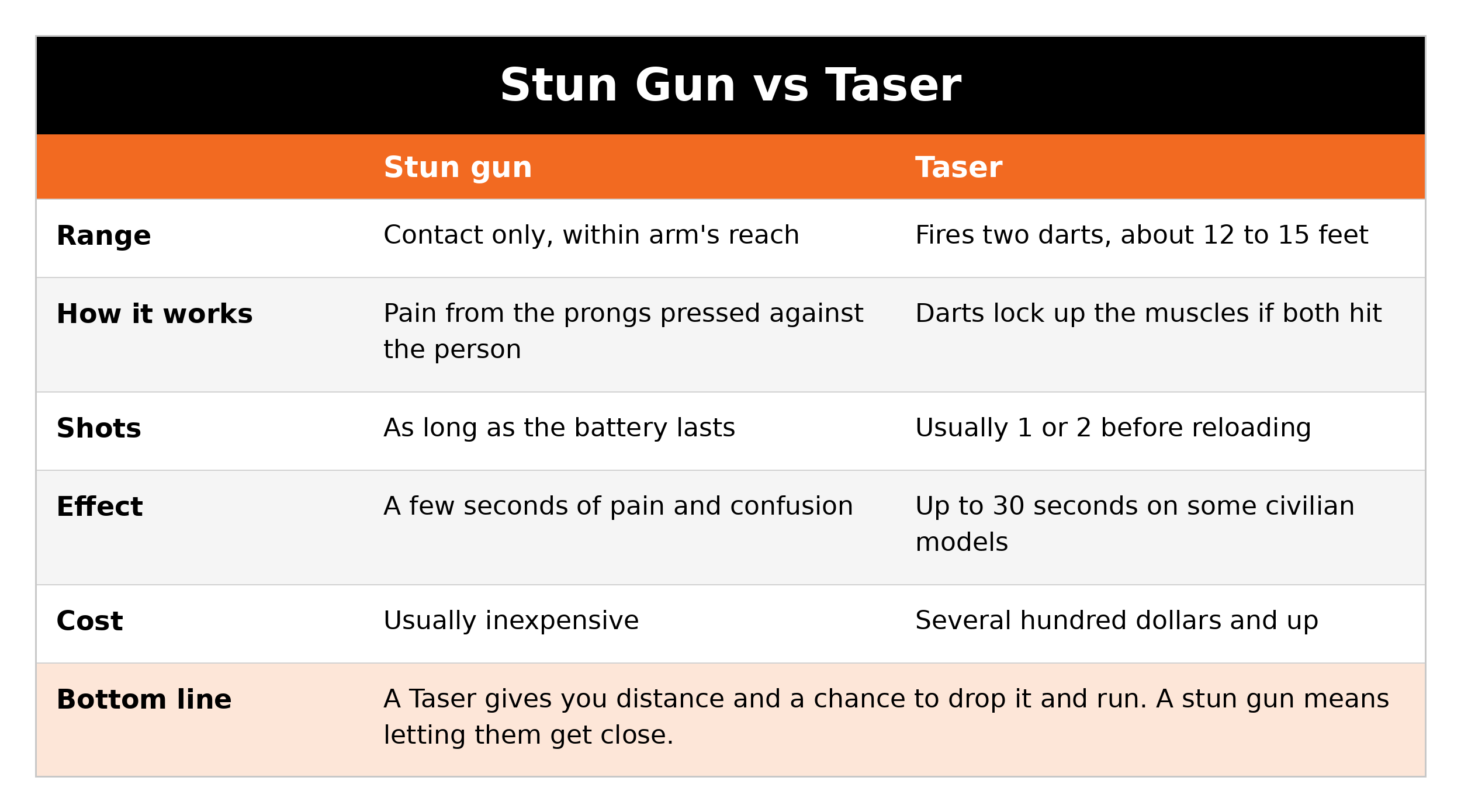
Stun Gun vs. Taser
Here's how they compare.
How to Use a Taser Well
Practice: Learn how it works and how to aim, so you can use it under stress. Use practice cartridges if your model offers them.
Use situational awareness first: SCAN your surroundings and create space. The best Taser encounter is the one you avoid. The free SCAN Family Card keeps the four SCAN steps in your pocket. Get it free here.
Aim for center mass, using the laser if your model has one. A wider spread between the darts usually works better, so don't fire from too close if you can help it.
Keep spare cartridges with you, in case you need to reload.
Fire, then move. Drop it if your model allows, get away, and call 911.
What to Say
Before you fire, if you can: "Stop! Back up! Leave me alone!"
To 911: "I was attacked. I used a Taser to defend myself. I need police." Then give your exact address or the nearest cross streets.
Taser Options
These are my independently assessed recommendations. You'll find them in my Personal Safety Tools Amazon store.
Professional series home and personal defense: TASER 7 CQ. Two shots without reloading, about a 12-foot reach, a laser, a bright light, a loud arc warning, and a contact stun mode. It's the more capable option, and it costs more (about $1,700).
Personal Taser: TASER Bolt 2. A compact personal protection device with a 15-foot range, laser targeting, and a contact stun mode. It fires one shot per cartridge and comes with two cartridges. Built for the "fire, drop, and run" plan (about $450).
Is a Taser Right for You?
A Taser makes sense if you want a less-lethal tool with real distance, you're willing to practice, and the cost fits your budget. Remember the limits: both darts have to hit, you get one or two shots, and it's one tool, not a plan.
Still deciding between a Taser, a stun gun, and pepper spray? The free Choose Your Tool guide helps you compare your options side by side. Get it free here.
Trying to decide whether a Taser is worth the cost compared to pepper spray or a stun gun? The free Choose Your Tool guide helps you compare personal safety tools and find the right fit for you and your family.
Ask Yourself
Could I hit a moving target with both darts while my heart is pounding?
Do I have a spare cartridge, and is my Taser charged?
If I had to use it, would I drop it and run, or would I freeze?
Remember
A Taser gives you distance, but both darts have to hit. Practice with it, keep a spare cartridge, and remember the plan: fire, drop, run, call 911.
Coming Up in Part 7: Pepper Ball Launchers
In Part 7, we look at pepper ball launchers: what they are, how they work from a distance, and where they fit in your home and family safety plan.
Next in the series: Less Than Lethal Self-Defense Options- Part 7: Pepper Ball Launchers
Get Started Today
Get the free Choose Your Tool guide. Compare personal safety tools and find the right fit for you and your family. Get it free here.
Get the free SCAN Family Card. Keep the four SCAN steps in your pocket and teach them to everyone in your family. Get it free here.
Quick Answers
How far can a civilian Taser reach?
Most civilian Tasers reach about 12 to 15 feet. The TASER Bolt 2 is rated for 15 feet and the TASER 7 CQ for about 12 feet. That keeps you out of arm's reach, but it is still close, so awareness and space still matter.
What is the difference between a Taser and a stun gun?
A stun gun only works when you press it against the attacker. A Taser fires two darts on thin wires from several feet away, and many models also have a contact stun mode for close range.
Why do both Taser darts have to hit?
The charge travels between the two darts, so both have to connect to lock up the attacker's muscles. If one dart misses, the Taser won't work as intended, which is why practice and a wider dart spread matter.
Are Tasers legal to carry?
Civilian Tasers are legal in many places, but some states, counties, and cities regulate or restrict them, and some require a permit. Check your state and county laws before you buy or carry one.
Go Deeper
The Family Safety Toolkit. 20 ready-to-use checklists for kids, travel, home, and emergencies, so your family has the steps in front of you instead of trying to remember them under stress.
Coming soon: The Family Emergency Preparedness Manual. The blog series cover each topic on its own. The Manual connects your vehicle, go bags, first aid, backup power, and communications into one family plan, with the worksheets, checklists, and drills you won't find on the blog.
Tools I recommend: For flashlights, pepper spray, personal alarms, and other personal safety tools, see my Personal Safety Tools Amazon store. For the everyday carry gear I recommend, see my Everyday Carry Amazon store. The flashlights I carry and recommend are in my Flashlights Amazon store.
The Full Series
Less Than Lethal Self-Defense Options- Intro: Not Every Problem Is a Gun Problem
Less Than Lethal Self-Defense Options- Part 1: The Flashlight
Less Than Lethal Self-Defense Options- Part 2: How Pepper Spray Works and How to Choose One
Less Than Lethal Self-Defense Options- Part 3: Carrying and Using Pepper Spray
Less Than Lethal Self-Defense Options, Part 4: Personal Alarms and Air Horns
Less Than Lethal Self-Defense Options- Part 7: Pepper Ball Launchers
Less Than Lethal Self-Defense Options- Part 8: Laws and Travel
Less Than Lethal Self-Defense Options- Part 9: Choosing the Right Tool
Related Reading
References
Axon / TASER. TASER Bolt 2 product page (range, cartridges, 30-second lockup, replacement guarantee).
Axon / TASER. TASER 7 CQ product page (reach, two shots, features, Safe Escape Replacement Guarantee).
Disclaimer
These suggestions are intended to help you and your family build awareness, confidence, and safer decision-making habits. No safety plan, checklist, or tool can guarantee 100% protection. This article is for general informational purposes only and is not legal advice or a substitute for professional training. Taser laws vary by state, county, and city, and some places require a permit or restrict them, so check your state and county laws before you buy or carry one. Use a Taser only in true self-defense. Prices and guarantees can change, so check with the manufacturer. Affiliate disclosure: I've linked to products from my Amazon store that I personally recommend. As an Amazon Associate, I earn from qualifying purchases, at no extra cost to you. Thank you for supporting my work.
If you are in immediate danger, get to safety and call 911.
Awareness gives you time. Time gives you options.
The Prepared Protector is someone who's decided that loving someone means being ready for them, not just hoping things go fine.
Prepared Not Paranoid. Protecting the Most Vulnerable Among Us.